Liber XX · Kabbalah · Chapter I: Angels & Divine Names
The Seven Names of God: Sacred Names in Judaism and Magic
The seven names of God that may not be erased in Jewish law — El, Eloah, Elohim, Elohai, YHWH, Shaddai and Tzevaot — and their use in Kabbalah and magic.

The "seven names of God" are the seven Hebrew names of the God of Israel that Jewish law forbids a scribe to erase once they have been written: El, Eloah, Elohim, Elohai, the four-letter name YHWH (with its spoken substitute Adonai), Shaddai and Tzevaot. The rule comes from the Talmud and was fixed in medieval codes, and the same names became the core vocabulary of Kabbalah, of Jewish amulets and of the Christian and Solomonic magic that borrowed from them.
The names in the Hebrew Bible§
The Hebrew Bible calls God by many names and titles, and each carries its own associations. The oldest is El, the common Semitic word for a god, which also appears in compounds such as El Elyon ("God Most High") and El Olam ("the everlasting God"). Elohim, grammatically a plural but used with singular verbs for the God of Israel, is the name used in the first creation account of Genesis; its singular Eloah appears mainly in poetic books such as Job. Elohai, "my God", is the same word with a possessive suffix.
Shaddai, usually rendered "Almighty", is the name associated with the patriarchs. In the passage that later writers would call the revelation of the covenant name, God tells Moses: "I appeared unto Abraham, unto Isaac, and unto Jacob, by the name of God Almighty, but by my name JEHOVAH was I not known to them" (Exodus 6:3, King James Version). The four-letter name YHWH, the Tetragrammaton, is thus presented as the name of the covenant made with Moses and Israel at the Exodus, while El Shaddai is the name of the covenant with Abraham.
Tzevaot ("of hosts", as in YHWH Tzevaot, "the LORD of hosts") is a title of God as commander of the heavenly armies, frequent in the prophets. Beside these stand phrases that are not names in the strict sense, such as Ehyeh asher Ehyeh, "I am that I am" (Exodus 3:14), God's answer when Moses asks his name at the burning bush.
The rule against erasing the names§
The prohibition grows out of Deuteronomy 12:3–4, which commands Israel to destroy the names of foreign gods but "not do so unto the LORD your God". The rabbis read this as a ban on erasing or destroying God's name. A baraita quoted in the Babylonian Talmud (Shevuot 35a), with parallels in the minor tractate Soferim, discusses which written names fall under the rule. It lists El, Eloah, Elohim, Elohekha and similar suffixed forms, Ehyeh asher Ehyeh, Adonai, YHWH, Shaddai and Tzevaot, and records a disagreement over whether Tzevaot is a true name or a mere epithet.
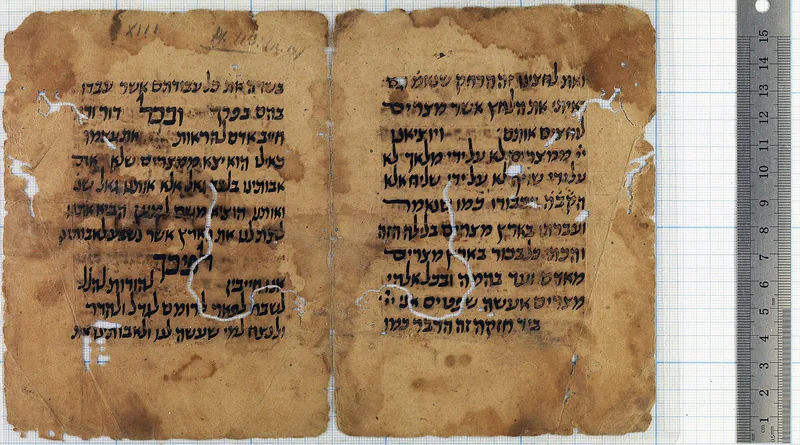
Maimonides gave the rule its classic legal form in the twelfth century. In his code, the Mishneh Torah (Laws of the Foundations of the Torah 6:2), he states that there are seven names that may not be erased: the name written YHWH (which he calls the "explicit name", ha-shem ha-meforash) or written Adonai, El, Eloah, Elohim, Elohai, Shaddai and Tzevaot. A scribe who makes a mistake while writing one of them in a Torah scroll cannot simply scrape it away; the sheet may have to be replaced, and worn-out pages containing the names are not thrown away but buried or stored in a genizah. The famous Cairo Genizah, whose hundreds of thousands of fragments transformed the study of medieval Judaism, exists because of this custom.
From law to custom§
The legal rule applies strictly to the Hebrew names written in a holy manner, but it shaped wider habits of reverence. Jews traditionally do not pronounce the Tetragrammaton at all, reading it as Adonai in prayer and as ha-Shem ("the Name") in ordinary speech. Many write "G-d" in English, a modern custom that extends the respect shown to the Hebrew names, although most authorities do not regard the English word as one of the seven. Other titles, such as "the Merciful" or "the Holy One, blessed be He", may be erased because they are descriptions rather than names.
The names in Kabbalah§
Medieval Kabbalah turned the divine names into a theology. In the system of the ten sefirot — the attributes through which the hidden God, Ein Sof, is manifested — each sefirah came to be associated with a name. A common scheme, found in Joseph Gikatilla's Sha'are Orah (Gates of Light, late thirteenth century) and developed by later kabbalists, runs roughly as follows:
| Sefirah | Associated name |
|---|---|
| Keter (Crown) | Ehyeh |
| Hokhmah (Wisdom) | Yah |
| Binah (Understanding) | YHWH (voweled as Elohim) |
| Hesed (Love) | El |
| Gevurah (Judgement) | Elohim |
| Tiferet (Beauty) | YHWH |
| Netzah (Endurance) | YHWH Tzevaot |
| Hod (Splendour) | Elohim Tzevaot |
| Yesod (Foundation) | Shaddai, El Hai |
| Malkhut (Kingship) | Adonai |
For the kabbalists, then, the names were not merely labels. Each was a channel of a particular divine power: Elohim stood for judgement and limit, El for mercy, Adonai for God's presence in the world, the Shekhinah. Meditation on the letters of the names and on their permutations — a practice developed by Abraham Abulafia in the thirteenth century — was a path of mystical ascent. The Zohar and Gikatilla repeatedly describe the Torah itself as a weaving of the names of God.
The Sefer Yetzirah and later gematria added another layer: since every Hebrew letter has a numerical value, names could be compared and combined by number. The seventy-two-letter name (the Shem ha-Mephorash), derived from three verses of Exodus 14, and the forty-two-letter name used in the prayer Ana be-Khoah, belong to this world of name-speculation.
Divine names in Jewish amulets and practical Kabbalah§
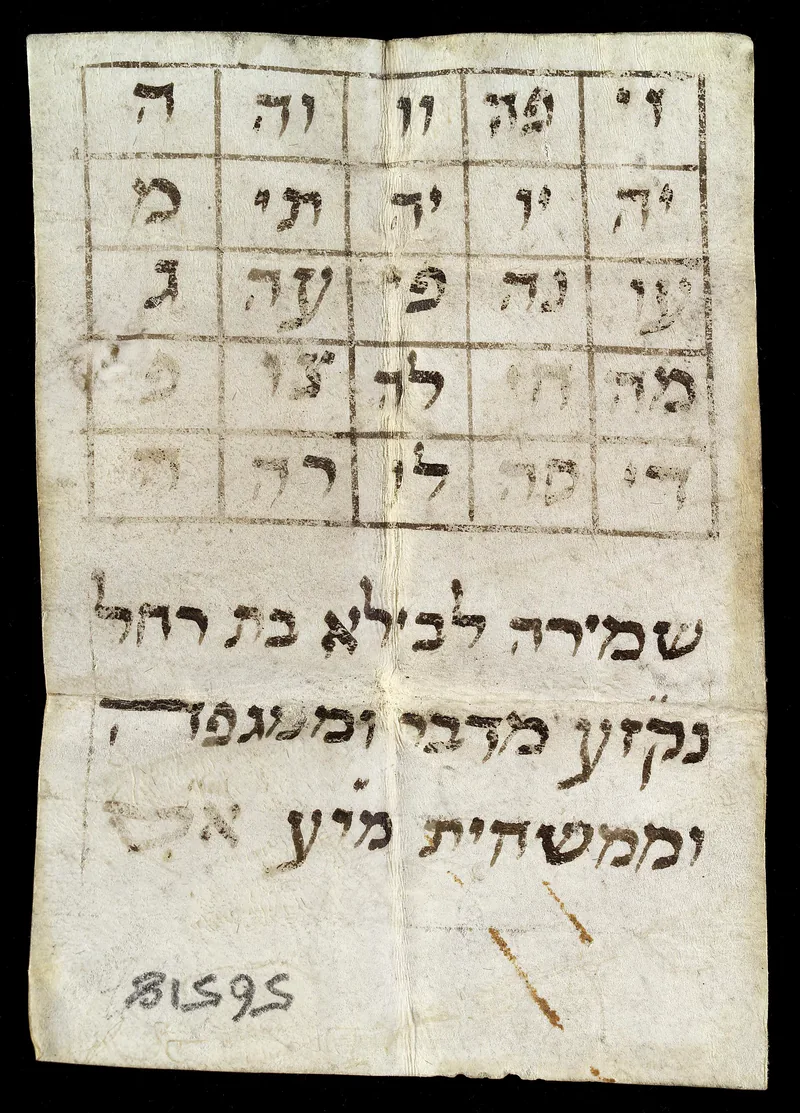
What kabbalists called "practical Kabbalah" (kabbalah ma'asit) used the names for protection and healing. Amulets (kameot) written on parchment or engraved on metal combined names such as Shaddai, permutations of the Tetragrammaton and the names of angels with verses from the Psalms. The most visible survival is the mezuzah on Jewish doorposts: the parchment inside carries the Shema, and on the outside of the scroll the name Shaddai is written, often read as an acronym for shomer daltot Yisrael, "guardian of the doors of Israel". Medieval rabbis such as Maimonides were critical of amulets that treated names as magic formulas, and the boundary between legitimate prayer and forbidden magic was debated throughout the Middle Ages.
The seven names in Christian and Solomonic magic§
Christian scholars of the Renaissance, starting with Pico della Mirandola and Johann Reuchlin, eagerly adopted the Hebrew names, believing they held the key to the power of words. Cornelius Agrippa's Three Books of Occult Philosophy (1533) gives tables of the ten divine names matched to the sefirot, the planets and the orders of angels, and these tables passed into almost every later handbook of ceremonial magic.
The grimoires used the names on circles, pentacles and seals. The Key of Solomon fills its pentacles with Hebrew names — often miscopied — such as El, Elohim, Adonai, Shaddai, Tetragrammaton and Agla (itself an acronym of a Hebrew blessing). The conjurations of the Lesser Key of Solomon invoke the spirits "by these names" in long litanies. The nineteenth-century Sixth and Seventh Books of Moses, printed by Johann Scheible in 1849 and in English in 1880, presented seals of the "seven planets" and tables of names as Moses' own secret magic; their Hebrew is largely garbled, but the idea that Moses commanded the spirits through the divine names is old, reaching back to late antique texts such as the Sword of Moses and the "Eighth Book of Moses" among the Greek magical papyri.
In the Golden Dawn and later Western ceremonial magic, the ten names became part of the "Qabalistic" system of correspondences: in the Lesser Banishing Ritual of the Pentagram, for example, the magician vibrates YHVH, Adonai, Eheieh and AGLA at the four quarters. These uses are modern Christian and occultist adaptations, and Jewish authorities do not recognise them as part of their tradition.
Interpreting the seven names§
For observant Jews the seven names are above all a matter of reverence and of law — how to write, store and speak of God. For kabbalists they are windows onto the inner life of God. For magicians, from late antiquity to the present, they have been words of power. Historians stress that these are three different contexts, and that magical texts frequently borrowed Hebrew names without understanding them. What unites them is the conviction, rooted in the biblical story of the covenant names revealed to Abraham and to Moses, that the name of God is not an arbitrary label but a presence.
Frequently asked questions§
What are the seven names of God that cannot be erased?§
According to Maimonides, following the Talmud, they are El, Eloah, Elohim, Elohai, YHWH (or Adonai), Shaddai and Tzevaot. Once written in a holy manner, these names may not be erased, and texts containing them are buried or kept in a genizah rather than thrown away.
What is the covenant name of God?§
In the Hebrew Bible, God reveals the name El Shaddai to the patriarchs and the four-letter name YHWH to Moses (Exodus 6:3). YHWH is therefore often described as the name of the covenant made with Israel at the Exodus.
Why do some people write G-d?§
It is a modern Jewish custom that extends the traditional respect for the Hebrew names of God to the English word, so that the name is not erased or defaced. Most legal authorities do not consider the English word one of the seven names, but many still follow the custom out of reverence.
Are the names of God used in magic?§
Yes. Jewish amulets, Christian Renaissance magic and the Solomonic grimoires all use Hebrew divine names on seals, circles and charms. Jewish legal authorities have long criticised the magical use of the names, and the grimoires often copy them incorrectly.
Sources and further reading§
- Mishneh Torah, Laws of the Foundations of the Torah — Moses Maimonides, c. 1180
- The Babylonian Talmud (Soncino edition) — Isidore Epstein (ed.), 1935
- Gates of Light: Sha'are Orah — Joseph Gikatilla, trans. Avi Weinstein, 1994
- On the Kabbalah and Its Symbolism — Gershom Scholem, 1965
- Major Trends in Jewish Mysticism — Gershom Scholem, 1941
- Jewish Magic and Superstition — Joshua Trachtenberg, 1939
- Three Books of Occult Philosophy — Heinrich Cornelius Agrippa, 1533