Liber XX · Kabbalah · Chapter I: Angels & Divine Names
The 72 Names of God: Shem ha-Mephorash in Kabbalah and Magic
The 72 Names of God (Shem ha-Mephorash): how they come from Exodus 14, their place in Kabbalah, the 72 angels, Reuchlin, Agrippa, Kircher and the Golden Dawn.

The 72 Names of God are seventy-two three-letter combinations derived from three consecutive verses of the Book of Exodus (14:19–21), each of which contains exactly seventy-two Hebrew letters. Together they form the "name of seventy-two" or, in later usage, the Shem ha-Mephorash ("the explicit" or "distinguished name"). Developed in rabbinic and medieval Jewish mysticism, the 72 names became one of the most widely used formulas in Jewish amulets, and through Christian Cabala they gave rise to the 72 angels of the Shem ha-Mephorash familiar from Western occultism.
How the 72 Names Are Formed from Exodus 14§
The three verses in Exodus 14:19–21 describe the angel of God moving behind the camp of Israel, the pillar of cloud standing between Israel and the Egyptians, and Moses stretching out his hand over the sea so that the waters divide. In the Hebrew text each verse contains seventy-two letters, a coincidence that early interpreters regarded as deliberate.
The traditional method arranges the three verses in parallel lines. The first verse is written in its normal order, from right to left; the second is written in reverse, beginning from its last letter; the third again in its normal order. Reading down the columns, one takes the first letter of the first verse, the last letter of the second verse and the first letter of the third, forming a triad; then the second letter of each in the same pattern, and so on. The result is seventy-two groups of three letters, 216 letters in all. The first triad is Vav–He–Vav (VHV), the second Yod–Lamed–Yod (YLY), the third Samekh–Yod–Tet (SYT).
The triads are not words and have no lexical meaning. Their power was understood to lie in their origin in the verses of the Exodus, the supreme act of divine deliverance, and in the numerical symbolism of gematria: 72 is the value of hesed, "loving-kindness", and 216 the value of gevurah, "might".
The Shem ha-Meforash in Rabbinic and Early Mystical Sources§
In the Mishnah, the Shem ha-Meforash is the four-letter name of God, YHVH, as pronounced in the Temple. Tractate Yoma describes how on the Day of Atonement the High Priest uttered the name and the people fell on their faces when they heard it. The Babylonian Talmud (Kiddushin 71a) mentions names of twelve and forty-two letters transmitted only to the discreet and pious, but it does not clearly describe the seventy-two-letter name.
The connection between the 72 letters and the Red Sea appears in midrashic tradition, which teaches that God redeemed Israel from Egypt by a name of seventy-two letters. The Mishnah (Sukkah 4:5) records that during the willow procession of the Feast of Tabernacles the priests chanted the mysterious words Ani va-Ho; Rashi, in the eleventh century, explained these as two of the 72 names derived from Exodus 14, and indeed VHV is the first triad and Aleph–Nun–Yod (ANY) the thirty-seventh. Abraham ibn Ezra commented on the 72 letters of the three verses, and the Sefer ha-Bahir speaks of a name of seventy-two. The German Pietists, especially Eleazar of Worms, discussed the 72 names extensively, and they appear in the magical and mystical anthology Sefer Raziel, available in its Latin form as the Sepher Raziel.
The 72 Names in Kabbalah: Hesed, Gevurah and the Spelling of YHVH§
Kabbalists built on these traditions in several ways. The equivalence of 72 with hesed and 216 with gevurah allowed the name to be read as a union of mercy and judgement, the two poles of the ten sefirot. Some writers also connected the number with traditions that counted seventy-two nations and languages in the world, an idea that Christian authors would later illustrate with the divine name written in seventy-two tongues.
In Lurianic Kabbalah the number 72 acquired a further meaning through milui, the "filling" of the letters of YHVH by spelling them out. When the four letters are spelled with yod, the total is 72, and this "name of AB" (the letters ayin–bet, numerically 72) was associated with the sefirah Hokhmah, Wisdom. Although this is a different name from the 72 triads of Exodus, kabbalists often treated them as related expressions of the same divine quality. The 72 triads also appear in kabbalistic meditations (kavvanot) and in liturgical poetry, and on amulets and talismans used for protection, often arranged in grids or alongside the seven names of God.
From Names to Angels: The 72 Angels of the Shem ha-Mephorash§
By the late Middle Ages, some Jewish and Christian writers began to treat each triad as the root of an angel's name, formed by adding the theophoric endings -el ("God") or -iah ("Yah"). From VHV came Vehuiah, from YLY Jeliel, from SYT Sitael, and so on through Elemiah, Mahasiah, Lelahel and the rest to the seventy-second, Mumiah. Each angel was associated with a verse from the Psalms containing the divine name, which could be recited with the name.
These angels were then mapped onto the heavens. Because the zodiac has 360 degrees, each angel could be given five degrees, or a "quinance", and two angels assigned to each of the thirty-six decans of ten degrees. Some systems also gave each angel days of the year, hours of the day and particular virtues. The modern popular practice of identifying a "guardian angel" by birth date draws above all on Lazare Lenain's La Science cabalistique (1823), which assigned the 72 "genii" to periods of the year with attributes and Psalm verses. These correspondences are early modern and modern elaborations, not part of the ancient Jewish tradition; for the wider context see angels and spirits.
Christian Cabala and the Grimoires: Reuchlin, Agrippa and Kircher§
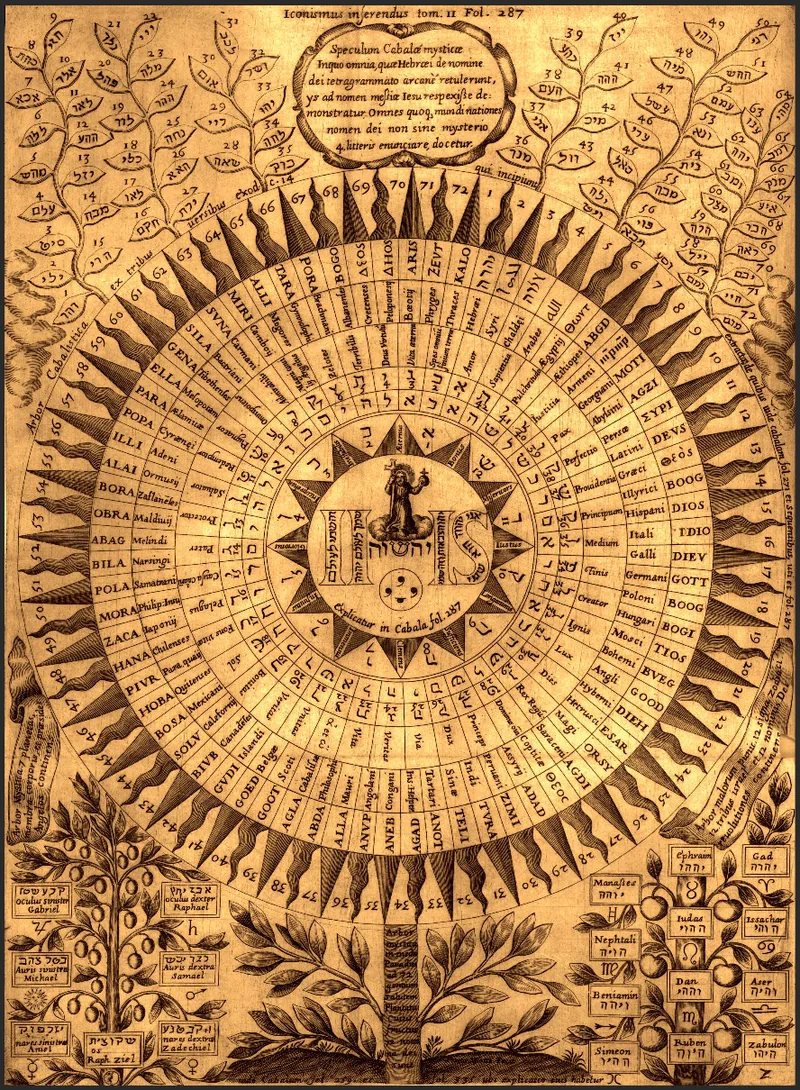
Christian scholars of the Renaissance found the 72 names fascinating. Johann Reuchlin discussed them in De Arte Cabalistica (1517), presenting the 72 angels with their Psalm verses as part of a Christian reading of Kabbalah. Cornelius Agrippa included tables of the 72 names and angels in the third book of his Three Books of Occult Philosophy (1533), described in Agrippa's Three Books. The Jesuit polymath Athanasius Kircher, in his Oedipus Aegyptiacus (1652–1654), published a celebrated diagram of the Shem ha-Mephorash in which the name of God in seventy-two languages radiates around a central Tetragrammaton; see Kircher's Cabala of the Hebrews.
The word Semamphoras or Schemhamphorash also entered the grimoire tradition, sometimes loosely, as a term for powerful divine names. The fourteenth-century Summa Sacre Magice of Berengar Ganell includes a Semamphoras table, and a German work, Semiphoras und Schemhamphoras Salomonis Regis, printed in 1686, was later reprinted among the texts associated with the Sixth and Seventh Books of Moses. In some later occult writing the 72 angels were paired, as a mirror image, with the 72 spirits of the Ars Goetia; this pairing is a modern construction rather than a feature of the Lemegeton itself.
Golden Dawn, Tarot and Modern Uses§
The Hermetic Order of the Golden Dawn incorporated the 72 angels into its system of correspondences. In its tarot teaching, each of the thirty-six numbered small cards from two to ten in the four suits rules one decan of the zodiac, and two angels of the Shem ha-Mephorash were assigned to each card, one for each quinance. This scheme is described in the order's documents on the tarot and has been carried into many modern decks and manuals; see the history of tarot and the minor arcana.
In contemporary popular spirituality, the 72 names have been presented as meditation tools, notably by the Kabbalah Centre in Yehuda Berg's The 72 Names of God (2003), which teaches readers to scan the triads visually for particular purposes. Many scholars and traditional rabbis regard this as a significant departure from the historical use of the names, which was restricted, liturgical and tied to the study of Torah. In traditional Jewish practice, the names remain present above all in amulets, in kabbalistic prayer books and in the reverent treatment of divine names described in practical Kabbalah.
Frequently asked questions§
What are the 72 Names of God?§
They are seventy-two three-letter combinations formed from the Hebrew letters of Exodus 14:19–21, read in a pattern that alternates forward and backward. Jewish mystics regarded them together as a single great name of God, associated with the miracle at the Red Sea.
What is the Shem ha-Mephorash?§
In the Mishnah, the Shem ha-Meforash is the Tetragrammaton as pronounced by the High Priest. In later Kabbalah and Christian Cabala, the term came to refer especially to the 72-fold name derived from Exodus 14 and, by extension, to the 72 angels formed from it.
Who are the 72 angels?§
They are names formed by adding -el or -iah to each of the 72 triads, beginning with Vehuiah, Jeliel and Sitael. Renaissance and later occultists assigned them Psalm verses, zodiacal degrees, decans and dates of the year. These attributions are largely early modern.
Are the 72 Names connected to the 72 demons of the Goetia?§
Not historically. The 72 spirits of the Ars Goetia come from the Solomonic grimoire tradition. Some modern occultists have paired them with the 72 angels as opposites, but this is a later construction.
Sources and further reading§
- Jewish Magic and Superstition — Joshua Trachtenberg, 1939
- Hebrew Amulets: Their Decipherment and Interpretation — T. Schrire, 1966
- Kabbalah — Gershom Scholem, 1974
- On the Art of the Kabbalah (De Arte Cabalistica) — Johann Reuchlin, 1517
- Three Books of Occult Philosophy — Henry Cornelius Agrippa, 1533
- Oedipus Aegyptiacus — Athanasius Kircher, 1652
- La Science cabalistique — Lazare Lenain, 1823
- The 72 Names of God: Technology for the Soul — Yehuda Berg, 2003