Liber XIX · Judaism · Chapter IX: Rabbinic Judaism & the Talmud
Rashi: Life and Commentaries on the Torah and the Talmud
Rashi of Troyes (1040–1105): his life, his commentaries on the Torah and Talmud, peshat and midrash, Old French glosses, the Tosafists and his legacy.

Rashi — the acronym of Rabbi Shlomo Yitzhaki (Solomon son of Isaac, 1040–1105) of Troyes in Champagne — is the most widely studied commentator in Jewish history. His concise commentary on the Torah, which explains the plain sense of the text while weaving in selected rabbinic midrash, has been the standard companion to the Five Books of Moses for more than nine centuries, and his running commentary on the Babylonian Talmud made that vast work accessible to generations of students. Printed beside the text in virtually every edition of both, Rashi has shaped how Jews read Scripture and Talmud more than any other medieval scholar.
Life of Rashi in Troyes and the Rhineland§
Rashi was born in Troyes, a market town of the county of Champagne, in 1040. Almost everything known about his life comes from his own writings and those of his students, and many later stories about him are legends. As a young man he travelled to the Rhineland, then the centre of Ashkenazi learning, and studied in Mainz under Jacob ben Yakar and Isaac ben Judah, and in Worms under Isaac ben Eleazar ha-Levi — teachers in the tradition of Rabbenu Gershom of Mainz, whose students' notes on the Talmud he would later use and surpass. Around 1070 he returned to Troyes, where he answered legal questions, taught students and wrote his commentaries.
Troyes was famous for its fairs, which drew merchants from across Europe, and its small Jewish community lived largely from trade, money-lending and agriculture. It is often said that Rashi himself made his living from vineyards, a claim drawn from the many references to wine-making in his writings, though the evidence is indirect. His later years were overshadowed by the First Crusade: in 1096 crusading bands massacred the Jewish communities of Mainz, Worms and Speyer where he had studied, and several liturgical laments for the victims are attributed to him. He died in Troyes in 1105. The small synagogue chapel in Worms that bears his name, and the nearby Rashi House museum, commemorate his student years there.
The Commentary on the Torah: Peshat and Midrash§
Rashi wrote commentaries on almost the entire Hebrew Bible, but his commentary on the Torah is the most important. It is short, written in clear Hebrew, and attached to individual words and phrases, explaining grammar, vocabulary, context and apparent contradictions. Commenting on the story of Adam and Eve hiding in the garden (Genesis 3), Rashi states his method: he has come only to give the plain meaning of Scripture (peshuto shel mikra) and such rabbinic interpretation (aggadah) as settles the words of the text "each word in its proper place".

In practice a large part of the commentary — by some estimates around three-quarters — is drawn from midrash and Talmud. Rashi selects, abridges and rephrases these sources, choosing those interpretations that answer a question raised by the text itself: a superfluous word, an unusual form, a gap in the story. His very first comment, on Genesis 1, asks why the Torah, a book of commandments, begins with creation rather than with the first commandment given to Israel in Exodus; his answer, taken from midrash, is that if the nations accuse Israel of seizing the land of Canaan, Israel can reply that the whole earth belongs to God, who gives it to whom He wills. Generations of readers have learned to ask, with Rashi's later commentators, "What was bothering Rashi?" — what difficulty in the verse prompted his comment.
The Torah commentary has been studied by children and scholars alike. The Shulchan Arukh permits a Jew to fulfil the custom of reviewing the weekly portion twice in Hebrew and once in the Aramaic translation by reading Rashi's commentary instead of the translation. Well over two hundred supercommentaries have been written on it, including those of Elijah Mizrahi in the early sixteenth century and Judah Loew of Prague (the Maharal), whose Gur Aryeh was printed in 1578. The first dated book printed in Hebrew was Rashi's commentary on the Torah, published at Reggio di Calabria in 1475.
Old French Glosses and the World of Champagne§
To explain difficult Hebrew or Aramaic words, Rashi often gives their equivalent in his own spoken language, Old French, written in Hebrew letters. These glosses, called la'azim, number in the thousands across his Bible and Talmud commentaries. Because they record the pronunciation of eleventh-century northern French phonetically, they are an important source for historians of the French language, and they offer glimpses of the everyday world of Champagne: tools, crafts, plants, foods, clothing and the techniques of the vineyard.
Rashi also shows awareness of his Christian surroundings. Some modern scholars, notably Avraham Grossman, argue that a number of his interpretations — on the election of Israel, the suffering servant of Isaiah or the Song of Songs as an allegory of God and Israel — answer Christian readings of Scripture that were becoming more assertive in his lifetime, though the extent of this polemical purpose is debated.
The Talmud Commentary and the Printed Page§
Rashi's commentary on the Babylonian Talmud is perhaps an even greater achievement. Talmud study in his time depended on the oral explanations of teachers, and the text, with its terse Aramaic arguments and abbreviations, was difficult to follow without them. Rashi's commentary accompanies the student through the discussion phrase by phrase, supplying punctuation in effect: it identifies who is speaking, explains terms and realia, fills in the logical steps and indicates where a question ends and an answer begins. He also worked to establish a correct text, recording and sometimes emending variant readings.
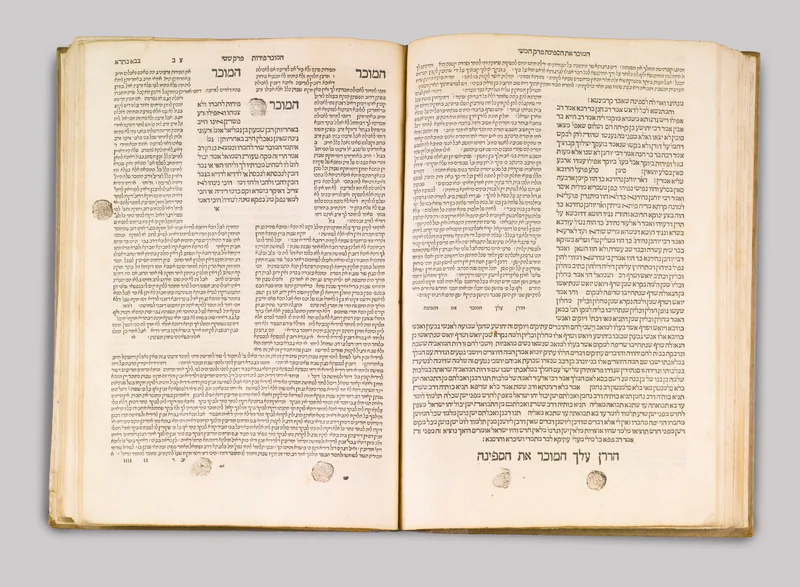
Rashi covered nearly all the tractates studied in his day. In some places his work was completed by others: his grandson Samuel ben Meir finished the commentary on most of tractate Bava Batra, and his son-in-law Judah ben Nathan the end of Makkot. Some commentaries printed under his name on other tractates are now considered the work of others. When the Talmud was printed — first in individual tractates by the Soncino press from 1484, then in the complete edition of Daniel Bomberg in Venice (1520–1523) — Rashi's commentary was set in the inner column of each page, with the Tosafot on the outer side, the layout still used today (see the Talmud and rabbinic Judaism). The semi-cursive typeface used for his commentary in Italian printings came to be called "Rashi script", though Rashi himself never wrote in it.
Rashi's Family, the Tosafists and His School§
Rashi had no sons but three daughters, Yocheved, Miriam and Rachel, who married scholars, and his grandsons became leaders of the next generation. Yocheved's sons included Samuel ben Meir (Rashbam), a Bible commentator who pushed further than his grandfather toward the plain meaning, and Jacob ben Meir, known as Rabbenu Tam, the greatest legal authority of twelfth-century French Jewry. Later stories that Rashi's daughters wore tefillin or wrote down his responsa are not supported by early evidence, though the family's learning is not in doubt.
Rabbenu Tam and his nephew Isaac of Dampierre led the movement of the Tosafists ("authors of additions"), whose glosses compare passages across the whole Talmud, point out contradictions, and frequently question or refine Rashi's explanations. Their method of dialectical analysis dominated Ashkenazi study for centuries. Rashi's students also compiled works recording his rulings and liturgical customs, such as the Machzor Vitry of Simhah of Vitry, and some of his responsa to legal questions survive. Together with the codes of Jewish law, these works shaped the practice of northern European Jewry.
Rashi in Jewish Learning and Christian Scholarship§
Rashi's authority in the Ashkenazi world became comparable to that of Maimonides among Sephardim, though their styles could not be more different: Maimonides the systematic philosopher and codifier, Rashi the patient explainer of texts. Students in traditional schools still begin Bible study with "Chumash and Rashi", and the commentary has been translated into many languages, including English editions that print it alongside the Torah.
His influence reached Christian scholarship too. The Franciscan Nicholas of Lyra (c. 1270–1349), whose Postillae on the whole Bible were among the most widely read commentaries of the later Middle Ages, drew so heavily on Rashi's interpretations of the literal sense that he was nicknamed "Solomon's ape". Through Lyra, Rashi's readings reached the Reformers: a Latin saying claims that if Lyra had not piped, Luther would not have danced. Christian Hebraists of the sixteenth and seventeenth centuries studied Rashi directly, and a complete Latin translation of his commentaries on the Bible was published in the early eighteenth century. Modern scholarship continues to study his sources, his exegetical method and his place in the intellectual renaissance of eleventh- and twelfth-century France, in which Jewish and Christian scholars alike turned to the careful reading of the literal sense of the Hebrew Bible.
Frequently asked questions§
What does the name Rashi stand for?§
Rashi is a Hebrew acronym formed from the initials of Rabbi Shlomo Yitzhaki, "Rabbi Solomon son of Isaac". Such acronyms were a common way of referring to great rabbis, as with Rambam for Maimonides.
Why is Rashi so important in Judaism?§
His commentaries made the Torah and the Babylonian Talmud understandable to ordinary students, and they have been printed alongside both texts for over five centuries. Almost every later commentator responds to him, and traditional Jewish education still introduces children to the Bible through his explanations.
What is Rashi script?§
Rashi script is a semi-cursive Hebrew typeface based on Sephardi handwriting, used by early Italian printers to distinguish commentaries from the main text. Because it was used for Rashi's commentary, it was named after him, but he did not use it himself.
Sources and further reading§
- Rashi — Avraham Grossman, 2012
- Rashi — Elie Wiesel, 2009
- Rashi: The Man and His World — Esra Shereshevsky, 1982
- The Pentateuch with Targum Onkelos, Haphtaroth and Rashi's Commentary — M. Rosenbaum & A. M. Silbermann, 1929
- Rashi and the Christian Scholars — Herman Hailperin, 1963
- Peshat and Derash: Plain and Applied Meaning in Rabbinic Exegesis — David Weiss Halivni, 1991