Liber XIX · Judaism · Chapter VIII: Prayer & the Synagogue
Tefillin, Tallit and Mezuzah: Jewish Ritual Objects Explained
Tefillin, tallit and mezuzah explained: the biblical commands behind them, how they are made and worn, their ancient history and the debate over amulets.

Tefillin, the tallit and the mezuzah are the three most familiar ritual objects of Jewish devotion. Tefillin are small black leather boxes containing handwritten scriptural passages, bound on the arm and head during weekday morning prayer; the tallit is the prayer shawl with ritual fringes (tzitzit) on its four corners; and the mezuzah is a parchment scroll in a case fixed to the doorposts of a Jewish home. All three fulfil commandments in the Torah, and all three carry the words of the Shema, the central declaration of Jewish faith.
The Biblical Commandments Behind the Ritual Objects§
The source of tefillin and mezuzah is the passage that follows the Shema in Deuteronomy 6: the words of God's commandments are to be on the heart, taught to one's children, and "thou shalt bind them for a sign upon thine hand, and they shall be as frontlets between thine eyes. And thou shalt write them upon the posts of thy house, and on thy gates." The same commands recur in Deuteronomy 11:18–20 and, for the sign on the hand and between the eyes, in Exodus 13:9 and 13:16. Some ancient and modern readers have taken these verses metaphorically, as a call to keep God's words constantly in mind; the Karaite movement, which rejected rabbinic tradition, did not wear tefillin. Rabbinic Judaism read them literally and defined in detail how they were to be fulfilled.
The fringes come from Numbers 15, which instructs the Israelites to make tassels on the corners of their garments, with a thread of blue, so that they "may look upon it, and remember all the commandments of the LORD"; Deuteronomy 22:12 specifies garments with four corners. The passage from Numbers is the third paragraph of the Shema, recited twice daily, as described in Jewish prayer and the synagogue.
Tefillin: Boxes, Straps and Scriptural Passages§
Each set of tefillin has two parts. The hand tefillin (shel yad) is a single-compartment box bound on the upper arm — traditionally the weaker arm — facing the heart, with its strap wound around the forearm and hand. The head tefillin (shel rosh) has four compartments and is placed above the hairline, centred between the eyes, with its strap encircling the head and the ends hanging down in front. Both contain the same four passages: Exodus 13:1–10 and 13:11–16, and Deuteronomy 6:4–9 and 11:13–21. In the hand tefillin they are written on one strip of parchment; in the head tefillin each is on its own small scroll.
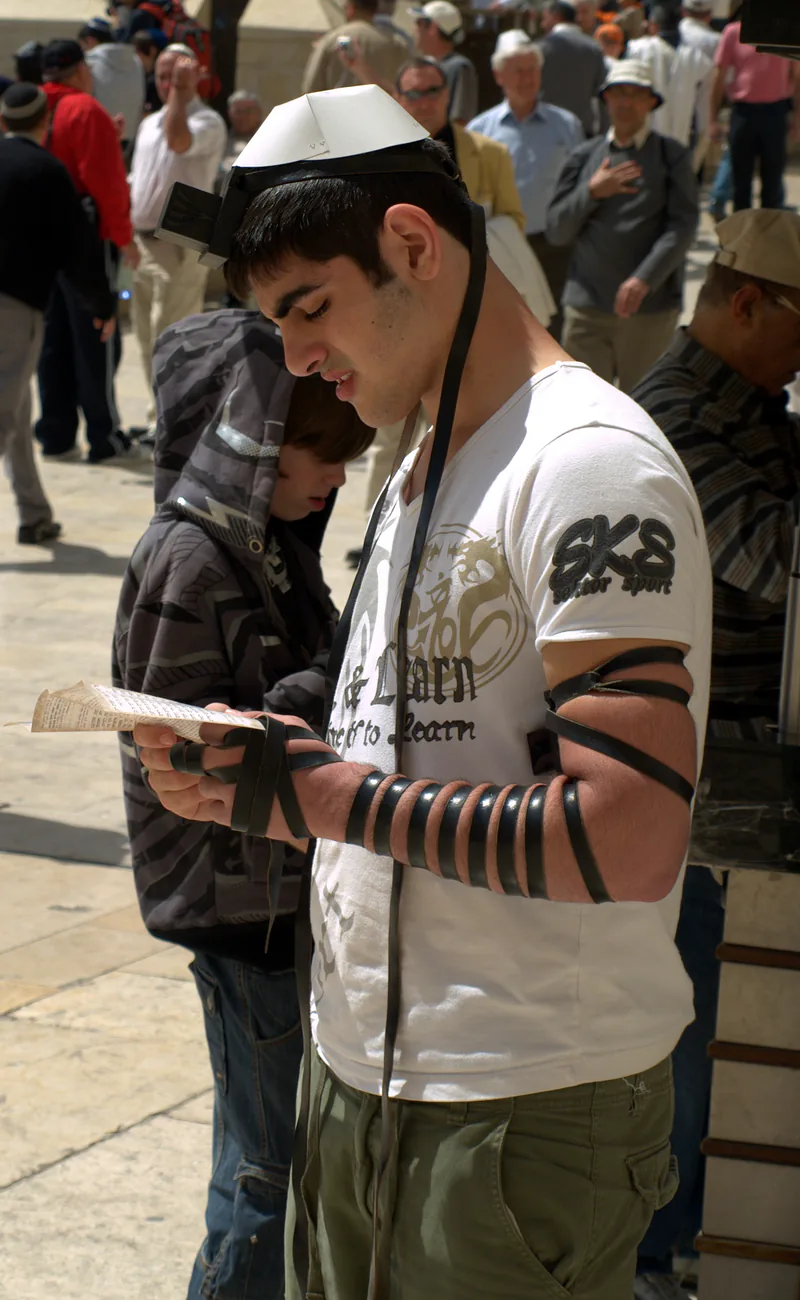
The boxes must be square and black, made from the hide of a kosher animal, and sewn with sinews. The Hebrew letter shin is embossed on two sides of the head box, one of them with an unusual four-headed form. Together with the knot of the head strap, shaped like the letter dalet, and the knot of the hand strap, shaped like a yod, the letters spell Shaddai, "Almighty", one of the names of God. A famous medieval dispute between Rashi and his grandson Rabbenu Tam concerns the order of the four passages; the standard practice follows Rashi, but some pious Jews, especially in Hasidic and Sephardi circles, put on a second pair made according to Rabbenu Tam after prayer.
Tefillin are worn at weekday morning prayer, but not on Sabbaths and festivals, which are themselves considered a "sign" between God and Israel. A boy begins to wear them at his bar mitzvah, at thirteen, often practising for a month beforehand. The parchment texts, like those of a mezuzah and a Torah scroll, must be written by hand by a qualified scribe with a quill and special ink; a single missing or malformed letter makes them unfit. These three scribal products are collectively called STaM, from the initials of Sefer Torah, Tefillin, Mezuzot.
Tefillin in Antiquity: Qumran and the Phylacteries§
The wearing of tefillin is old. The Letter of Aristeas and the historian Josephus mention the practice, and the Gospel of Matthew (23:5) criticises those who "make broad their phylacteries". The Greek phylakterion means "safeguard" or "amulet", which suggests how outsiders, and probably many Jews, understood these objects. The most important evidence comes from the caves of Qumran and other Judaean desert sites, where archaeologists recovered tefillin cases and dozens of tiny folded parchment slips dating from about the second century BCE to the first century CE (see the Dead Sea Scrolls).
The Qumran tefillin are often written in minute script, and their contents vary more than later rabbinic law allows: some include the Ten Commandments and longer extracts of Deuteronomy and Exodus. Yigael Yadin published a set in 1969, and scholars have used the finds to show that both the practice and the core passages were established before the rabbinic period, while the exact standardisation of the texts came later. The rabbis themselves explained that the Ten Commandments had once been recited daily but were removed from the liturgy and from tefillin to counter sectarian claims that only they had been given at Sinai.
The Tallit and the Fringes (Tzitzit)§
The tallit is a four-cornered shawl, traditionally of wool or linen and often white with black or blue stripes, worn by men at morning prayer every day, including Sabbaths and festivals, and at all services on Yom Kippur. At each corner hangs a fringe (tzitzit) of eight strands, made by threading four long cords through a hole and tying them with a fixed pattern of double knots and windings. Rashi popularised a numerical interpretation: the word tzitzit has the numerical value 600, which with eight strands and five knots makes 613, the traditional number of the commandments. Because fringes are required only on four-cornered garments, observant men also wear a smaller garment, the tallit katan, under their clothes all day, often with the fringes visible.

The Torah's "thread of blue" (tekhelet) was dyed with a costly pigment from a marine creature. Knowledge of its source was lost after late antiquity, and for many centuries tzitzit were made entirely white. In the 1880s the Hasidic rebbe Gershon Henoch Leiner of Radzyn proposed a cuttlefish dye, adopted by his followers; since the late twentieth century many Jews have adopted a blue thread from the Murex trunculus snail, which most researchers now identify as the ancient source, although many authorities do not require it. A tallit traditionally covers the dead at burial, often with one fringe cut to show that the obligation of the commandments has ended.
The Mezuzah on the Doorpost§
A mezuzah (literally "doorpost") is a parchment containing the first two paragraphs of the Shema, Deuteronomy 6:4–9 and 11:13–21, rolled and placed in a protective case. It is fixed to the right-hand doorpost as one enters, in the upper third of the post, on the main entrance and on the doors of living rooms within a Jewish home and building. Ashkenazi Jews place it slanting, the top inclined towards the room, a compromise attributed to a disagreement between Rashi, who wanted it vertical, and Rabbenu Tam, who wanted it horizontal. The word Shaddai is written on the back of the parchment, often visible through a window in the case, and later tradition read it as an acronym for "Guardian of the doors of Israel". Many Jews touch the mezuzah and kiss their fingers when passing, and the parchment should be checked twice in seven years.
A well-known rabbinic story, preserved in the Jerusalem Talmud, tells that the Parthian king Artaban sent Rabbi Judah the Prince a priceless pearl and asked for something equally valuable in return. The rabbi sent a mezuzah, explaining that the king had sent him something he must guard, while he had sent something that would guard the king as he slept.
Protection, Amulets and the Debate over Magic§
That story expresses a theme that runs through the history of these objects: they were understood not only as reminders but also as protection. In the Middle Ages scribes in some regions added the names of angels, holy names and magical seals to the mezuzah parchment, turning it into a powerful amulet, as Joshua Trachtenberg documented in Jewish Magic and Superstition. Maimonides condemned the practice in his legal code, warning that those who wrote angels' names in a mezuzah had turned a commandment that teaches the unity and love of God into an amulet for their own benefit. His view prevailed in law, and standard mezuzot today carry only the biblical text and Shaddai.
Yet popular belief persisted. When misfortune strikes, many families still have their mezuzot checked for errors, and the mezuzah is sometimes worn as a pendant, a practice discouraged by many rabbis. Such attitudes belong to the wider history of protective practice described in Jewish magic and folklore, where the line between devotion and protection was continually negotiated.
Frequently asked questions§
What is written inside tefillin?§
Four passages from the Torah: Exodus 13:1–10, Exodus 13:11–16, Deuteronomy 6:4–9 and Deuteronomy 11:13–21. They speak of remembering the exodus, of the oneness and love of God, and of binding these words as a sign on the hand and between the eyes.
Why are tefillin not worn on the Sabbath?§
The Torah calls tefillin a "sign", and the rabbis taught that the Sabbath and festivals are themselves signs of the covenant between God and Israel. On those days the additional sign of tefillin is therefore not needed.
Can women wear a tallit and tefillin?§
In Orthodox law these are obligations of men, since women are generally exempt from time-bound positive commandments, and most Orthodox authorities discourage women from wearing them. Conservative, Reform and Reconstructionist Judaism permit or encourage women to wear them, and many do.
What is the difference between a mezuzah and an amulet?§
In Jewish law a mezuzah is a commandment: a scroll with the biblical text affirming God's unity, placed on the doorpost as the Torah instructs. Many Jews also see it as a sign of divine protection, but authorities such as Maimonides insisted that it must not be treated as a magical charm.
Sources and further reading§
- Tefillin from Qumran (X Q Phyl 1–4) — Yigael Yadin, 1969
- Jewish Magic and Superstition — Joshua Trachtenberg, 1939
- Judaism: Practice and Belief, 63 BCE–66 CE — E. P. Sanders, 1992
- To Be a Jew: A Guide to Jewish Observance in Contemporary Life — Hayim Halevy Donin, 1972
- The Jewish Book of Why — Alfred J. Kolatch, 1981
- Jewish Liturgy: A Comprehensive History — Ismar Elbogen, 1993