What Is Kabbalah? History, Core Ideas and Key Texts Explained
What is Kabbalah? A guide to Jewish mysticism: its history from Merkavah to Hasidism, Ein Sof, the sefirot, tikkun, and its Christian and Hermetic forms.
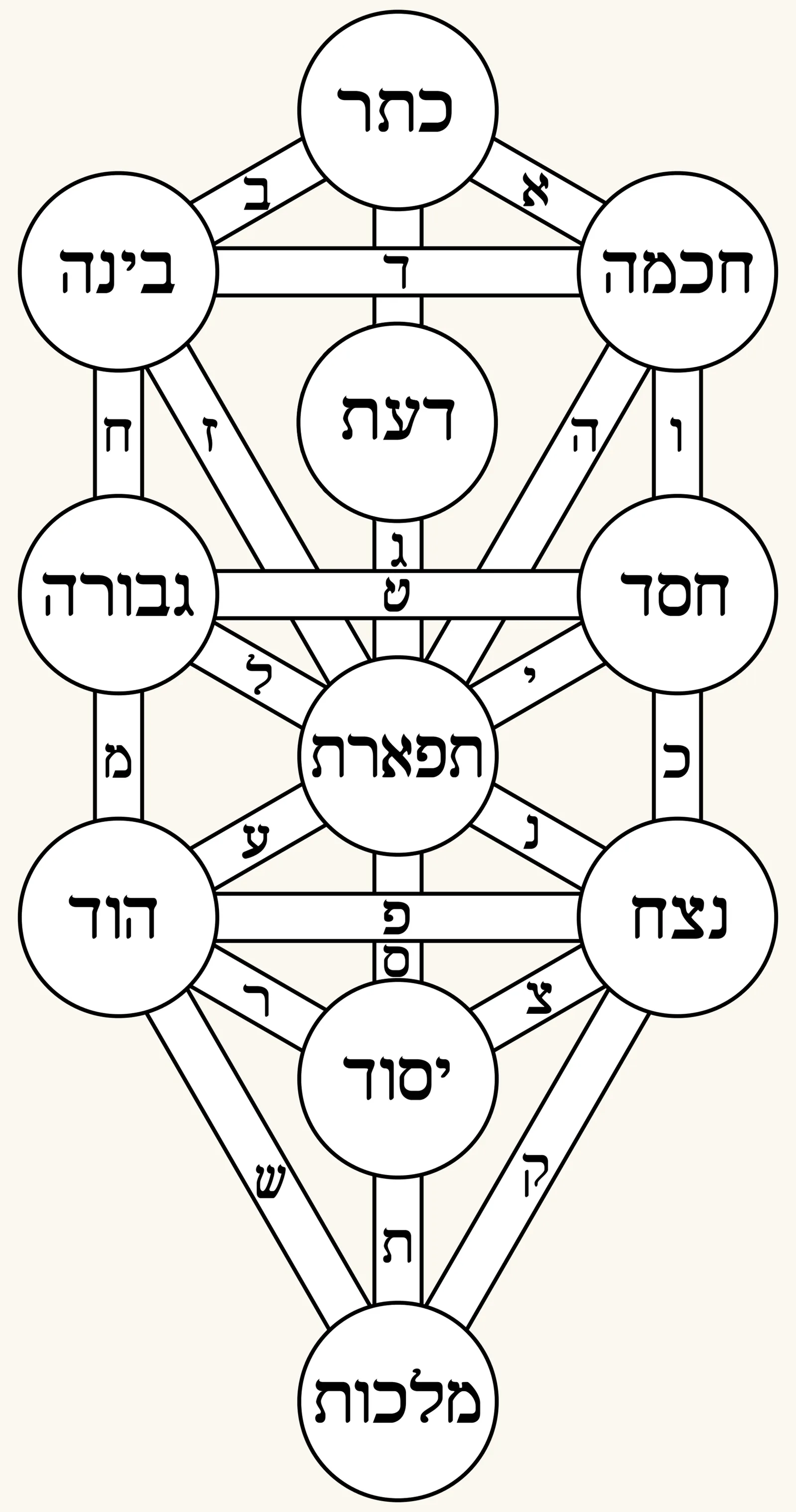
Kabbalah is the main esoteric tradition of Judaism: a body of teaching about the hidden nature of God, the structure of creation, and the meaning of the commandments, which took recognisable shape in southern France and Spain in the twelfth and thirteenth centuries. Its name means "reception" or "received tradition", and its classic texts describe the divine as an infinite, unknowable source (Ein Sof) that becomes manifest through ten powers called sefirot. Over eight centuries it developed through several distinct schools and was later adapted, in quite different forms, by Christian scholars and Western occultists.
The Meaning of the Word Kabbalah§
The Hebrew word qabbalah originally meant simply "tradition" in the ordinary rabbinic sense: material received from earlier authorities, as opposed to the written Torah. In classical rabbinic literature the books of the Prophets and Writings are sometimes called qabbalah. Only in the late twelfth and thirteenth centuries did the term come to designate a particular body of esoteric doctrine, transmitted from teacher to student and claimed to reach back to Moses at Sinai or even to Adam.
Practitioners often used other names as well. Kabbalists called their teaching hokhmat ha-nistar ("the hidden wisdom") or hokhmat ha-emet ("the wisdom of truth"), and called themselves ba'alei ha-sod ("masters of the secret") or maskilim ("the enlightened"). The word therefore carries two claims at once: that the doctrine is ancient, and that it must be received personally rather than invented.
Modern English uses three spellings in a rough but useful way. Kabbalah usually refers to the Jewish tradition; Cabala to the Christian adaptation of the Renaissance; and Qabalah to the Hermetic and occultist system of the nineteenth and twentieth centuries. The spellings are not consistently applied, but the distinctions behind them are real and are followed in this article.
Historical Phases of Jewish Mysticism§
Scholars generally describe Jewish mystical history as a sequence of overlapping phases. None of them simply replaced the one before; older texts were constantly reread through newer lenses.
Merkavah and Hekhalot mysticism§
The earliest stratum is the literature of the divine chariot (merkavah) and the heavenly palaces (hekhalot), based on the vision in Ezekiel 1. These texts, written in Hebrew and Aramaic and usually dated between late antiquity and the early Islamic period, describe ascents through seven palaces to the throne of glory, hymns sung by angels, and the adjuration of angelic princes. They form the subject of the separate article on Merkavah and Hekhalot mysticism.
The Sefer Yetzirah§
The short and enigmatic Sefer Yetzirah ("Book of Formation") describes creation through "thirty-two wondrous paths of wisdom": ten sefirot and the twenty-two letters of the Hebrew alphabet. Its date is disputed, with proposals ranging from the second to the ninth century. The word sefirot here seems to mean numbers or dimensions, not yet the divine attributes of later Kabbalah, but medieval readers saw the two as continuous. See the full article on the Sefer Yetzirah.
Provence and the Sefer ha-Bahir§
Historical Kabbalah proper appears in Provence in the late twelfth century. The Sefer ha-Bahir ("Book of Brightness"), which surfaced there around 1180, presents in short parables a God whose powers are arranged as a structure, including a feminine aspect and a cosmic tree. The circle around Abraham ben David of Posquières and his son Isaac the Blind (c. 1160–1235) developed meditative and theological teachings on the sefirot, emphasising contemplative prayer.
Gerona and Castile§
Isaac the Blind's students carried this teaching to Gerona in Catalonia, where Azriel and Ezra of Gerona wrote systematic treatises and the great legal authority Moses ben Nahman (Nahmanides, 1194–1270) alluded to kabbalistic readings in his Torah commentary. In Castile a further generation, including Joseph Gikatilla and Moses de León, produced the most influential works of the period. In the same century Abraham Abulafia (1240–c. 1291) developed a distinct "prophetic" Kabbalah centred on letter combination and meditative techniques aimed at ecstatic experience.
The Zohar§
The Zohar ("Radiance"), written largely in Aramaic and circulated from the 1280s onward, became the central classic of Kabbalah. Presented as the teaching of the second-century sage Shimon bar Yochai, it is attributed by most modern scholars wholly or in large part to Moses de León and his circle. Its rich symbolic reading of the Torah eventually gave it near-canonical status. See The Zohar.
Safed and Isaac Luria§
After the expulsion of the Jews from Spain in 1492, kabbalists dispersed across the Mediterranean. In the sixteenth century the Galilean town of Safed became an extraordinary centre of learning. Moses Cordovero (1522–1570) produced a vast systematic synthesis, the Pardes Rimonim, and Isaac Luria (1534–1572) taught a new and dramatic myth of divine contraction, cosmic shattering and repair, preserved mainly through his disciple Hayyim Vital. Lurianic Kabbalah spread across the Jewish world in the seventeenth century and provided the framework for the messianic movement around Sabbatai Zevi (1626–1676). See Lurianic Kabbalah.
Hasidism and the modern period§
In eighteenth-century Podolia, the movement associated with Israel ben Eliezer, the Baal Shem Tov (c. 1700–1760), reinterpreted kabbalistic ideas in psychological and devotional terms, stressing joy, cleaving to God, and the figure of the tzaddik. It is discussed in Hasidism and the Baal Shem Tov. Kabbalah also continued in non-Hasidic forms, from the Lithuanian circle of the Vilna Gaon to the Sephardic schools of Jerusalem. In the twentieth century, figures such as Abraham Isaac Kook and Yehuda Ashlag gave Kabbalah new philosophical and social expressions, and late-century movements popularised it far beyond traditional settings.
Core Ideas: Ein Sof, the Sefirot and the Shekhinah§
Kabbalistic thought is diverse, but several concepts recur across most schools.
Ein Sof§
Ein Sof, "without end", is the kabbalistic name for God as utterly infinite and beyond all description. Ein Sof has no attributes, cannot be named, and is not directly addressed in prayer. Early kabbalists drew on medieval Neoplatonic philosophy here, sharing its insistence that the ultimate source transcends every category.
The ten sefirot§
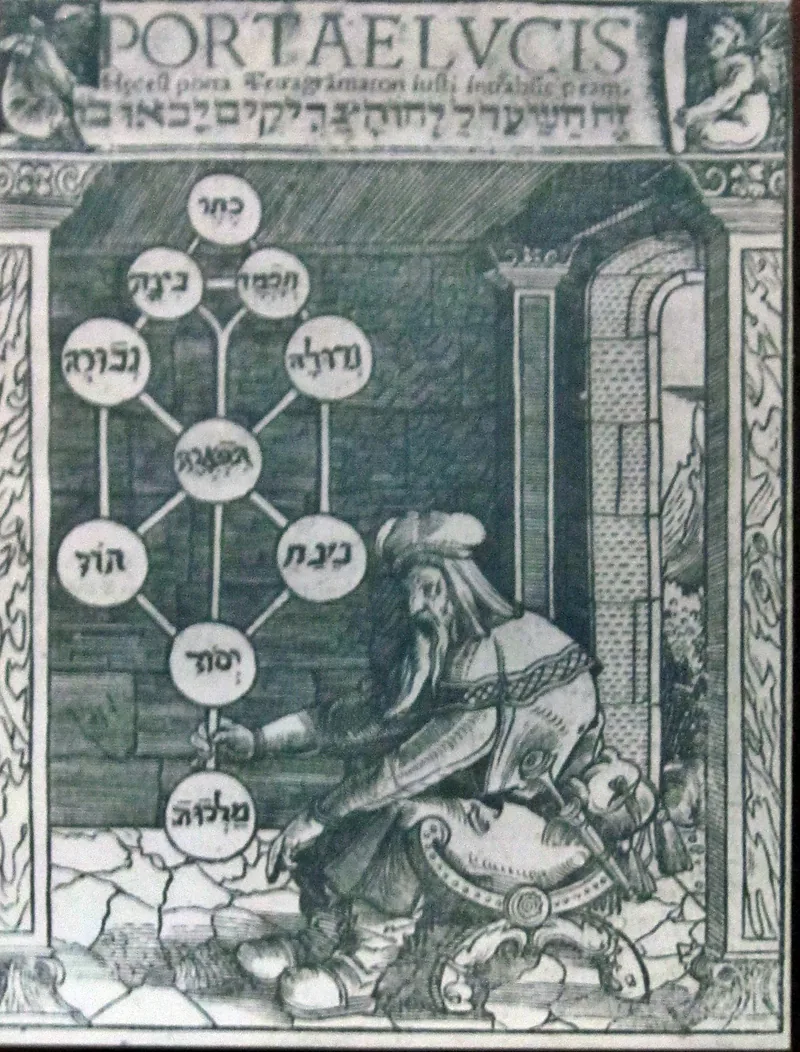
Between the hidden Ein Sof and the created world stand the ten sefirot, usually listed as Keter (Crown), Hokhmah (Wisdom), Binah (Understanding), Hesed (Loving-kindness), Gevurah (Strength or Judgment), Tiferet (Beauty), Netzah (Eternity), Hod (Splendour), Yesod (Foundation) and Malkhut (Kingship). Kabbalists debated whether the sefirot are God's very essence or instruments through which God acts, and Cordovero's synthesis tried to hold both views together. Arranged in a branching pattern, they form the "Tree of Life" described in The Ten Sefirot and the Tree of Life.
The sefirot function as a symbolic language. Nearly every word of the Torah can be read as pointing to one of them, so that the narrative of the Patriarchs, the architecture of the Tabernacle and the laws of the Sabbath all become descriptions of divine life. Abraham corresponds to Hesed, Isaac to Gevurah, Jacob to Tiferet, and King David to Malkhut.
The Shekhinah and the sacred union§
One of Kabbalah's boldest developments was its understanding of the Shekhinah, the divine "Presence" of rabbinic literature, as a feminine aspect of God identified with the tenth sefirah. The Zohar speaks of the union of the Holy One, blessed be He (Tiferet) with the Shekhinah (Malkhut), and of the Shekhinah's exile alongside Israel. Human actions, especially the commandments performed with right intention (kavvanah), were believed to promote or hinder this union.
Evil, exile and tikkun§
Kabbalists also developed theories of evil, often describing an "other side" (sitra ahra) or "husks" (kelippot) that arise from an excess of judgment. In the Lurianic system, the shattering of vessels at the beginning of creation scattered divine sparks into the realm of the husks, and human religious life became a task of tikkun, restoring the broken order. This gave everyday observance a cosmic significance that proved deeply attractive. The modern liberal phrase tikkun olam ("repairing the world") draws on this vocabulary, although its ethical and social use differs considerably from the original metaphysical meaning.
Practice: Study, Prayer and Contemplative Technique§
Kabbalah has always been more than speculative theology. Its practices included intensive study of the Zohar and related texts, contemplative intentions (kavvanot) in prayer that align each word with a sefirah, meditations on divine names, vigils such as the midnight lament for the destroyed Temple, and new customs including the Friday evening welcome of the Sabbath. Abulafia's school taught breathing and letter-combination exercises intended to bring the practitioner to prophecy, and Hebrew letters and numbers were analysed through techniques such as gematria.
A strand often called "practical Kabbalah" (kabbalah ma'asit) dealt with amulets, angelic adjurations and divine names used for protection or healing. Many authorities regarded it with caution or discouraged it, and the line between it and wider Jewish magic is not always sharp.
Traditionally, study was restricted. A frequently cited guideline held that a student should be mature, married and learned in Talmud and law, sometimes summarised as reaching forty years of age. These restrictions varied by community and were loosened considerably from the sixteenth century onward, especially with the spread of printed books.
How Scholars Study Kabbalah§
Modern academic study of Kabbalah was effectively founded by Gershom Scholem (1897–1982), whose Major Trends in Jewish Mysticism (1941) and Origins of the Kabbalah established a historical narrative of phases, sources and schools. Scholem took Kabbalah seriously as a vital force in Jewish history at a time when many historians dismissed it as superstition, and he emphasised its mythic and Gnostic-like features.
Moshe Idel, in Kabbalah: New Perspectives (1988) and many later works, challenged several of Scholem's frameworks. He stressed continuity with older Jewish traditions rather than Gnostic influence, distinguished "theosophical-theurgical" Kabbalah (focused on the sefirot and on influencing divine life) from "ecstatic" Kabbalah (focused on mystical experience), and paid close attention to magical and practical dimensions. Elliot Wolfson has explored visionary experience and gender in kabbalistic symbolism, while Yehuda Liebes, Joseph Dan, Rachel Elior and Boaz Huss have reshaped specific areas such as Zohar authorship and the modern reception of Kabbalah.
Christian Cabala and Hermetic Qabalah§
Christian Cabala in the Renaissance§
From the late fifteenth century, Christian scholars began reading kabbalistic texts, often through Latin translations. Giovanni Pico della Mirandola (1463–1494) included numerous kabbalistic theses among his famous 900 Theses (1486), arguing that Kabbalah confirmed Christian doctrine. Johann Reuchlin's De verbo mirifico (1494) and De arte cabalistica (1517) developed the idea that inserting the letter shin into the four-letter name of God produced a form of the name of Jesus. Later works such as Christian Knorr von Rosenroth's Kabbala Denudata (1677–1684) made portions of the Zohar and Lurianic texts available in Latin. Christian Cabala aimed largely at apologetics and at recovering a supposed primordial revelation, and it reshaped kabbalistic concepts to fit Trinitarian theology.
Hermetic Qabalah and the occult revival§
In the nineteenth century, French occultist Éliphas Lévi linked the twenty-two Hebrew letters to the twenty-two trumps of the tarot. The Hermetic Order of the Golden Dawn, founded in London in 1888, built an entire ritual and initiatory system on the Tree of Life, mapping grades onto the sefirot and assigning tarot cards, planets, colours and gods to the paths. Samuel Liddell MacGregor Mathers translated parts of the Kabbala Denudata into English as The Kabbalah Unveiled (1887). Aleister Crowley's tables in 777 and Dion Fortune's The Mystical Qabalah (1935) carried the system into twentieth-century esotericism.
Hermetic Qabalah uses the Tree of Life as a universal map of consciousness and correspondence, largely detached from Jewish law, liturgy and Hebrew textual study. It is best understood as its own tradition, descended through Christian Cabala and Renaissance occult philosophy, rather than as a version of Jewish Kabbalah.
Frequently asked questions§
Is Kabbalah part of Judaism?§
Yes. Historically, Kabbalah developed within rabbinic Judaism, and many of its greatest figures, such as Nahmanides and Joseph Karo, were also leading legal authorities. Its texts presuppose Hebrew, the Torah, the Talmud and the commandments. Some Jewish thinkers, particularly rationalists, criticised it, but it shaped Jewish liturgy and custom profoundly.
Who wrote the Zohar?§
The Zohar presents itself as the teaching of Shimon bar Yochai, a second-century rabbi. Most modern scholars attribute it to Moses de León and possibly a circle of kabbalists in thirteenth-century Castile, with some later layers written by other authors. Many traditional communities continue to accept the ancient attribution.
What is the difference between Kabbalah, Cabala and Qabalah?§
Kabbalah usually denotes the Jewish tradition, Cabala the Christian Renaissance adaptation, and Qabalah the Hermetic system of modern occultism such as the Golden Dawn. The three share some vocabulary, such as the sefirot and the Tree of Life, but differ in purpose, context and interpretation.
Do you have to be Jewish to study Kabbalah?§
Traditional Jewish Kabbalah was taught within Jewish communities to observant, learned men, and many traditional teachers still hold that view. Academic study is open to anyone, and twentieth-century popular movements have taught simplified forms to broad audiences. Practices vary widely depending on which tradition one is speaking of.
Sources and further reading§
- Major Trends in Jewish Mysticism — Gershom Scholem, 1941
- Origins of the Kabbalah — Gershom Scholem, 1987 (English translation)
- Kabbalah — Gershom Scholem, 1974
- Kabbalah: New Perspectives — Moshe Idel, 1988
- Kabbalah: A Very Short Introduction — Joseph Dan, 2006
- The Wisdom of the Zohar — Isaiah Tishby, 1989 (English translation)
- Through a Speculum That Shines — Elliot R. Wolfson, 1994
- The Christian Kabbalah: Jewish Mystical Books and Their Christian Interpreters — Joseph Dan (ed.), 1997
- De arte cabalistica — Johann Reuchlin, 1517