Liber XXXII · Thelema · Chapter III: Tarot & Qabalah in Thelema
Tarot and Qabalah in Thelema: Thoth Deck, 777 and the Tree
Tarot and Qabalah in Thelema: Crowley's Thoth tarot, the Tzaddi and Heh exchange, Liber 777 and gematria, A∴A∴ grades on the Tree and Typhonian Qabalah.

In Thelema, tarot and Qabalah form a single symbolic system inherited from the Golden Dawn and reshaped by Aleister Crowley in the light of The Book of the Law. Its main monuments are Liber 777 (1909), a book of tables of correspondences built on the Kabbalistic Tree of Life, and the Thoth tarot, painted by Lady Frieda Harris to Crowley's design between 1938 and 1943 and explained in The Book of Thoth (1944). Thelemites use this system for meditation, ritual, divination and the mapping of spiritual attainment.
Hermetic Qabalah as Crowley Received It§
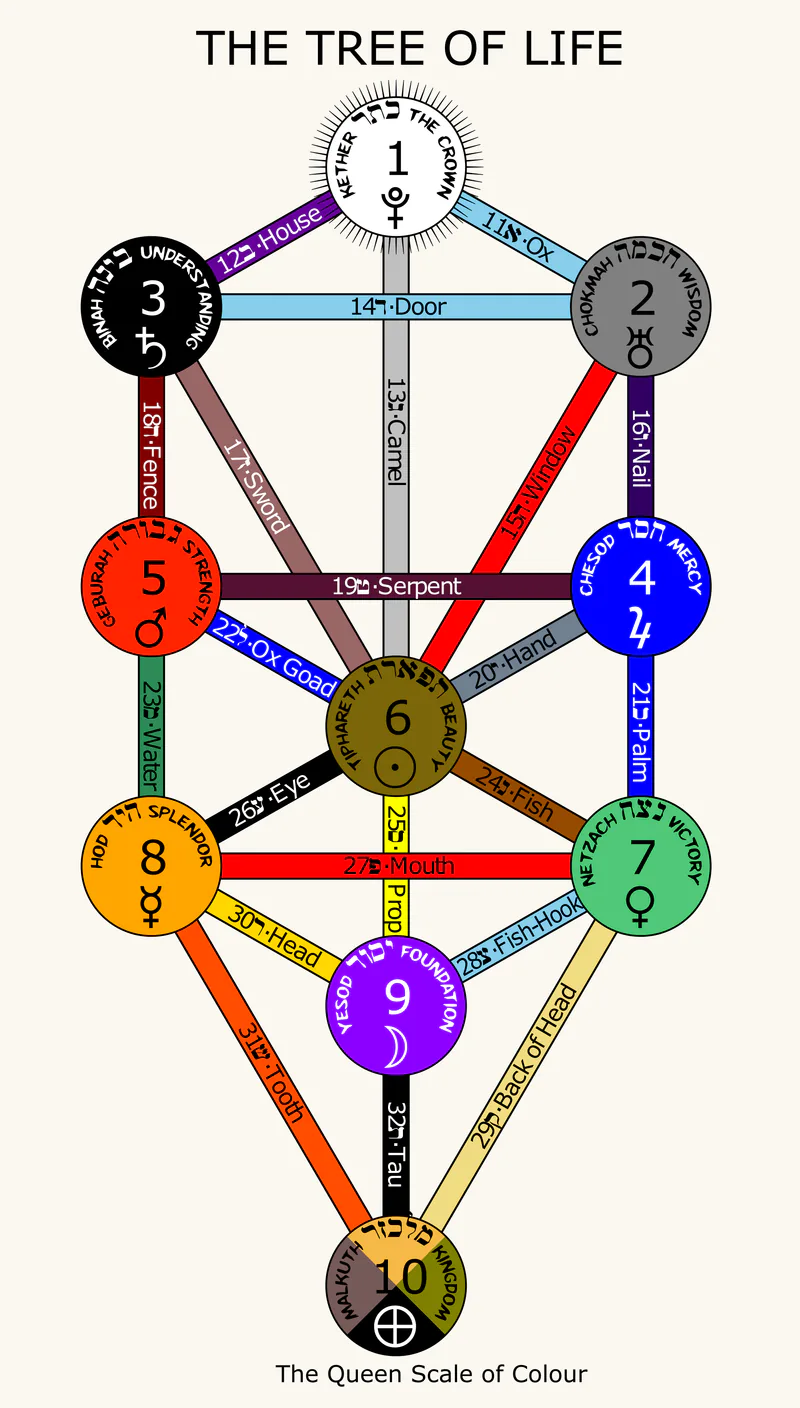
The Qabalah Crowley learned in the Hermetic Order of the Golden Dawn was a Christian and occultist adaptation of Jewish Kabbalah, passed down through Renaissance Christian Cabala, the Latin translations of Christian Knorr von Rosenroth, Éliphas Lévi and S. L. MacGregor Mathers. It centred on the Tree of Life, the diagram of ten sefirot joined by twenty-two paths, onto which the Golden Dawn mapped the Hebrew letters, the planets, signs and elements, the tarot trumps and its own grades of initiation. The history of this tradition is surveyed in Christian and Hermetic Qabalah.
Crowley valued Qabalah less as a doctrine than as a language. He described it as a system of classification and a way of relating any idea to any other through number, enabling the magician to analyse experience and to construct rituals with consistent symbolism.
Liber 777 and the Tables of Correspondence§
Liber 777 (777), published anonymously in 1909, is a set of tables in which each row corresponds to one of the thirty-two "paths" of the Tree (the ten sefirot plus the twenty-two letters) and each column to a category: Hebrew names of God, archangels, Greek, Egyptian and Hindu deities, colours in four scales, animals, plants, precious stones, perfumes, drugs, magical weapons, tarot cards and more. It drew heavily on Golden Dawn material, including work by Mathers and Allan Bennett, which Crowley systematised and extended. The book allows a practitioner to assemble, for example, all the correspondences of Venus or of Netzach for a ritual.
Crowley also compiled the Sepher Sephiroth, a dictionary of Hebrew words arranged by numerical value, published in The Equinox in 1912, and wrote on gematria in essays such as "Gematria" in The Equinox. These texts, with 777, were collected after his death as The Qabalah of Aleister Crowley (1973) and later as 777 and Other Qabalistic Writings.
Thelemic Numbers and Words of Power§
Thelemic Qabalah attaches great significance to particular numbers, often derived from Greek or Hebrew gematria:
- 93: the value of thelēma (will) and agapē (love) in Greek, and of Aiwass by one of Crowley's spellings; it serves as a greeting.
- 418: the value of Abrahadabra, which Crowley called the word of the Aeon, and of the Hebrew letter Cheth spelled in full; also the number of Liber 418, The Vision and the Voice.
- 666: the number of the Beast in Revelation, which Crowley adopted as his own, a solar number in Hermetic Qabalah as the sum of the numbers 1 to 36.
- 31: the value of AL and LA ("God" and "not" in Hebrew), the key Crowley found to Liber AL's title.
The Book of the Law also contains passages that Crowley believed concealed a Qabalistic key in English letters, including a string of letters and numbers in its second chapter, which he expected a future "child" to decode. This prompted several "English Qabalah" systems in the later twentieth century, which assign number values to the Latin alphabet; Thelemites dispute whether any of them is the key intended.
The Thoth Tarot§
Crowley began work on a tarot in 1938 with the painter Lady Frieda Harris (1877–1962), intending a modest revision of the traditional designs; the project grew over five years into seventy-eight new paintings full of astrological, alchemical, Egyptian and Qabalistic symbolism, influenced in style by projective geometry and contemporary art. The Book of Thoth (1944) explains the cards. The paintings were exhibited in 1942, but a printed deck appeared only in 1969, long after both creators had died.
The Thoth deck differs from the Golden Dawn and Rider-Waite-Smith traditions in several ways:
- Renamed trumps: Adjustment (VIII, for Justice), Lust (XI, for Strength), Art (XIV, for Temperance), the Aeon (XX, for Judgement) and the Universe (XXI, for the World); the Magician becomes the Magus and the Wheel of Fortune simply Fortune.
- Numbering: Adjustment remains VIII and Lust XI, as in the Marseille order, while keeping the Golden Dawn astrological attributions.
- Courts: Knight, Queen, Prince and Princess, with the Knight as the highest.
- Minor arcana: the numbered cards carry one-word titles (Dominion, Love, Ruin) from their Golden Dawn decan attributions; see Minor Arcana.
"Tzaddi is not the Star"§
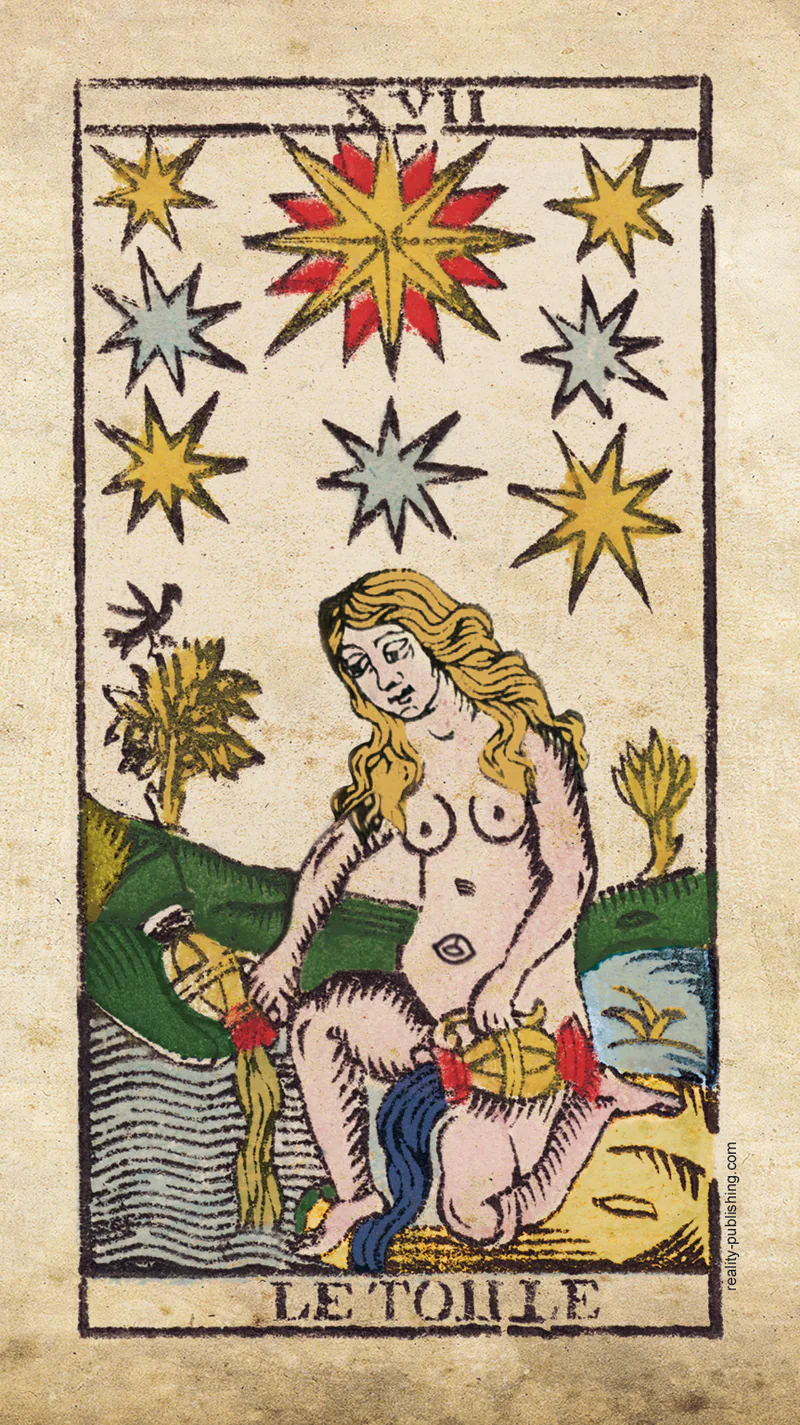
A verse in the first chapter of The Book of the Law states that the letter Tzaddi is not the Star. Crowley concluded that the attributions of trumps IV and XVII must be exchanged: the Emperor takes Tzaddi and the Star takes Heh, while each keeps its zodiac sign (Aries and Aquarius). On the Tree of Life the swap creates a loop around the zodiac that mirrors the Golden Dawn's exchange of Strength and Justice, a symmetry Crowley regarded as confirming the revision. For the standard attributions see Major Arcana.
The Tree of Life and the A∴A∴ Grades§
The grades of the A∴A∴ are placed on the Tree, numbered by two figures: the grade and the sefirah counted from the top.
| Order | Grades (sefirah) |
|---|---|
| Outer: the Golden Dawn | Probationer (0=0), Neophyte (1=10, Malkuth), Zelator (2=9, Yesod), Practicus (3=8, Hod), Philosophus (4=7, Netzach), Dominus Liminis (a link grade) |
| Second: the Rosy Cross | Adeptus Minor (5=6, Tiphareth), Adeptus Major (6=5, Geburah), Adeptus Exemptus (7=4, Chesed), Babe of the Abyss (a link grade) |
| Third: the Silver Star | Magister Templi (8=3, Binah), Magus (9=2, Chokmah), Ipsissimus (10=1, Kether) |
Attaining the Knowledge and Conversation of the Holy Guardian Angel is associated with Tiphareth, the centre of the Tree, and the crossing of the Abyss, between Chesed and Binah, with the dissolution of the ego. The unnumbered region of Daath ("knowledge") in the Abyss became important in later Thelemic thought; see Thelemic Doctrine.
Later Developments: Achad and the Typhonian Qabalah§
Crowley's student Charles Stansfeld Jones (Frater Achad) proposed in Q.B.L., or the Bride's Reception (1922) and later works a new arrangement of the paths on the Tree, effectively reversing the Golden Dawn attributions, which Crowley rejected but which some later writers adopted. Kenneth Grant, in Nightside of Eden (1977), turned to the reverse or shadow side of the Tree, the Qliphoth, describing "tunnels of Set" behind each path, which became central to Typhonian Thelema. These innovations show the continuing creativity, and the disagreements, within Thelemic Qabalah.
Frequently asked questions§
Who painted the Thoth tarot?§
The Thoth tarot was painted by Lady Frieda Harris under Aleister Crowley's direction between 1938 and 1943. It was first published as a deck in 1969, after both had died.
What is Liber 777?§
Liber 777 is a book of Qabalistic tables compiled by Crowley and published in 1909. It lists correspondences of gods, colours, plants, stones, tarot cards and other symbols for each of the thirty-two paths of the Tree of Life.
Why are the Emperor and the Star swapped in the Thoth tarot?§
A verse in The Book of the Law says that Tzaddi is not the Star. Crowley therefore gave the letter Tzaddi to the Emperor and Heh to the Star, keeping their zodiac signs unchanged.
Is Thelemic Qabalah the same as Jewish Kabbalah?§
No. It is a form of Hermetic Qabalah built on Golden Dawn teaching, which itself adapted Jewish Kabbalistic ideas through Christian and occult intermediaries. It adds tarot, astrology, Egyptian gods and Thelemic doctrine that have no place in Jewish tradition.
Sources and further reading§
- 777 and Other Qabalistic Writings of Aleister Crowley — Aleister Crowley, ed. Israel Regardie, 1977
- The Book of Thoth — Aleister Crowley, 1944
- The Vision and the Voice — Aleister Crowley, 1911
- A Garden of Pomegranates — Israel Regardie, 1932
- Q.B.L., or the Bride's Reception — Frater Achad (Charles Stansfeld Jones), 1922
- Nightside of Eden — Kenneth Grant, 1977
- A History of the Occult Tarot, 1870–1970 — Ronald Decker and Michael Dummett, 2002