Liber XIII · High Magick · Chapter I: Angelic Magic & Invocation
The Holy Guardian Angel: Abramelin and the Sacred Magic
The Holy Guardian Angel in magic: the Book of Abramelin, its manuscripts and operation, and the Knowledge and Conversation in the Golden Dawn and Crowley.

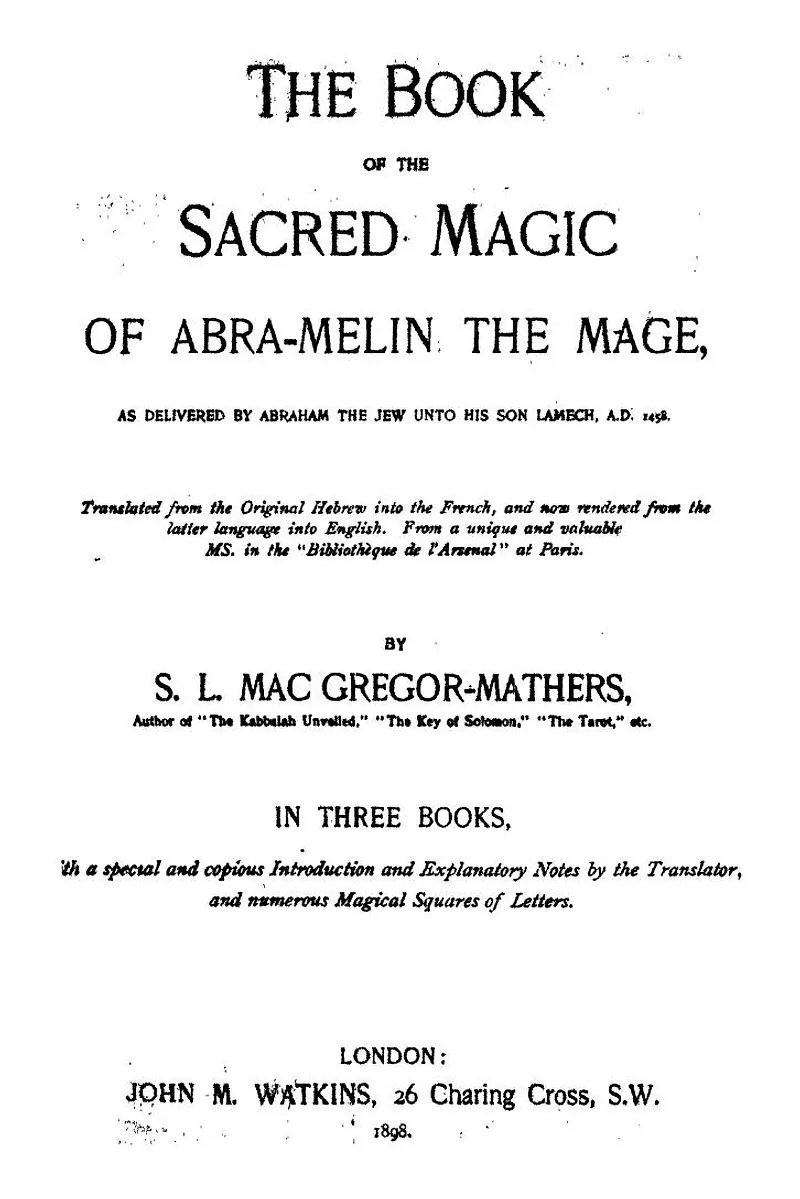
The Holy Guardian Angel is the personal angel that, in modern ceremonial magic, each person is believed to possess and may come to know directly. The idea takes its name and its classic method from the Book of Abramelin, a German grimoire known from manuscripts of the early seventeenth century, which describes a long retreat of prayer ending in the "knowledge and conversation" of one's guardian angel; Samuel Liddell MacGregor Mathers translated it in 1898 and Aleister Crowley made the attainment the centre of his magical system.
The Guardian Angel and the Personal Daimon Before Abramelin§
Many ancient traditions held that each person has an attendant spirit. Plato's dialogues speak of a daimon allotted to each soul, and Socrates described a divine sign, his daimonion, that warned him away from wrong actions. Later Platonists developed this into a doctrine of the personal daimon. Iamblichus, in On the Mysteries, discussed how a person's daimon could be known through theurgic ritual, and Porphyry's Life of Plotinus tells of a priest in Rome who summoned Plotinus' companion spirit, which proved to be a god rather than a daimon.
Jewish and Christian tradition offered the guardian angel. Jesus warns against despising little ones because "their angels do always behold the face of my Father" (Matthew 18), and the believers in Acts assume that Peter has an angel (Acts 12). The Shepherd of Hermas describes an angel of righteousness accompanying each person, and medieval theologians such as Thomas Aquinas taught that every human being is assigned a guardian angel at birth. A feast of the Guardian Angels spread in the Catholic Church in the early modern period and was extended to the whole Church in 1670.
Renaissance magicians combined these strands. Agrippa wrote of three guardian spirits, or "geniuses", that each person receives, and the Ars Paulina taught that a personal angel could be found from the degree of the zodiac rising at birth (see Ars Paulina and Ars Almadel). The Book of Abramelin turned this inherited belief into a complete spiritual discipline.
The Book of Abramelin: Manuscripts and Authorship§
The Book of Abramelin claims to be written by Abraham, a Jew of Worms, for his younger son Lamech, and dates itself to 1458. Abraham describes years of travel through Europe and the Near East in search of true magic, which he finally received from an Egyptian sage called Abramelin who lived near the Nile. The book is in several parts: Abraham's autobiography and advice, the method of the sacred operation, and a long series of magic squares of letters for practical purposes.
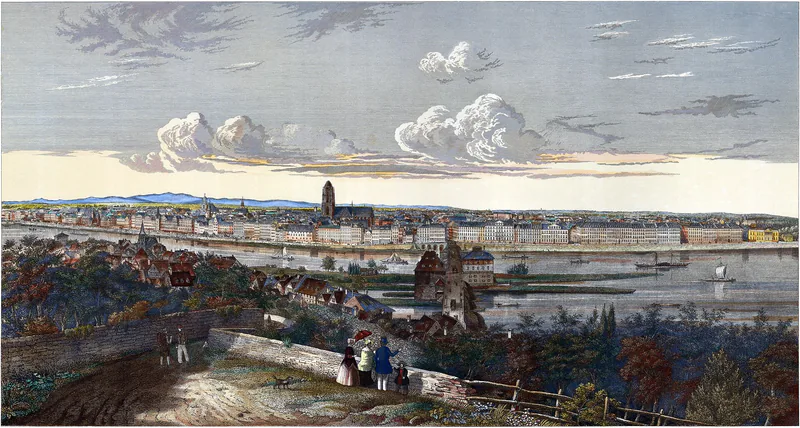
The earliest surviving manuscripts are in German and date from around 1608; a German printed edition appeared in 1725. Mathers found a French translation of the eighteenth century in the Bibliothèque de l'Arsenal in Paris and published it in English in 1898 as The Book of the Sacred Magic of Abra-Melin the Mage. The French version is shorter, and its operation lasts six months, while the German manuscripts prescribe eighteen months. In 2001 Georg Dehn published a critical edition based on the German sources, later translated into English by Steven Guth.
Dehn proposed that Abraham of Worms was the historical Rabbi Jacob ben Moses Moellin, the Maharil (c. 1365–1427). Most scholars regard this identification as unproven. The book's Jewish persona is conventional in grimoire literature, and its theology and some details suggest a Christian author or editor writing in German in the sixteenth century; others see genuine Jewish elements in its piety and its use of Hebrew. The catalogue entry for the Book of Abramelin summarises the manuscript evidence.
The Abramelin Operation as the Book Describes It§
The core of the book is the "sacred magic", an extended retreat. In the French version it begins after Passover and lasts six months, divided into periods of increasing intensity. The operator withdraws progressively from ordinary business, keeps chastity and temperance, and prays daily in a dedicated oratory with an altar, lamp and incense. The book gives recipes for a holy anointing oil, modelled on Exodus 30, and a perfume. It insists that the operation depends on sincere repentance and prayer rather than on ceremony, and that it may be performed by Jews and Christians alike.
At the end of the retreat the operator, sometimes assisted by a young child as seer, is promised the appearance of the guardian angel, who will instruct him in true wisdom and in the remaining work. The book then describes how, under the angel's protection, the magician summons the princes of evil spirits and binds them to obedience, so that they and their servants may be employed through the magic squares. Historians treat this as the book's view of the right order of the cosmos: demons serve only when the magician is first united with his angel and with God. The site's ritual summary of the Abramelin operation describes the stages historically.
The magic squares themselves, grids of letters, some resembling the ancient SATOR square, are assigned to purposes from healing and finding treasure to flight and invisibility. Many later readers ignored them and treated the book above all as a manual of devotion.
Mathers, Crowley and the Knowledge and Conversation§
Mathers' translation appeared while he led the Hermetic Order of the Golden Dawn, and it quickly influenced the order's younger members. Aleister Crowley bought Boleskine House on Loch Ness in 1899 specifically to perform the operation, which the book says requires a secluded house and a purpose-built oratory. He abandoned the attempt in 1900 when he became involved in the order's internal disputes and left for Mexico. Stories of misfortune linked to the book, and to Boleskine, became part of occult folklore.
Crowley later claimed to have attained the Knowledge and Conversation of the Holy Guardian Angel in 1906, after a period of daily invocation during a journey through China. He described methods for it in several writings: Liber Samekh (1921), an adaptation of an ancient Greek invocation of the "Headless One" from the magical papyri, earlier used in the Golden Dawn and printed as a preliminary invocation in his 1904 edition of the Goetia; and instructions in his Magick that compress the Abramelin retreat into shorter forms. His biographer Richard Kaczynski traces how these experiences shaped Thelema.
The Holy Guardian Angel in the Golden Dawn and Thelema§
In Golden Dawn teaching the corresponding figure was the "Higher and Divine Genius", whom the candidate for the inner order (the Adeptus Minor grade) swore to seek, and who was linked with Tiphareth, the central sefirah of the Tree of Life. Crowley's A∴A∴ made the Knowledge and Conversation the defining achievement of the Adeptus Minor, the condition for all higher work.
Crowley was not consistent about the angel's nature. At times he equated it with the higher self or with the Augoeides, the "luminous body" of the Neoplatonists, a term he borrowed through Edward Bulwer-Lytton. In later letters he insisted that the angel is an independent, objective being, not merely an aspect of the magician's mind. Both readings continue in modern Thelema and ceremonial magic.
Psychological and Devotional Interpretations§
Israel Regardie and later writers influenced by Carl Jung often interpreted the Holy Guardian Angel psychologically, as an image of the integrated Self, and the retreat as a disciplined process of individuation. Others in the Christian esoteric and Jewish-inspired traditions read it in devotional terms, close to the ordinary guardian angel of church teaching, and emphasise prayer and repentance as the book itself does.
Modern practitioners have adapted the operation in many ways, from full eighteen-month retreats to daily invocations over a few weeks; accounts of these undertakings form a small genre of occult memoir. Historians of esotericism treat the Holy Guardian Angel as a revealing case of how an early modern grimoire was transformed into a modern spiritual path. For the broader history, see angel magic: a complete guide.
Frequently asked questions§
What is the Holy Guardian Angel?§
In ceremonial magic, the Holy Guardian Angel is a personal angel or higher spiritual guide attached to each person. Attaining its "knowledge and conversation" is regarded as a central goal of the magical path, especially in the Abramelin tradition and in Thelema.
Who wrote the Book of Abramelin?§
The book claims to be by Abraham of Worms, writing in 1458, but its earliest manuscripts date from around 1608. Its true author is unknown; some see a Jewish source, while many scholars think it was written or edited by a Christian in German.
How long does the Abramelin operation take?§
Mathers' French-based translation gives six months; the German manuscripts edited by Georg Dehn give eighteen months. Modern practitioners have also devised much shorter adaptations.
Is the Holy Guardian Angel the same as the Christian guardian angel?§
The two ideas are related, and the Abramelin book draws on Christian and Jewish belief in guardian angels. In modern magic, however, the Holy Guardian Angel is usually understood as a higher self or personal divine guide to be consciously contacted, which goes beyond church teaching.
Sources and further reading§
- The Book of the Sacred Magic of Abramelin the Mage — S. L. MacGregor Mathers (trans.), 1898
- The Book of Abramelin — Abraham von Worms, Georg Dehn & Steven Guth (trans.), 2006
- Magick: Liber ABA, Book Four — Aleister Crowley, 1997
- Perdurabo: The Life of Aleister Crowley — Richard Kaczynski, 2002
- On the Mysteries — Iamblichus, Emma C. Clarke, John M. Dillon & Jackson P. Hershbell (trans.), 2003
- The Greek Magical Papyri in Translation — Hans Dieter Betz (ed.), 1986
- Angels: A History — David Albert Jones, 2010
- The Golden Dawn — Israel Regardie, 1937