Liber XIII · High Magick · Chapter I: Angelic Magic & Invocation
The Lesser Banishing Ritual of the Pentagram and the Archangels
The Lesser Banishing Ritual of the Pentagram explained: its Golden Dawn origins, the four archangels Raphael, Gabriel, Michael and Uriel, and its symbolism.

The Lesser Banishing Ritual of the Pentagram (LBRP) is a short ceremony created in the Hermetic Order of the Golden Dawn in the late nineteenth century, in which the magician traces pentagrams to the four quarters, vibrates Hebrew names of God and calls the archangels Raphael, Gabriel, Michael and Uriel to stand around the circle. It is the best-known ritual of modern ceremonial magic and the place where most practitioners first encounter the four archangels as a working system.
The Four Archangels in Scripture and Tradition§
Only two angels are named in the Hebrew Bible. Michael, "who is like God?", appears in Daniel as the great prince who stands for Israel (Daniel 12); in the New Testament he disputes with the devil over the body of Moses (Jude) and leads the angelic army against the dragon (Revelation 12). Gabriel, "strength of God", explains Daniel's visions (Daniel 8) and announces the births of John the Baptist and Jesus (Luke 1).
Raphael, "God heals", is the guide and healer of the book of Tobit, part of the Catholic and Orthodox Old Testament, where he describes himself as one of seven holy angels who stand before God. Uriel, "God is my light", belongs to the apocryphal literature: he guides Enoch through the cosmos in 1 Enoch and instructs the seer in 2 Esdras. Western Christianity was wary of him; a Roman synod of 745 restricted the named angels that could be venerated to Michael, Gabriel and Raphael, while Eastern and Ethiopian traditions continued to honour Uriel. Saul Olyan and other scholars have shown how these names emerged from Jewish interpretation of scripture in the Second Temple period.
Jewish tradition also placed four angels around the divine throne. A midrashic tradition puts Michael on the right, Gabriel on the left, Uriel in front and Raphael behind, and this arrangement entered the prayer said before sleep, in which the worshipper asks for the four angels on each side and the divine Presence above. The Golden Dawn ritual clearly draws on this pattern.
Michael, Gabriel, Raphael and Uriel in Magic§
Magical texts invoked the archangels from late antiquity onward. The Greek magical papyri call on Michael, Gabriel, Raphael and Ouriel; Aramaic amulets ask them to protect the bearer; the medieval grimoires use their names to seal circles and to constrain lesser spirits. In the Renaissance they were mapped onto planets, days and elements, though the sources do not agree. The Heptameron gives Michael to Sunday and the Sun, Gabriel to Monday and the Moon, and Raphael to Wednesday and Mercury, while Agrippa's scale of seven sets Raphael with the Sun and Michael with Mercury (see planetary angels in Agrippa and the Heptameron).
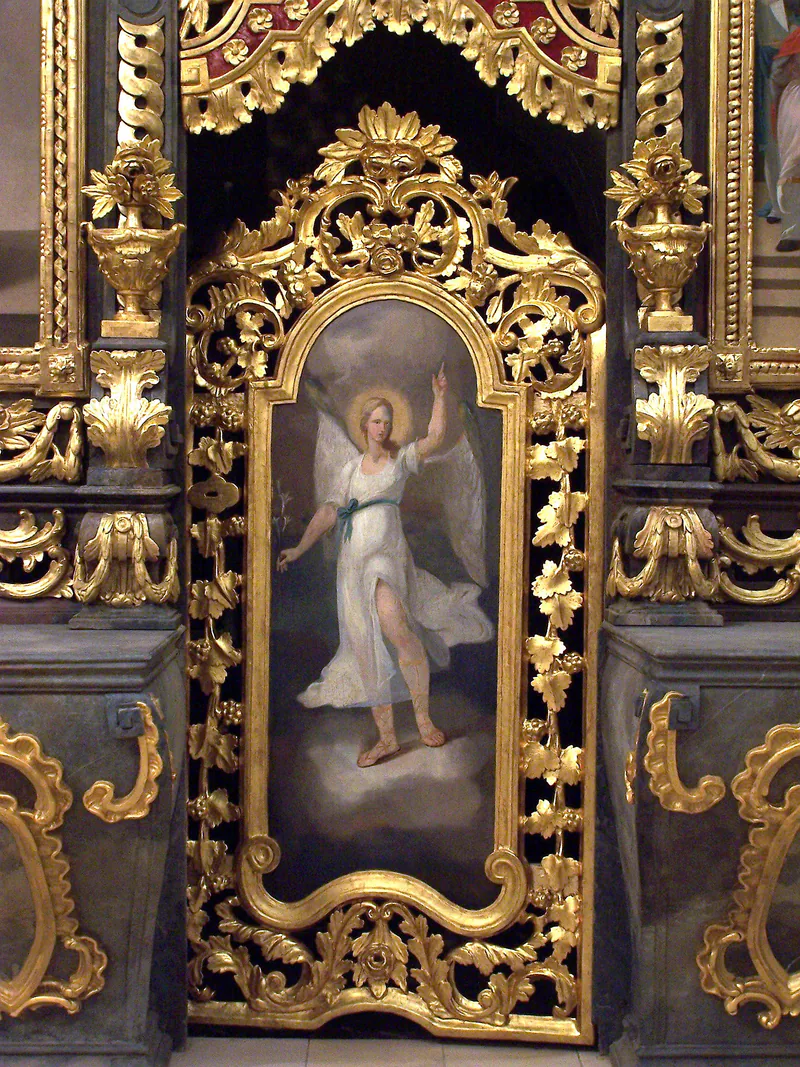
The Golden Dawn fixed a fourfold scheme that became standard in modern magic:
- Raphael — East, air, healing and the intellect; robed in yellow and violet.
- Michael — South, fire, strength and protection; robed in red and green.
- Gabriel — West, water, revelation and the emotions; robed in blue and orange.
- Uriel (often spelled Auriel) — North, earth, light and stability; robed in the colours of earth.
These attributions are modern correspondences, assembled from older traditions in the late nineteenth century, not an ancient fixed system. They also appear in the order's elemental rituals, in its "telesmatic" images of angels built from the letters of their names, and in later Wiccan and pagan rites that borrowed the quarters. For the broader angelic hierarchy, see angels and spirits in ceremonial magic.
Origins of the Lesser Banishing Ritual of the Pentagram§
The Hermetic Order of the Golden Dawn was founded in London in 1888 by William Wynn Westcott, Samuel Liddell MacGregor Mathers and William Robert Woodman. Its Outer Order taught a curriculum of Kabbalah, astrology and tarot; among the first practical instructions given to a Neophyte was the "Lesser Ritual of the Pentagram", in an invoking and a banishing form. The circulated paper drew on Éliphas Lévi's emphasis on the pentagram as a symbol of the human microcosm and of mind ruling the elements, on Agrippa's divine names and on the Kabbalistic Tree of Life.
The ritual was confidential until Aleister Crowley, who had left the order, printed it in Liber O vel Manus et Sagittae in his journal The Equinox in 1909. Israel Regardie's publication of the Golden Dawn papers (1937–1940) made it widely available, and it has since been reprinted in almost every manual of ceremonial magic, including Donald Michael Kraig's Modern Magick (1988). The site's ritual entry summarises the historical text.
The Structure of the LBRP§
As practised in Golden Dawn-derived traditions, the ritual has four parts. It is usually performed standing and facing east.
The Qabalistic Cross§
The practitioner visualises a sphere of light above the head and draws it down through the body while vibrating Hebrew words: Ateh (Thou art) at the forehead, Malkuth (the Kingdom) at the feet, ve-Geburah (and the Power) at the right shoulder, ve-Gedulah (and the Glory) at the left, and le-Olam, Amen (for ever, Amen) with the hands clasped at the breast. The words adapt the doxology attached to the Lord's Prayer in some texts of Matthew 6, itself echoing 1 Chronicles 29, and map it onto the sefirot of the Tree of Life.
The four pentagrams and divine names§
Moving clockwise, the practitioner traces a banishing pentagram of earth in each quarter, beginning at the lower left point and rising to the apex, and vibrates a divine name into it: YHVH in the east, Adonai in the south, Eheieh in the west and AGLA in the north. A line of light is imagined connecting the pentagrams into a circle.
The invocation of the archangels§
Standing with arms outstretched in the form of a cross, the practitioner calls the four archangels. Crowley's 1909 text begins: "Before me Raphael; Behind me Gabriel; On my right hand Michael; On my left hand Auriel." Each is visualised in the appropriate colours and element, and the formula ends with the pentagrams flaming about and a six-rayed star in the column of the body.
Closing§
The Qabalistic Cross is repeated. The whole ceremony takes a few minutes.
Symbolism: Pentagrams, Divine Names and the Elements§
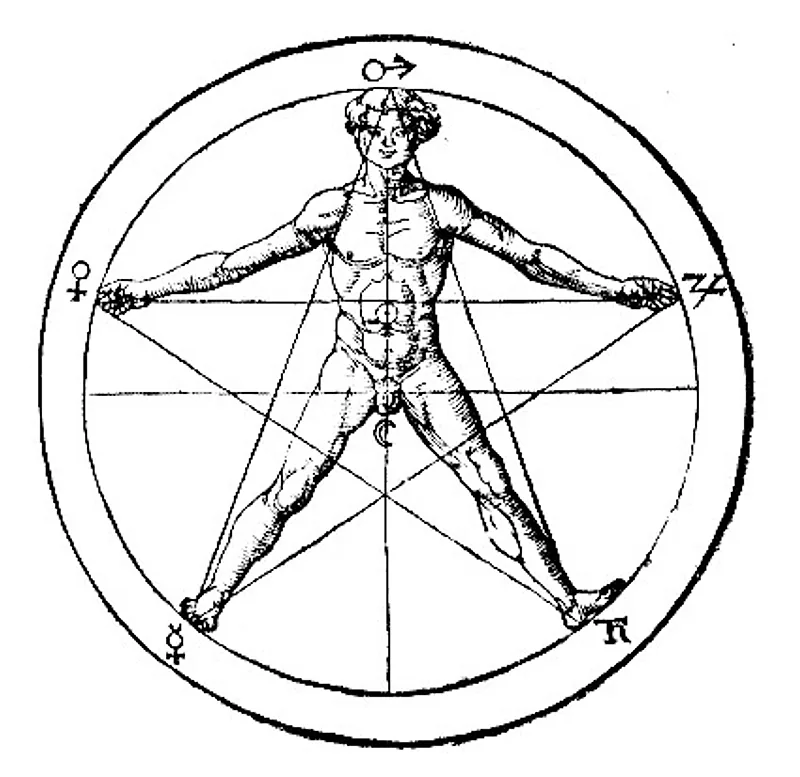
Golden Dawn teaching read the pentagram as the four elements crowned by spirit, and the human figure with arms and legs outstretched. Drawing it in the banishing direction was understood to disperse disordered elemental influences, while the invoking form called them in. The hexagram mentioned at the end of the invocation symbolised the union of macrocosm and microcosm, and is developed in the companion hexagram rituals taught alongside it.
The divine names correspond to the Kabbalistic structure of the order: the four-letter name YHVH, the name Adonai associated with Malkuth, the name Eheieh associated with Kether, and AGLA, an acronym of a Hebrew phrase meaning "Thou art mighty for ever, O Lord", long used on amulets and in the grimoires. The archangels, in turn, act as guardians of a consecrated space. Regardie and later writers described the ritual as a psychological as well as a magical exercise, centring attention, steadying the breath and establishing a sense of order before meditation.
Variations, Interpretations and Influence§
The LBRP has generated many variants. Crowley composed the Star Ruby, which replaces the Hebrew names and archangels with Greek formulae, and Thelemic groups use both. Christian esoteric orders substitute Christian names; some Jewish-inspired practitioners return to the original bedtime prayer; Wiccan and pagan rites borrowed the idea of calling guardians to the four quarters, sometimes keeping the archangels and sometimes replacing them with elemental powers. Golden Dawn orders pair the LBRP with the Lesser Ritual of the Hexagram and the Middle Pillar exercise.
Scholars such as Alex Owen have treated the ritual as an example of the late Victorian occultists' interest in the trained imagination and the cultivated self. For practitioners it remains the basic act of angelic invocation in daily practice: a short prayer-like rite that frames the self between the four archangels and the divine names. For the wider history of such rites, see angel magic: a complete guide and ritual and symbolism.
Frequently asked questions§
What does LBRP stand for?§
LBRP stands for the Lesser Banishing Ritual of the Pentagram, a ceremony from the Hermetic Order of the Golden Dawn. "Lesser" distinguishes it from the Supreme Ritual of the Pentagram taught in higher grades, and "banishing" from the invoking form of the same ritual.
Which archangels are called in the LBRP?§
Raphael in the east, Gabriel in the west, Michael in the south and Uriel (Auriel) in the north. They are associated with air, water, fire and earth respectively in the Golden Dawn system.
Is the LBRP Jewish or Christian?§
Neither, strictly. It was composed by British occultists using Hebrew divine names, Kabbalistic ideas and archangels shared by Judaism and Christianity. Its invocation of four angels resembles a traditional Jewish bedtime prayer, and its Qabalistic Cross adapts a Christian doxology.
How old is the Lesser Banishing Ritual of the Pentagram?§
It dates from the founding years of the Golden Dawn, in the late 1880s or early 1890s. Its elements are older, but the ritual as a whole is a modern composition.
Sources and further reading§
- The Golden Dawn — Israel Regardie, 1937
- Magick: Liber ABA, Book Four — Aleister Crowley, 1997
- Modern Magick — Donald Michael Kraig, 1988
- Self-Initiation into the Golden Dawn Tradition — Chic Cicero & Sandra Tabatha Cicero, 1995
- A Thousand Thousands Served Him: Exegesis and the Naming of Angels in Ancient Judaism — Saul M. Olyan, 1993
- 1 Enoch: A New Translation — George W. E. Nickelsburg & James C. VanderKam, 2004
- The Place of Enchantment: British Occultism and the Culture of the Modern — Alex Owen, 2004
- Jewish Magic and Superstition — Joshua Trachtenberg, 1939