Liber XIII · High Magick · Chapter VII: Ritual & Symbolism
Ritual and Symbolism in Ceremonial Magic: Tools, Signs and Temple
Ritual and symbolism in ceremonial magic: the temple, the Tree of Life and its paths, the elemental tools, pentagram and hexagram, colours and god-forms.

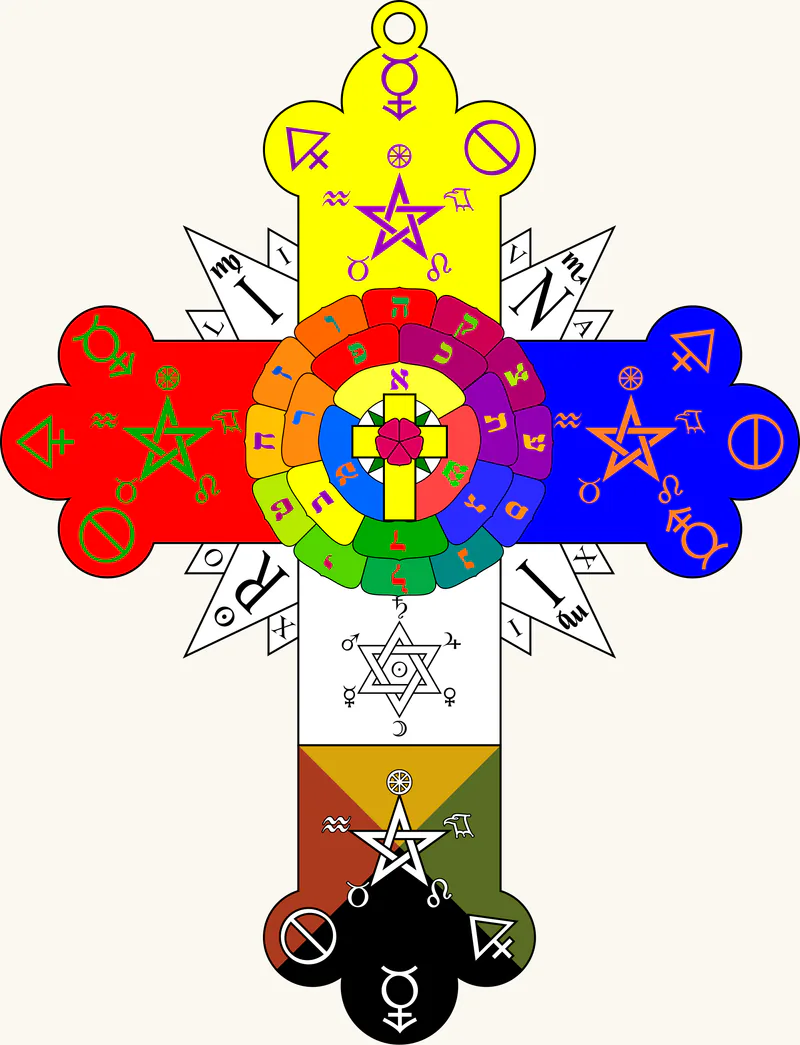
Ritual in ceremonial magic is built from a dense language of symbols: a consecrated temple oriented to the cardinal points, the Kabbalistic Tree of Life with its ten sefirot and twenty-two paths, the four elemental tools of wand, cup, dagger and pentacle, the pentagram and hexagram, divine names, colours and the visualised forms of gods. Most of this symbolic system took its modern shape in the Hermetic Order of the Golden Dawn in the 1880s and 1890s, drawing on the grimoires, Renaissance occult philosophy and the work of Eliphas Lévi.
Ritual as symbolic drama§
Ceremonial magicians have long understood ritual as a structured drama in which the practitioner acts within a microcosm of the universe. The older grimoires already prescribed a purified place, the magic circle, consecrated instruments and precise words. Eliphas Lévi, in the 1850s, interpreted these elements as symbols that focus the will and imagination and act upon the "astral light". The Golden Dawn developed this into an initiatory theatre in which officers represented divine powers and the candidate passed through symbolic stages.
Many modern practitioners and scholars emphasise the psychological dimension of this symbolism: ritual concentrates attention, evokes particular states of mind and enacts a story of transformation. Practitioners themselves vary in whether they regard the beings and forces invoked as external realities, psychological processes or both. The general background is set out in What Is Ceremonial Magic?.
The temple and the magic circle§
The Golden Dawn temple was arranged as a symbolic cosmos. Its altar stood at the centre, often a double cube representing the union of above and below, and the room was oriented with the east, the place of the rising sun, as the direction of light. Two pillars, black and white, recalled Boaz and Jachin, the pillars of Solomon's Temple, and the opposition of severity and mercy on the Tree of Life. Banners, lamps and the stations of officers each had a meaning explained in the order's teaching.

The older magic circle of the grimoires, drawn with divine names and protective signs, served as a boundary between the magician and evoked spirits. In the Ars Goetia, a triangle outside the circle marked where the spirit was to appear. Modern ritual often uses a "cast" circle as a sacred space rather than a protective barrier, a usage that also passed into Wicca.
The Tree of Life and the twenty-two paths§
The central symbolic map of modern ceremonial magic is the Kabbalistic Tree of Life, a diagram of ten sefirot (divine emanations) connected by twenty-two paths. Jewish Kabbalah associated the paths with the twenty-two letters of the Hebrew alphabet; Christian Kabbalists and later occultists added further correspondences. See the Tree of Life and the ten sefirot for the Jewish background.
In the Golden Dawn system, numbered after the Sefer Yetzirah's "thirty-two paths of wisdom", the ten sefirot are paths one to ten and the connecting channels are paths eleven to thirty-two. Each path was assigned a Hebrew letter (from Aleph on the eleventh path to Tav on the thirty-second), a tarot trump, and an element, planet or zodiac sign. Initiation through the grades was imagined as climbing the Tree, and members practised "pathworking", guided visualisation along these paths. The linking of the tarot trumps to the Hebrew letters began with Lévi, though the Golden Dawn rearranged his attributions; see the history of tarot.
The four elemental weapons§
The Golden Dawn adept made and consecrated four "elemental weapons", each corresponding to an element and to a suit of the tarot:
- The fire wand — fire, and the suit of wands.
- The water cup — water, and the suit of cups.
- The air dagger — air, and the suit of swords.
- The earth pentacle — earth, and the suit of pentacles or coins.
These four were associated with the four letters of the divine name YHVH and with the four quarters of the temple. The adept also used a lotus wand, a rose cross lamen and other implements of the Second Order. Older grimoires prescribed different tools, such as the knives, wand and sickle of the Key of Solomon. The fourfold set became standard in modern magic and, with modifications, in Wicca.
The pentagram and hexagram§
The pentagram, a five-pointed star, symbolised in occult tradition the four elements surmounted by spirit, and the human being as microcosm. Lévi treated the upright pentagram as a sign of the spirit governing the elements and the inverted pentagram as an emblem of disorder or evil, an interpretation that later became widespread. The hexagram, formed of two interlaced triangles, signified the macrocosm, the union of fire and water and, in the Golden Dawn, the seven planets placed around its points and centre.
Golden Dawn teaching included ritual forms built on these figures. The best known, the Lesser Ritual of the Pentagram, combines the Qabalistic Cross, the tracing of pentagrams to the four quarters with divine names, and an invocation of the four archangels Raphael, Gabriel, Michael and Uriel. It has been published widely since Regardie's The Golden Dawn and is often taught as a basic exercise in concentration and the creation of sacred space. Hexagram rituals performed analogous functions in relation to the planets.
Names, colours and god-forms§
Golden Dawn practice gave great weight to divine names, especially Hebrew names associated with the sefirot, which were "vibrated", intoned in a resonant voice felt throughout the body. The underlying belief in the power of sacred names goes back to Jewish and late antique magic and is discussed in gematria and related articles.
Colour was another symbolic language. The order taught four "colour scales", named after the King, Queen, Prince (or Emperor) and Princess (or Empress), assigning colours to each sefirah and path in four worlds. Flashing colours, complementary pairs, were used on talismans to produce a vivid effect. In the practice of assuming god-forms, officers and practitioners visualised themselves in the shape of Egyptian deities to embody the forces those gods represented.
Modern synthesis and interpretation§
Much of this symbolism is a nineteenth-century synthesis. The cipher manuscripts behind the Golden Dawn rituals date from the nineteenth century, and the order's genius lay in combining Kabbalah, tarot, astrology, Egyptian religion, Enochian magic and Masonic ritual into a coherent whole. Aleister Crowley's tables in 777 (1909) systematised the correspondences, and Regardie's later books, including The Middle Pillar (1938), linked ritual to psychology. Historians of esotericism study this material as an example of how modern religious movements construct tradition, while practitioners treat it as a living symbolic language. The orders that carried it are described in magical orders.
Frequently asked questions§
What are the four magical weapons?§
In Golden Dawn ceremonial magic they are the fire wand, water cup, air dagger and earth pentacle. Each corresponds to an element, a tarot suit and a letter of the divine name, and together they represent the adept's mastery over the elements.
Why are tarot cards linked to the Tree of Life?§
Eliphas Lévi proposed that the twenty-two tarot trumps corresponded to the twenty-two Hebrew letters, and the Golden Dawn assigned each trump to one of the twenty-two paths of the Tree of Life. This linkage is a nineteenth-century innovation, not part of the tarot's original history.
What does the pentagram mean in ceremonial magic?§
It usually represents the four elements ruled by spirit, and the human being as a small world. In ritual, pentagrams are traced to invoke or banish elemental forces, with different forms for each element.
Sources and further reading§
- The Golden Dawn — Israel Regardie, 1937
- The Tree of Life: An Illustrated Study in Magic — Israel Regardie, 1932
- Transcendental Magic: Its Doctrine and Ritual — Eliphas Lévi, 1856
- 777 — Aleister Crowley, 1909
- The Magicians of the Golden Dawn — Ellic Howe, 1972
- A Cultural History of Tarot: From Entertainment to Esotericism — Helen Farley, 2009