What Is Ceremonial Magic? History and Practice of High Magick
What is ceremonial magic? An introduction to high magick: its roots in the grimoires and Renaissance occult philosophy, the Golden Dawn, methods and aims.

Ceremonial magic, also called ritual magic or "high magick", is the learned tradition of Western magic in which elaborate rituals, consecrated tools, divine names and systems of correspondences are used to invoke divine and spiritual powers, usually with the aim of spiritual attainment as well as practical results. It grew from the medieval grimoires and the occult philosophy of the Renaissance and took its modern form in nineteenth-century France and England, above all in the Hermetic Order of the Golden Dawn.
Defining ceremonial or high magic§
The terms "ceremonial magic" and "high magic" distinguish this tradition from "low" or folk magic: the charms, amulets and remedies of village healers and cunning folk. High magic was learned magic, practised by people who could read Latin, Hebrew or Greek; it relied on books, complex rituals and a theoretical understanding of the cosmos. The distinction is a historical convention rather than a hard boundary, since learned and popular practices constantly borrowed from each other.
In modern usage, ceremonial magic usually refers to the tradition shaped by the Golden Dawn and its successors. Its practitioners often prefer the word "magick", a spelling revived by Aleister Crowley to distinguish ritual and spiritual magic from stage conjuring. Crowley defined it as "the Science and Art of causing Change to occur in conformity with Will", a definition widely quoted in modern occultism.
Ancient and medieval roots§
Ritual magic in the West has many ancestors. The Greek magical papyri of Roman Egypt contain invocations, divine names and procedures for summoning spirits that anticipate later grimoires. Jewish traditions of angel magic and the power of divine names, Neoplatonic theurgy and the astral magic of Arabic texts such as the Picatrix all contributed.

In medieval Europe, the most direct ancestor of ceremonial magic was what Richard Kieckhefer calls the "clerical underworld": literate clerics who copied and practised rituals for conjuring spirits, often under the name of King Solomon. Books such as the Key of Solomon, the Sworn Book of Honorius and the Ars Notoria taught prayers, fasting, purification, magic circles and the invocation of angels and demons. These traditions are surveyed in What Is Solomonic Magic? and necromancy in the Middle Ages.
Renaissance occult philosophy§
The Renaissance gave ritual magic a philosophical dignity. Marsilio Ficino's astral magic and Giovanni Pico della Mirandola's union of magic and Kabbalah proposed that a pious philosopher could work wonders through the natural sympathies of the cosmos and the power of sacred names. In 1533 Heinrich Cornelius Agrippa published the complete Three Books of Occult Philosophy, dividing magic into natural, celestial and ceremonial branches and treating ceremonial magic as the highest, concerned with religion, divine names and angels.
The Elizabethan mathematician John Dee, working with the scryer Edward Kelley from 1582, recorded conversations with angels and received the system later called Enochian magic. Further sixteenth-century texts, such as the Heptameron attributed to Peter of Abano and the Arbatel (1575), circulated widely in print and manuscript.
The nineteenth-century revival§
After a decline in the eighteenth century, ritual magic revived in the nineteenth. In England, Francis Barrett's The Magus (1801) repackaged Agrippa and other sources. The decisive figure was the Frenchman Eliphas Lévi (Alphonse-Louis Constant, 1810–1875), whose Dogme et rituel de la haute magie (1854–1856) presented magic as a sublime science based on a universal "astral light", the power of the trained will and a system of correspondences linking the Kabbalah and the tarot. Lévi's books, more theoretical than practical, inspired French occultists such as Papus and English esotericists alike.
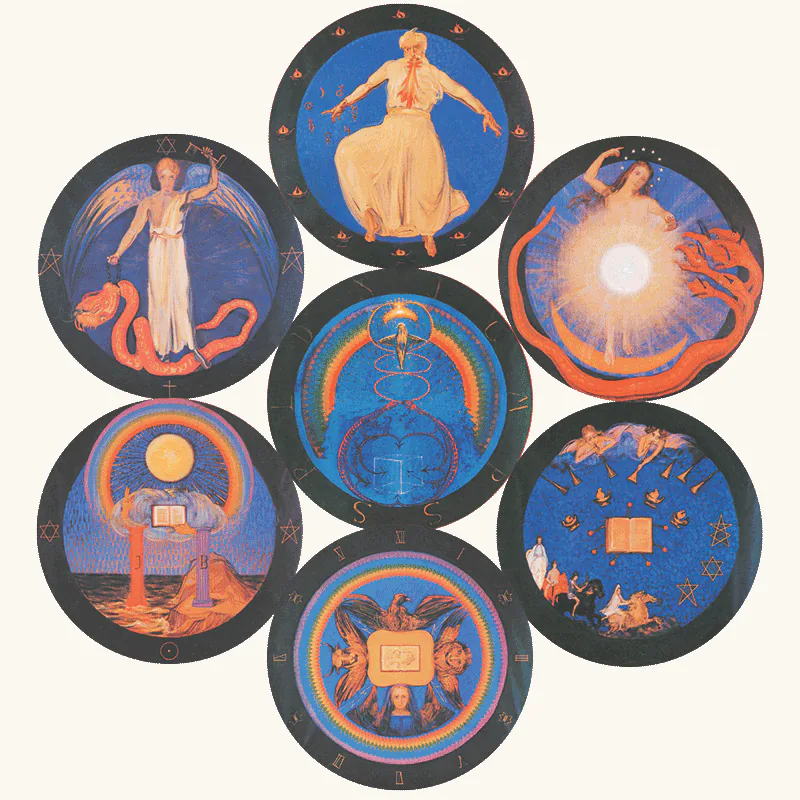
In 1888 three Freemasons, William Wynn Westcott, Samuel Liddell MacGregor Mathers and William Robert Woodman, founded the Hermetic Order of the Golden Dawn in London. It combined Kabbalah, astrology, tarot, alchemy, Egyptian symbolism, the Enochian system and Masonic-style initiation into a graded curriculum. The Golden Dawn's rituals, published by Israel Regardie in 1937–1940, became the foundation of most later ceremonial magic.
Methods and elements of ceremonial magic§
Although systems differ, ceremonial magic shares recurring features, described here historically:
- Purification and preparation — fasting, bathing, prayer and periods of abstinence, inherited from the grimoires.
- Sacred space — a consecrated temple or a drawn circle that marks the place of working and, in older texts, protects the magician.
- Consecrated tools — wand, cup, dagger and pentacle; robes, lamens and altars, each charged with symbolic meaning.
- Divine and angelic names — Hebrew names of God, angelic names and "barbarous words", vibrated or chanted.
- Correspondences — colours, incenses, metals, numbers and planetary hours chosen to harmonise every element of a ritual.
- Invocation and evocation — calling a divine force into oneself, or calling a spirit to appear outside the circle.
- Visualisation and meditation — inner work such as pathworking, astral travel and the "assumption of god-forms".
The symbolism of these elements is explored in ritual and symbolism in ceremonial magic, and the beings involved in angels and spirits.
The aims of high magick§
Older grimoires offer many practical aims: finding treasure, gaining favour, acquiring knowledge or binding spirits. The Renaissance and modern traditions, without abandoning practical work, place spiritual attainment at the centre. The Golden Dawn spoke of the aspirant's progress through the sefirot of the Tree of Life toward the divine; Crowley, drawing on the Book of Abramelin, made the "Knowledge and Conversation of the Holy Guardian Angel" the central goal of the adept. Many modern practitioners describe ceremonial magic as a disciplined path of self-knowledge and transformation comparable to mystical traditions. Scholars describe these aims descriptively, without endorsing claims about their results.
Ceremonial magic today and in scholarship§
Ceremonial magic continues in successor orders of the Golden Dawn, in Thelemic groups such as the A∴A∴ and Ordo Templi Orientis, and among many independent practitioners; it has also influenced Wicca, which adopted the magic circle and elemental tools, and chaos magick. See the guide to magical orders.
Academic interest has grown since the 1970s. Historians such as Richard Kieckhefer, Frank Klaassen and Claire Fanger have studied medieval ritual magic; Alex Owen's The Place of Enchantment (2004) placed the Golden Dawn in the context of modernity; and scholars of Western esotericism have treated ceremonial magic as a serious subject in religious history.
Frequently asked questions§
What is the difference between high magic and low magic?§
High magic refers to the learned, ritual tradition based on books, divine names and cosmological theory, often aimed at spiritual attainment. Low magic refers to practical folk magic such as charms, amulets and healing. The distinction is useful but historically fluid.
Why is magick spelled with a "k"?§
The spelling is an old variant revived by Aleister Crowley in the early twentieth century to distinguish ritual and spiritual magic from stage illusion. It is now common among Thelemites and many other occultists.
Is ceremonial magic the same as the Golden Dawn?§
No. The Golden Dawn is the most influential modern ceremonial order, but ceremonial magic is older and broader, including medieval grimoire magic, Renaissance occult philosophy, Enochian magic, Thelema and many independent practitioners.
Is ceremonial magic a religion?§
It is usually practised as a spiritual discipline rather than as a religion in itself, and practitioners come from many backgrounds. Some forms, such as Thelema, are organised as religious movements, while others are framed as esoteric philosophy.
Sources and further reading§
- Forbidden Rites: A Necromancer's Manual of the Fifteenth Century — Richard Kieckhefer, 1997
- Three Books of Occult Philosophy — Heinrich Cornelius Agrippa, 1533
- Transcendental Magic: Its Doctrine and Ritual — Eliphas Lévi, 1856
- The Golden Dawn — Israel Regardie, 1937
- The Magicians of the Golden Dawn — Ellic Howe, 1972
- The Place of Enchantment: British Occultism and the Culture of the Modern — Alex Owen, 2004
- Ritual Magic — E. M. Butler, 1949