Liber V · Chaos Magick · Chapter I: Chaos Magick
Chaos Magick: History, Sigils and Belief as a Tool
Chaos magick explained: Austin Osman Spare's sigils, Peter Carroll and the IOT, belief as a tool, gnosis, paradigm shifting and Grant Morrison's pop magic.
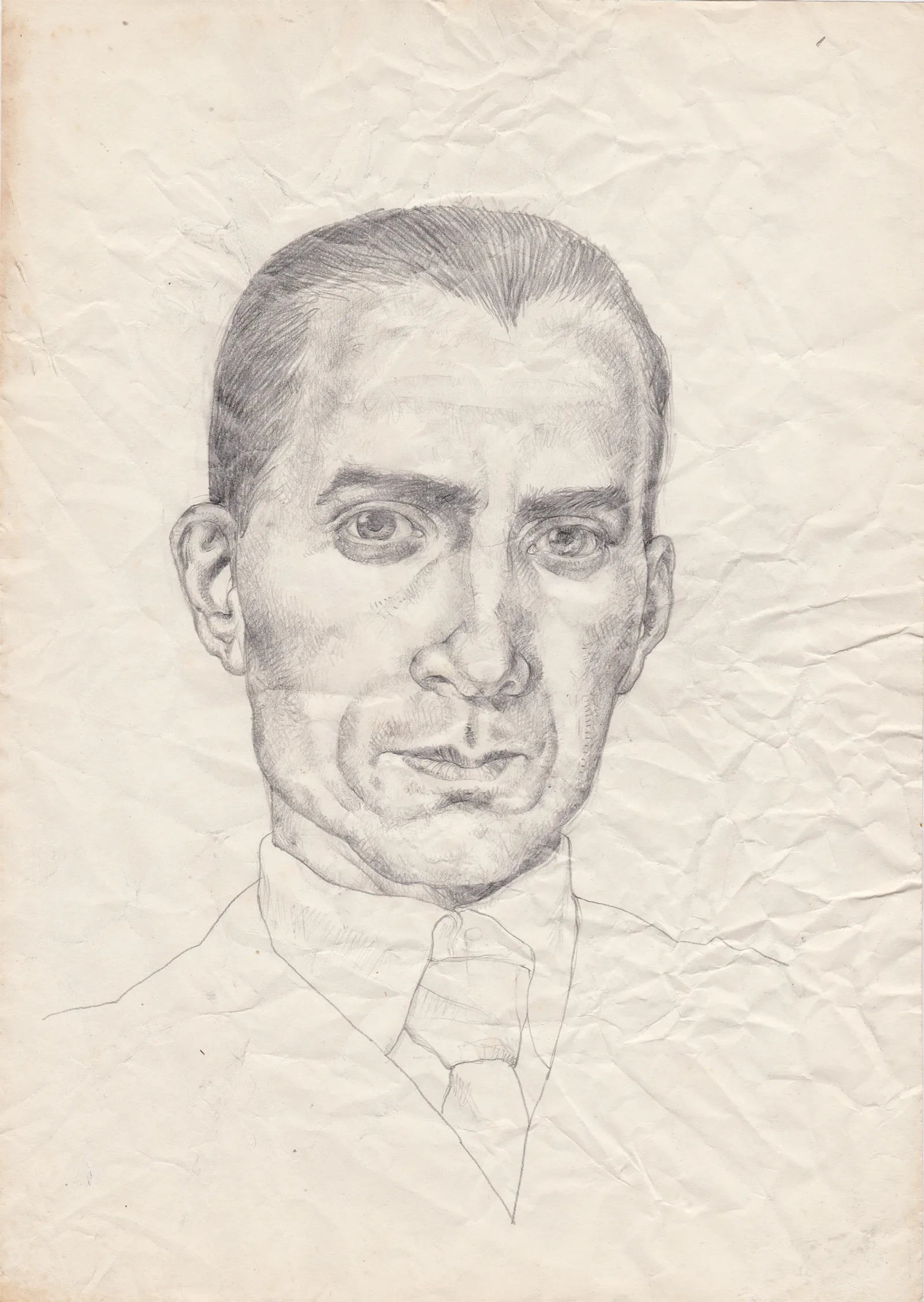
Chaos magick is a postmodern current of Western occultism, founded in England in the late 1970s, that treats belief itself as a tool: practitioners adopt and discard symbolic systems pragmatically, judging them by results rather than by claims to truth. Drawing on Austin Osman Spare's sigil technique and the writings of Peter J. Carroll and Ray Sherwin, it emphasises altered states ("gnosis"), experimentation and the freedom to borrow from any tradition, including fiction and popular culture.
Austin Osman Spare and the sigil§
The most important forerunner of chaos magick is Austin Osman Spare (1886–1956), a London artist of considerable talent who exhibited at the Royal Academy as a teenager and was briefly associated with Aleister Crowley's order the A∴A∴ around 1909–1910. Spare soon went his own way. In The Book of Pleasure (Self-Love): The Psychology of Ecstasy (1913) and later writings he developed a personal magical philosophy centred on "Kia," an undefinable absolute freedom, and on the "Zos," the body and mind as a whole.
Spare's lasting contribution was a method of sigils: a desire is written as a sentence, condensed into an abstract monogram, then charged in a state of emptied or exhausted mind and deliberately forgotten, so that the wish can sink into the subconscious without the interference of conscious lust for result. He also wrote of the "death posture," a practice of inducing a state of vacuity, and of an "alphabet of desire." His work was largely forgotten until the 1950s and 1970s, when Kenneth Grant, who knew Spare in his last years, published accounts of him in books such as Images and Oracles of Austin Osman Spare (1975). Through Grant, Spare's ideas reached the young magicians who would found chaos magick.
Peter Carroll, Ray Sherwin and the IOT§
In the mid-1970s Peter J. Carroll and Ray Sherwin, both connected with the alternative magazine The New Equinox, which Sherwin edited, began to articulate a new approach. Sherwin's The Book of Results (1978) offered a lucid account of sigil magic building on Spare. Carroll's Liber Null, first circulated in 1978 and later published with Psychonaut in a single volume in 1987, presented a training programme and a theory of magic stripped of what he considered dogmatic baggage.

In 1978 Carroll and Sherwin announced the formation of the Illuminates of Thanateros (IOT), a name joining Thanatos and Eros, death and love. Conceived as a loose network of magicians committed to results-based practice, it developed in the 1980s into a structured international organisation, often referred to as "the Pact," with grades and temples, especially in Britain, Germany and later elsewhere. Internal disputes in the early 1990s, sometimes called the "Ice Magick Wars," led to departures, including Carroll's own withdrawal from its leadership in the mid-1990s. The IOT continues to exist. Carroll's later books, such as Liber Kaos (1992), extended his ideas into speculative physics and a "chaos" cosmology.
Other figures helped define the current: Phil Hine, whose Condensed Chaos (1995) became a standard introduction; Lionel Snell, writing as Ramsey Dukes, whose SSOTBME (1974) influenced the movement's philosophy; and the British band and network Thee Temple ov Psychick Youth, founded around Genesis P-Orridge in 1981, which spread sigil practice through the music and art underground.
Belief as a tool: the philosophy of chaos magick§
Chaos magick's most distinctive principle is that belief is a tool. Instead of committing to one religion or magical system as true, the chaos magician adopts a belief deliberately and fully for a period, uses it to achieve a result or experience, and then sets it aside. The slogan "nothing is true, everything is permitted," borrowed via William S. Burroughs from legends of the medieval Nizari Ismaili leader Hassan-i Sabbah, was taken up as a motto, though practitioners interpret it in varied ways.
This stance is often compared with postmodern philosophy, and scholars such as Hugh Urban and Egil Asprem have discussed chaos magick as a characteristically late modern response to the plurality of worldviews. It shares with Crowley's Thelema an emphasis on individual will and experimentation, and with the Golden Dawn a reliance on correspondence and ritual, but it treats symbols as arbitrary and interchangeable rather than as fixed keys to a hidden cosmos. Chaos magicians also tend to prefer a psychological or "results-only" vocabulary, while some, especially Carroll, have proposed quasi-scientific models of how magic might work.
Gnosis and altered states of consciousness§
Chaos magicians use the word gnosis in a specialised sense quite different from that of ancient Gnosticism: it denotes an altered state of consciousness in which the conscious mind's "censor" is bypassed, allowing a magical intention to take effect. Carroll divided such states into two broad kinds. Inhibitory gnosis is reached through stillness, deep meditation, sensory deprivation or exhaustion, approaching Spare's "death posture." Excitatory gnosis is reached through arousal: drumming, dancing, chanting, hyperventilation, sexual excitation or intense emotion. Practitioners are generally advised to avoid methods that risk physical or mental harm, and many writers within the movement caution against using intoxicants or extreme techniques, especially by people with health conditions.
The sigil method described§
The sigil remains the emblematic chaos-magick technique and is widely described in the literature. In Spare's classic version, as later popularised, the practitioner first writes a statement of intent, phrased as a desire already fulfilled. Repeated letters are then removed, and the remaining letters are combined into a single abstract glyph, simplified until it no longer obviously reads as words. The sigil is "charged" by focusing on it while in a state of gnosis, after which it is destroyed or put aside and the magician deliberately tries to forget the intent, on the theory that conscious desire for the result obstructs it.
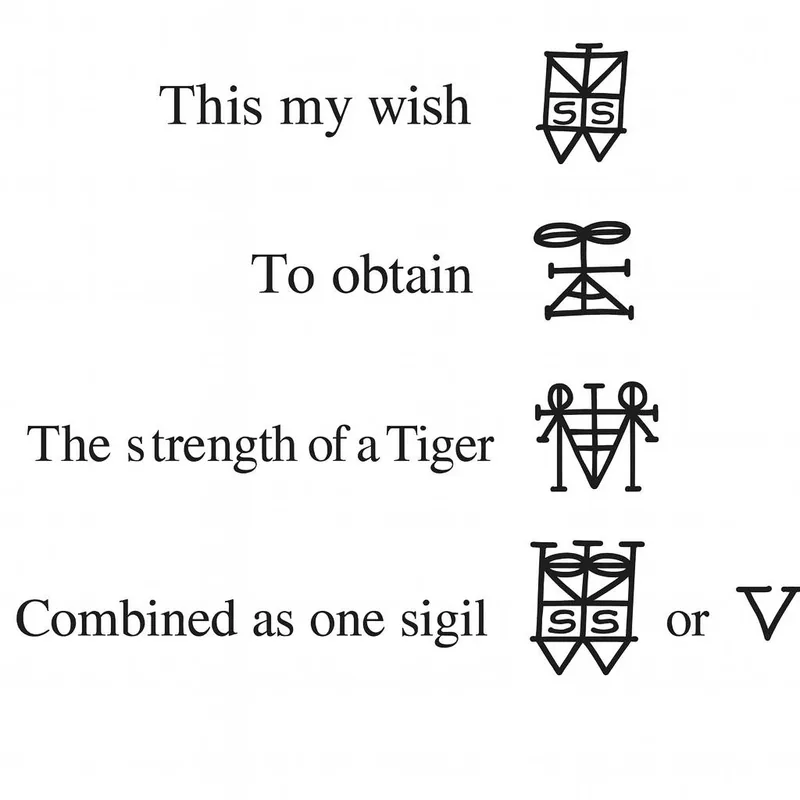
Variations include mantric sigils, in which the letters are rearranged into a nonsense chant, and pictorial sigils, in which the desire is expressed as a composite image. Grant Morrison later popularised the "hypersigil," a larger work of art or fiction designed to act as an extended sigil.
Paradigm shifting, servitors and borrowed pantheons§
Because belief is treated as instrumental, chaos magicians practise paradigm shifting: working for a time within a chosen framework, whether a classical pantheon, Voodoo, Lovecraftian fiction or a self-invented religion, then moving to another. Carroll's Liber Null recommended exercises such as adopting, for a period, beliefs contrary to one's own.
Related practices include creating servitors, artificial entities given a name, a sigil and a task, and working with deities drawn from fiction or popular culture. Critics within other occult traditions have objected that this approach can be shallow or appropriative, especially when living religious traditions are treated as interchangeable; chaos magicians reply that their method simply makes explicit what all magic involves.
Grant Morrison and chaos magick in the internet era§
The Scottish comics writer Grant Morrison brought chaos magick to a large audience. Their comic series The Invisibles (1994–2000), which Morrison described as a hypersigil, was saturated with occult ideas, and their widely circulated essay "Pop Magic!" (published in 2003 in the anthology Book of Lies, edited by Richard Metzger) presented sigils and "godforms" in an accessible, irreverent style. The comics writer Alan Moore, though not a chaos magician, also spoke publicly about his own magical practice from the 1990s.
From the 1990s onward, chaos magick spread through mailing lists, forums, blogs and later social media, becoming one of the most widely practised forms of modern magic among younger people. Its flexibility made it easy to combine with other currents, from ceremonial magic to modern witchcraft. Internet culture also produced phenomena described by participants as meme magic, a term popularised in political online subcultures around 2016, which many longstanding practitioners regarded as a distortion. Today chaos magick is less an organisation than a broad, eclectic sensibility, united by its pragmatism and its refusal of fixed dogma.
Frequently asked questions§
What is chaos magick in simple terms?§
Chaos magick is a modern approach to magic that treats beliefs and symbols as tools rather than truths. Practitioners use whatever system works for a given purpose, emphasising personal experiment, altered states and results.
Who founded chaos magick?§
Chaos magick is usually traced to Peter J. Carroll and Ray Sherwin, who founded the Illuminates of Thanateros in 1978 in England. Their work built on the sigil magic of the artist Austin Osman Spare.
Why is it spelled "magick"?§
The spelling "magick" was popularised by Aleister Crowley to distinguish his ritual practice from stage conjuring. Many chaos magicians adopted it, though others write simply "chaos magic."
What is gnosis in chaos magick?§
In chaos magick, gnosis means an altered state of consciousness used to bypass the conscious mind when charging a sigil or performing a ritual. It may be inhibitory, through stillness and meditation, or excitatory, through arousal such as drumming or dancing.
Sources and further reading§
- The Book of Pleasure (Self-Love): The Psychology of Ecstasy — Austin Osman Spare, 1913
- Liber Null & Psychonaut — Peter J. Carroll, 1987
- Liber Kaos — Peter J. Carroll, 1992
- The Book of Results — Ray Sherwin, 1978
- Condensed Chaos: An Introduction to Chaos Magic — Phil Hine, 1995
- Images and Oracles of Austin Osman Spare — Kenneth Grant, 1975
- Book of Lies: The Disinformation Guide to Magick and the Occult — Richard Metzger (ed.), 2003
- Magia Sexualis: Sex, Magic, and Liberation in Modern Western Esotericism — Hugh B. Urban, 2006