Liber V · Chaos Magick · Chapter I: Chaos Magick
Gnosis in Chaos Magick: Trance, Ecstasy and Altered States
Gnosis in chaos magick explained: inhibitory and excitatory states, Spare's death posture, Carroll's Liber Null, parallels in trance research and cautions.

In chaos magick, "gnosis" is the name for an altered state of single-pointed attention in which a magical act, such as charging a sigil, is believed to take effect. Peter J. Carroll's Liber Null (1978) divided it into inhibitory gnosis, reached through stillness and the quieting of the mind, and excitatory gnosis, reached through arousal, rhythm and intense emotion; the idea derives from Austin Osman Spare's teaching that desire must bypass the conscious mind.
What Chaos Magicians Mean by Gnosis§
The Greek word gnosis means knowledge, and in the history of religion it usually refers to the saving, revealed knowledge prized by the ancient Gnostics and by later mystical currents. Chaos magick uses the word differently. For Carroll and his followers, gnosis is not a body of knowledge but a condition of mind: a moment in which ordinary self-talk, doubt and analysis fall silent and attention is gathered into a single point.
The reason this state matters is theoretical. Chaos magick inherited from Spare the conviction that conscious desire is the enemy of magical success. When we want something consciously, we also doubt it, worry about it and imagine its failure; the mind's critical faculty, which Spare and later writers sometimes called the "psychic censor", blocks the intention from reaching the deeper levels where, they hold, magic operates. Gnosis is the state in which the censor is bypassed. A sigil, an invocation or a visualised image introduced at that moment is believed to lodge itself where conscious resistance cannot reach it. The same logic underlies the instruction to forget a sigil after charging it, described in Sigil Magic.
Chaos magicians interpret this mechanism in different ways. Some speak of the subconscious mind in psychological terms; others of spirits, energy or information, following the different "models" of magic distinguished by writers such as Frater U∴D∴. What they share is the practical claim that magic works best when the operator is not thinking about it.
Spare's Death Posture and the Roots of the Idea§
The deepest root of the concept is the work of the artist and magician Austin Osman Spare (1886–1956). In The Book of Pleasure (1913) Spare described what he called the "death posture", a set of practices for suspending ordinary consciousness. Among them were gazing at one's reflection until the sense of self dissolved, and holding the body in a strained position until exhaustion produced a blank, receptive state. He also wrote of "vacuity" and of a condition of "neither-neither", in which the mind refuses to settle on either term of any pair of opposites, and of the moment of sexual climax as a gateway in which a desire could be "sent" beneath awareness.
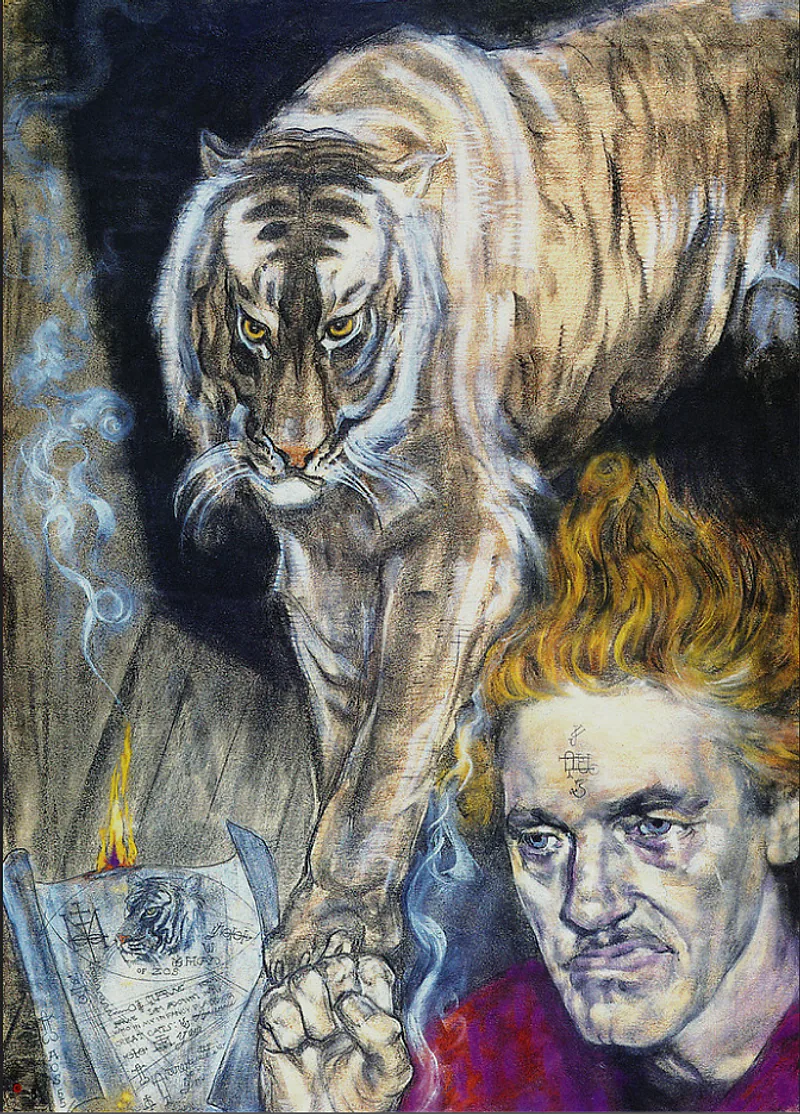
Spare's language was idiosyncratic, and he never set it out as a system. His ideas were transmitted to the post-war occult world chiefly by Kenneth Grant, who befriended him in the late 1940s and wrote about him extensively in the 1970s. Carroll, Ray Sherwin and their associates took Spare's scattered hints and turned them into a practical classification.
Other influences fed in. Aleister Crowley had combined yoga, ceremonial exaltation and sexual magic, and taught that the magician should work himself into a state of devotional ecstasy during invocation. The 1960s and 1970s brought widespread Western interest in meditation, Tantra and the psychology of altered states, and anthropologists' descriptions of shamanic trance were widely read. Chaos magicians absorbed all of this while insisting that the techniques could be separated from the religious systems in which they had developed.
Inhibitory Gnosis: Stillness, Concentration and Exhaustion§
In Carroll's classification, inhibitory gnosis is reached by reducing activity until the mind becomes still. The methods he and later writers list are familiar from many contemplative traditions:
- Concentration on a single object, image, sound or sigil, sustained until other thoughts fall away.
- Stillness of body, holding a posture without movement for long periods, as in seated meditation.
- Regulated breathing, slowed and made rhythmic.
- Sensory reduction, such as darkness or silence, which removes the usual distractions.
- Fatigue, the blank state that follows sustained effort or long wakefulness, which echoes Spare's death posture.
Carroll's training exercises in Liber Null were designed to build the capacity for this state gradually, through practice in sitting motionless, breathing evenly and stopping the flow of verbal thought. Readers will recognise kinship with techniques described in Meditation: A Complete Guide, although the purpose differs: in contemplative traditions stillness is usually a path to insight, liberation or union with God, whereas in chaos magick it is a means to make a specific intention effective.
Excitatory Gnosis: Dance, Rhythm, Emotion and Sexual Arousal§
Excitatory gnosis moves in the opposite direction. Here the mind is overwhelmed rather than quieted, so that ordinary thinking is swept away by intensity. The methods commonly cited include:
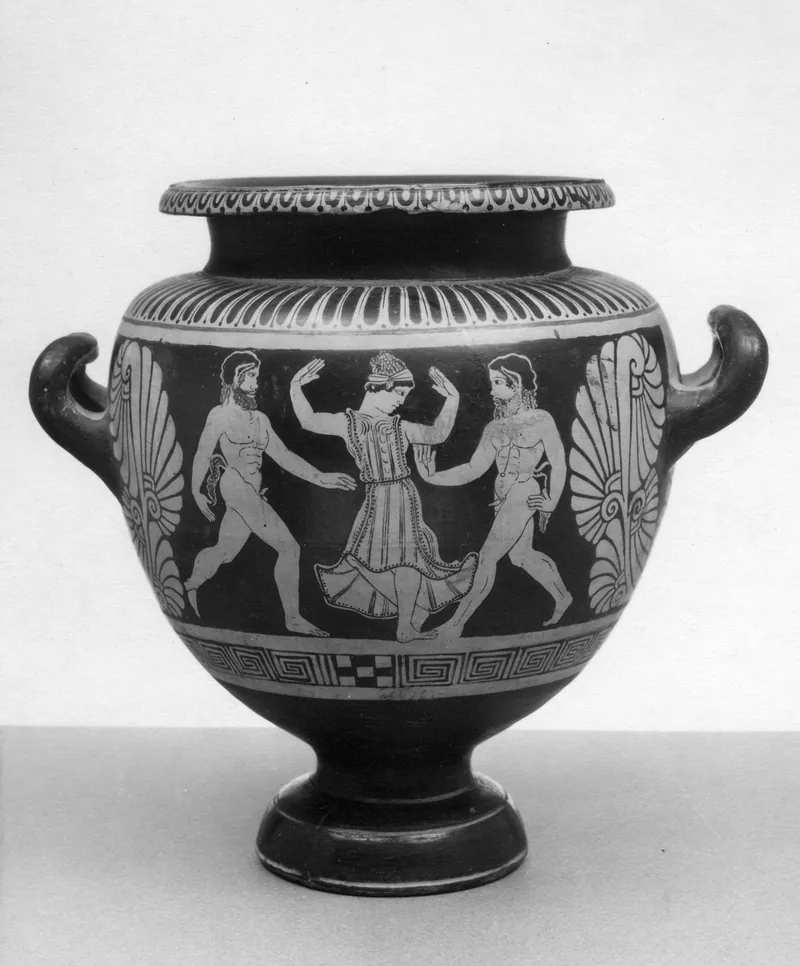
- Dance and spinning, sustained to the point of dizziness or abandon.
- Drumming, chanting and rhythmic music, often repetitive and accelerating.
- Strong emotion, whether laughter, anger, fear or grief, deliberately raised.
- Sexual arousal and climax, the method most directly inherited from Spare and from traditions of sex magick.
- Physical exertion and sensory overload, including heat, noise and light.
Group rituals in chaos magick often use excitatory methods, building rhythm and volume until a peak is reached and the shared aim is released. Writers such as Jan Fries, in Visual Magick (1992) and Seidways (1996), explored shaking, swaying and spontaneous movement as routes to trance, drawing on Northern European and other sources.
Some early chaos texts also listed intoxicants among the routes to gnosis. This site does not describe such methods; many later practitioners rejected them as unreliable and risky, and the cultural history of sacred plants is treated separately in the herbal section of this library.
Ecstasy and Trance in Comparative Perspective§
The division between quieting and arousing routes to altered states is not unique to chaos magick, and scholars arrived at similar distinctions independently. In 1971 the pharmacologist Roland Fischer proposed a "cartography" of states ranging from hyperaroused ecstasy to the deep calm of meditation, both ends of which he associated with loss of ordinary self-awareness. The ethnomusicologist Gilbert Rouget, in Music and Trance (French 1980, English 1985), contrasted "ecstasy", typically reached in silence, solitude and stillness, with "trance", typically reached through movement, noise and the presence of others. The parallel with inhibitory and excitatory gnosis is close, though Carroll's scheme was a practitioner's working tool rather than a product of fieldwork.
Religious history offers abundant examples of both routes. The whirling and rhythmic remembrance of God (dhikr) in some Sufi orders, described in Sufism, uses movement and repetition; the ecstatic rites of Dionysus in ancient Greece used music and dance; the trance practices studied under the name of shamanism frequently involve drumming. At the other pole stand the silent concentration of yogic and Buddhist meditation and the hesychast prayer of Eastern Christianity. Anthropologists such as Erika Bourguignon showed that institutionalised altered states are found in the great majority of human societies.
Chaos magicians tend to read this evidence as confirmation that the techniques are universal and detachable from their cultural setting. Many scholars would add a qualification: in each tradition the meaning of the experience depends heavily on the beliefs, expectations and community surrounding it. The anthropologist T. M. Luhrmann's research on magicians in London and on evangelical Christians suggests that practice and expectation shape what people actually experience, which fits the chaos magick view of belief as something cultivated.
Risks, Cautions and Criticisms§
Altered states are not harmless in every case. Prolonged sleep deprivation, fasting, hyperventilation and extreme exertion carry physical risks, and intense trance or dissociative practice can be destabilising for people with a history of psychosis, severe anxiety, trauma or dissociative conditions. Responsible authors in chaos magick, as in contemplative traditions, advise moderation, grounding afterwards, and stopping a practice that produces persistent distress. A parallel caution is familiar from discussions of kundalini yoga. Altered states of consciousness are no substitute for medical or psychological care.
Critics within the occult world have also argued that the chaos magick account of gnosis is too mechanical, reducing the rich spiritual contexts of trance to a switch for "loading" intentions. Defenders reply that this simplicity is deliberate: by naming the common element in many practices, the concept allows magicians to experiment freely and to compare results.
Frequently asked questions§
What is gnosis in chaos magick?§
It is a brief altered state of focused, thought-free attention in which a magical intention, such as a sigil, is charged. Chaos magicians believe that in this state the conscious mind's doubts are bypassed, allowing the intention to take effect.
What is the difference between inhibitory and excitatory gnosis?§
Inhibitory gnosis is reached by quieting body and mind through stillness, concentration and slow breathing. Excitatory gnosis is reached by overwhelming the mind through dance, rhythm, intense emotion or sexual arousal. Both aim at the same moment of single-pointed focus.
Is chaos magick gnosis the same as Gnosticism?§
No. Ancient Gnosticism used gnosis for revealed, saving knowledge about God and the soul. Chaos magick borrowed the word in the twentieth century for a psychological state, and the two have no historical connection beyond the shared Greek term.
Where does the idea of the death posture come from?§
The death posture comes from Austin Osman Spare's The Book of Pleasure (1913). Spare used the term for practices that suspend ordinary self-awareness, and chaos magicians later treated it as a classic form of inhibitory gnosis.
Sources and further reading§
- The Book of Pleasure (Self-Love): The Psychology of Ecstasy — Austin Osman Spare, 1913
- Liber Null & Psychonaut — Peter J. Carroll, 1987
- Condensed Chaos: An Introduction to Chaos Magic — Phil Hine, 1995
- Visual Magick: A Manual of Freestyle Shamanism — Jan Fries, 1992
- Seidways: Shaking, Swaying and Serpent Mysteries — Jan Fries, 1996
- Music and Trance: A Theory of the Relations between Music and Possession — Gilbert Rouget, 1985
- Religion, Altered States of Consciousness, and Social Change — Erika Bourguignon (ed.), 1973
- Persuasions of the Witch's Craft: Ritual Magic in Contemporary England — T. M. Luhrmann, 1989