Liber V · Chaos Magick · Chapter I: Chaos Magick
Phil Hine: Condensed Chaos, Servitors and Modern Chaos Magic
Phil Hine and chaos magic: Pagan News, Condensed Chaos (1995), Prime Chaos, servitors, The Pseudonomicon and his influence on later chaos magicians.

Phil Hine is a British occult writer whose books, above all Condensed Chaos: An Introduction to Chaos Magic (1995), made chaos magick accessible to a generation of readers in the 1990s and after. A co-founder of the magazine Pagan News, he wrote influential short works on servitors, invocation, Lovecraftian magic and modern shamanism, and he is widely regarded as the movement's most important popular interpreter after its founders.
Early Life and Path into Magic§
Hine grew up in the seaside town of Blackpool in north-west England and studied psychology and sociology, interests that remain visible in his writing. Like many British occultists of his generation he was drawn into magic in the late 1970s and early 1980s through a mixture of paganism, Crowleyan magick and the psychology of C. G. Jung, whose ideas about archetypes and the unconscious appear repeatedly in his early work.
During the 1980s he moved into the West Yorkshire scene in which chaos magick had been born a few years earlier through the work of Peter J. Carroll and Ray Sherwin. This milieu was informal and experimental: small groups met in private houses, exchanged duplicated papers and tried out rituals drawn from any source that seemed promising. Hine absorbed its pragmatic attitude while keeping a strong interest in pagan and shamanic practice, a combination that gave his writing its distinctive warmth and breadth.
Pagan News and the British Occult Press§
With the Thelemite writer and musician Rodney Orpheus, Hine co-founded and co-edited Pagan News, an occult newspaper of the late 1980s and early 1990s. It mixed news, polemic, humour, reviews and practical articles, and it gave space to pagans, Thelemites, chaos magicians and others who rarely appeared side by side. Its irreverent tone and its willingness to argue with established figures made it one of the most distinctive publications of the British occult scene in the period, which also saw intense public anxiety about alleged ritual abuse, described in The Satanic Panic. A selection from the paper was published in 2023 as Delinquent Elementals, edited by Hine and Orpheus.
Pagan News Publications also issued Hine's first books, a three-part series on Techniques of Modern Shamanism: Walking Between the Worlds (1986), Two Worlds and Inbetween (1989) and Touched by Fire (1989). These works approached shamanism as a set of techniques for trance and inner journeying that a Western practitioner might adapt, an approach then common in neo-shamanic circles and since criticised by scholars for detaching practices from their cultural contexts; the wider subject is discussed in Shamanism.
Condensed Chaos and Prime Chaos§
Hine's reputation rests mainly on his chaos writings of the early 1990s, first issued as pamphlets by the magazine Chaos International, which was closely connected with the Illuminates of Thanateros. Condensed Chaos appeared in pamphlet form in 1992 and was expanded into a book, Condensed Chaos: An Introduction to Chaos Magic, published in the United States by New Falcon in 1995. Prime Chaos (1993) followed as a companion volume focused on ritual, invocation and the construction of personal magical systems.
An attitude rather than a system§
The central argument of Condensed Chaos is that chaos magic is better understood as an attitude than as a body of doctrine. Hine presents it as an ongoing practice of self-experiment in which the magician learns to notice how belief, habit and perception shape experience, and then deliberately varies them. He discusses gnosis, sigils, banishing, invocation and evocation, divination and the use of different "paradigms", but always with an emphasis on reflection, humour and practical results rather than on grandiose claims. Compared with Carroll's austere Liber Null, the book is conversational and encouraging, and it addresses readers who may be working alone.
Hine also wrote frankly about the psychological hazards of magical practice, including obsession, inflation of the ego and the disorientation that can follow intense work with altered states and gnosis. His insistence on grounding, everyday competence and a sense of humour became part of the movement's self-image.
Servitors and the Pseudonomicon§
Two of Hine's shorter works had particular influence. Chaos Servitors: A User Guide (1991) systematised the creation of servitors, artificial entities designed for a specific task and given a name, a sigil and a defined "lifespan". The idea had older roots in Theosophical thought-forms and in occult notions of the egregore, but Hine's practical presentation made the servitor one of the signature techniques of chaos magic. The concept and its history are explored in Servitors and Egregores.
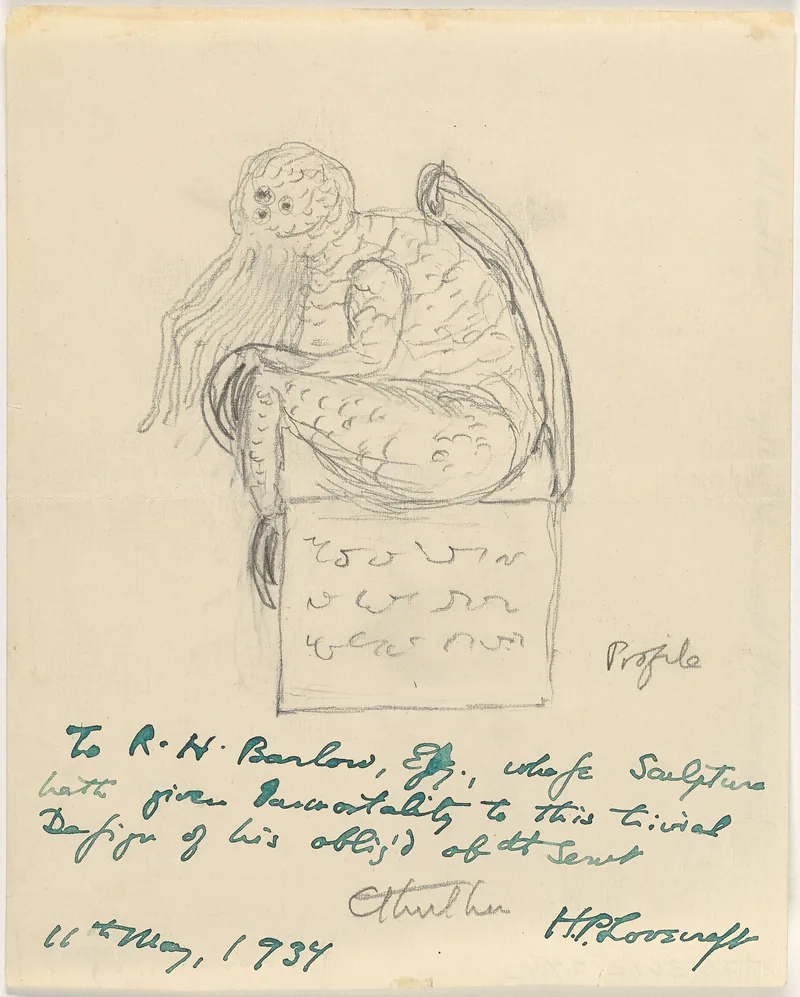
Hine also played a significant part in the development of Lovecraftian magic. He edited Starry Wisdom (1990), a collection of essays from the Esoteric Order of Dagon, a loose network of magicians working with the mythos of H. P. Lovecraft, and later wrote The Pseudonomicon (2004), which treats Lovecraft's entities as a framework for confronting fear, madness and the dissolution of the self. Like other chaos writers he was not claiming that Lovecraft's fiction recorded real beings; rather, he used it as a symbolic system that could be entered deliberately for its psychological effects, an approach discussed in Pop-Culture Magic.
Later Writing, Tantra and Scholarship§
From the mid-1990s Hine contributed to anthologies published by New Falcon, including essays on sexual magic from a chaos perspective and on the "serpent power" in Western tantric practice. He developed a long-standing interest in Indian religions, writing on Vaishnava devotion and on the history of tantra, and in later years has written and spoken about how tantric ideas and the chakras were received and reshaped in Western esotericism. These interests connect his work with the scholarly history traced in Tantra: History and Practice.
Based in London since the 1990s, he has taught workshops in Europe and North America and gathered many of his scattered essays in Hine's Varieties: Chaos and Beyond (2019). His later writing is more historical in tone, closer to the methods of academic religious studies than to the manifesto style of early chaos literature.
Influence and Assessment§
Hine's books arrived at a moment when chaos magic was spreading beyond its British origins through mail-order publishing and, soon afterwards, the early internet. Text versions of his pamphlets circulated widely online in the 1990s, and Condensed Chaos became, alongside Liber Null & Psychonaut, the book most often recommended to newcomers. His emphasis on servitors, invocation of any deity and playful self-experiment did much to define the popular image of chaos magic described in What Is Chaos Magick?.
Scholars of contemporary esotericism treat him as a key figure in the "second wave" of chaos magic, more personal and pluralistic than the founders and more attentive to psychology and community. Critics within the occult world have sometimes regarded his approach as too eclectic, but his writing is generally credited with making chaos ideas humane and practical. A survey of the movement's literature appears in Chaos Magick Books.
Frequently asked questions§
Who is Phil Hine?§
Phil Hine is a British occult writer who grew up in Blackpool and became involved in chaos magic in West Yorkshire in the 1980s. He co-founded the magazine Pagan News and wrote Condensed Chaos, Prime Chaos and The Pseudonomicon.
What is Condensed Chaos about?§
Condensed Chaos: An Introduction to Chaos Magic (1995) is a practical introduction that presents chaos magic as an attitude of self-experiment rather than a fixed system. It covers belief shifting, gnosis, sigils, servitors, invocation and the psychological risks of practice.
Did Phil Hine invent servitors?§
Not the underlying idea, which draws on older notions of thought-forms and egregores. His Chaos Servitors: A User Guide (1991) and later writings did, however, popularise the term and the practical method among chaos magicians.
What is The Pseudonomicon?§
The Pseudonomicon (2004) is Hine's book on magic using the fictional mythos of H. P. Lovecraft. It treats Lovecraft's entities as symbols for working with fear and the breakdown of ordinary identity, not as literal beings.
Sources and further reading§
- Condensed Chaos: An Introduction to Chaos Magic — Phil Hine, 1995
- Prime Chaos — Phil Hine, 1993
- The Pseudonomicon — Phil Hine, 2004
- Walking Between the Worlds — Phil Hine, 1986
- Delinquent Elementals: The Very Best of Pagan News — Phil Hine and Rodney Orpheus (eds), 2023
- Liber Null and Psychonaut — Peter J. Carroll, 1987
- The History of British Magick After Crowley — Dave Evans, 2007
- Contemporary Esotericism — Egil Asprem and Kennet Granholm (eds), 2013