Liber V · Chaos Magick · Chapter III: Magic & Culture
Alan Moore's Magic: Glycon, Promethea and Performance Workings
Alan Moore's magic: his 1993 turn to the occult, the snake god Glycon, Steve Moore, the performance workings, Promethea and the Bumper Book of Magic.

Alan Moore (born 1953), the English writer of Watchmen, V for Vendetta and From Hell, announced on his fortieth birthday in 1993 that he had become a magician, and since then magic has been central to his comics, novels and performances. He chose as his patron the Roman-era snake god Glycon, formed a performance group called The Moon and Serpent Grand Egyptian Theatre of Marvels, explored the Qabalah at length in Promethea and argued that magic and art are, in essence, the same activity.
The Decision of 1993§
Moore was born in Northampton on 18 November 1953 and became one of the most celebrated writers in English-language comics during the 1980s. By the early 1990s, having broken with the major American publishers, he was working on independent projects, including From Hell with the artist Eddie Campbell. Moore has said that he had long been interested in the occult and that, as he reached forty, he felt that the logical consequence of his work on language and imagination was to declare himself a magician. He did so publicly on his fortieth birthday in 1993, a gesture he has described as partly a mid-life commitment and partly a deliberate act of self-transformation.
His approach owed something to the climate of the time. Chaos magick had popularised the idea that any symbolic system could be used, and Moore's friend and fellow comics writer Grant Morrison was experimenting with similar ideas, as described in Hypersigils. Moore, however, has generally presented his magic in terms of art, history and personal experience rather than the techniques of any particular school, and he has kept his distance from organised occult groups.
Glycon and the Question of the Puppet God§
Moore's chosen deity is Glycon, a serpent god with a human-like head whose cult was founded in the second century AD by Alexander of Abonoteichus, in Paphlagonia on the southern shore of the Black Sea. The cult became popular across the eastern Roman Empire, and statues, coins and gems depicting Glycon survive; a well-known marble statue found at Constanța in Romania in 1962 shows the coiled serpent with long hair and human ears. Almost everything known about the founder comes from the satirist Lucian of Samosata, whose Alexander the False Prophet portrays him as a fraud who used a tame snake fitted with a linen head to deceive the credulous.
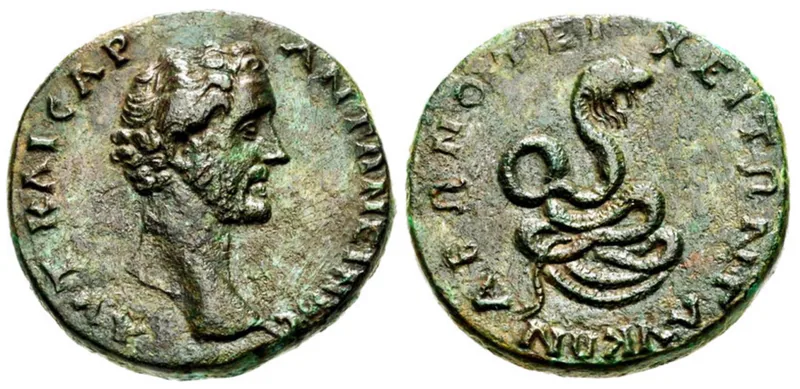
Moore has openly acknowledged that Glycon may have been a glove puppet. For him this is part of the god's appeal: if gods exist as ideas, then a god first presented through a puppet is no less real than any other, and the choice of a deity widely regarded as a hoax expresses his view that the objective status of gods is less important than their effect on the imagination. This attitude places Moore close to chaos magick's understanding of belief, while his reverence for Glycon is presented as sincere. The broader use of fictional and disputed deities is examined in Pop-Culture Magic.
Steve Moore and the Performance Workings§
Moore's closest magical companion was Steve Moore (1949–2014), no relation, a comics writer, Fortean researcher and scholar of Chinese divination whom Alan had known since his teens. Steve Moore's lifelong private devotion to the lunar goddess Selene was described by Alan in the long essay Unearthing (2006). Together they spoke of a magical order, The Moon and Serpent Grand Egyptian Theatre of Marvels, which functioned less as a lodge than as a framework for collaborative work.
The order's most visible activity was a series of spoken-word performances, staged with musicians including David J and Tim Perkins, which Moore called "workings". Beginning in 1994 with a performance under the order's name, they included The Birth Caul (1995), a meditation on childhood and memory written after the death of Moore's mother; The Highbury Working (1997), a psychogeography of a district of north London; Snakes and Ladders (1999); and Angel Passage (2001), on William Blake. Several were released as recordings, and Eddie Campbell adapted The Birth Caul and Snakes and Ladders into comics. In these works the ritual and the artwork are deliberately indistinguishable: the performance is itself the magical act.
Promethea and the Qabalah in Comics§
Moore's most extended exposition of magic is Promethea, published in thirty-two issues between 1999 and 2005 with art by J. H. Williams III. It begins as a superhero story about a college student who becomes the vessel of Promethea, a being of the imagination who has been incarnated through stories over centuries. It soon develops into something unique in mainstream comics: a sustained, visually inventive guide to Western esotericism.
In a celebrated sequence the heroine climbs the Tree of Life, with each issue devoted to one of the sefirot and drawn in a distinct style that reflects its traditional correspondences. Other issues present the tarot's major arcana as a history of the world, explain the Hermetic principle "as above, so below" and feature figures such as Aleister Crowley and the alchemists. The series closes with an apocalypse understood not as destruction but as a revelation in which the world of imagination and the material world are made visible together. For many readers Promethea was their first sustained encounter with the Qabalah and the history of tarot.
From Hell, Idea Space and the Theory of Magic§
Moore's occult thought appears throughout his other work. From Hell (serialised 1989–1996, collected 1999), with Eddie Campbell, reimagines the Whitechapel murders of 1888 as a ritual carried out by the royal physician William Gull according to an imagined Masonic and solar mythology, and it maps London's churches by Nicholas Hawksmoor as a hidden geometry, drawing on the poet Iain Sinclair's psychogeography. Moore's notes make clear that the Gull theory is a vehicle for ideas rather than a historical claim; the real history of the fraternity is treated in Freemasonry.
Moore has also developed a theory of "Idea Space", a shared realm of consciousness in which thoughts, stories and gods exist and can be explored, rather as one explores a landscape. In interviews and essays, notably the much-discussed "Fossil Angels" (written in the early 2000s), he has argued that magic, like art, consists in manipulating symbols, words and images to bring about changes in consciousness, adapting a definition by Crowley. In the same essay he criticised much contemporary occultism for relying on borrowed systems and outworn hierarchies instead of creating new work, a view that sets him apart from both traditional orders and some chaos magicians.
The Bumper Book of Magic and Later Work§
For many years Moore and Steve Moore planned a practical guide to magic intended to be accessible and visually rich. After Steve Moore's death in 2014 Alan completed it, and The Moon and Serpent Bumper Book of Magic was published in October 2024 by Top Shelf and Knockabout, with contributions by artists including Kevin O'Neill, Melinda Gebbie and John Coulthart. Modelled on the annuals of British childhood, it combines illustrated essays on the theory and history of magic, biographies of magicians from prehistory to modern times, a comic about Alexander of Abonoteichus, a tarot section and a pop-up "theatre" that serves as a portable shrine.
Moore's novels Voice of the Fire (1996) and Jerusalem (2016), both set in Northampton, extend his magical vision into literary fiction, treating his home town as a place where history, myth and the afterlife interpenetrate. Scholars of religion and popular culture, including those discussed in Magic and Culture, treat him as one of the clearest examples of how occult ideas moved from small esoteric circles into mainstream literature and art.
Frequently asked questions§
Is Alan Moore really a magician?§
Moore has described himself as a practising magician since 1993 and speaks of his magic seriously. He understands it chiefly as an art of working with language, symbols and consciousness, and he does not claim supernatural powers in any conventional sense.
Who is Glycon?§
Glycon was a snake god with a human-like head whose cult was founded in the second century AD by Alexander of Abonoteichus. The satirist Lucian claimed the god was a puppet, and Moore adopted him partly because that doubt illustrates his own view of how gods exist in the imagination.
What is Promethea about?§
Promethea (1999–2005) is a comic series by Moore and J. H. Williams III that grows from a superhero story into a guided tour of Western magic, including the Tree of Life, the tarot, alchemy and Crowley's Thelema.
What is the Moon and Serpent Bumper Book of Magic?§
It is an illustrated guide to magic by Alan Moore and Steve Moore, published in 2024, combining essays, biographies of magicians, comics, tarot and a pop-up shrine. Moore completed it after Steve Moore's death in 2014.
Sources and further reading§
- Promethea — Alan Moore and J. H. Williams III, 1999
- From Hell — Alan Moore and Eddie Campbell, 1999
- The Moon and Serpent Bumper Book of Magic — Alan Moore and Steve Moore, 2024
- Alexander the False Prophet — Lucian of Samosata, c. 180
- Magic Words: The Extraordinary Life of Alan Moore — Lance Parkin, 2013
- The Occult World — Christopher Partridge (ed.), 2015