Liber III · Black & White Magic · Chapter V: Necromancy
Necromancy in the Middle Ages: Demonic Magic and Its Books
Necromancy in the Middle Ages: its ancient roots, the Munich Handbook, the Sworn Book of Honorius, clerical magicians and the 1277 and 1398 condemnations.

In the Middle Ages, necromancy usually meant not raising the dead but conjuring demons through Latin ritual: prayers, divine names, circles and exorcistic commands drawn from the language of the Church. Practised mainly by literate clerics and students, it was recorded in manuals such as the fifteenth-century Munich Handbook and condemned repeatedly by theologians, most famously at Paris in 1277 and 1398.
Ancient Necromancy: Consulting the Dead§
The Greek word nekromanteia means divination by the dead. Its most famous literary model is the eleventh book of Homer's Odyssey, the Nekyia, in which Odysseus, on Circe's instructions, travels to the edge of the world, makes offerings and sacrifices, and speaks with the shade of the prophet Tiresias and with the ghosts of his mother and fallen comrades who come to drink the blood. Greek tradition also knew of oracles of the dead (nekyomanteia) at sites associated with entrances to the underworld, such as the river Acheron in Epirus and Lake Avernus near Cumae. Daniel Ogden's Greek and Roman Necromancy (2001) surveys this material and the difficulty of separating literary convention from actual cult.
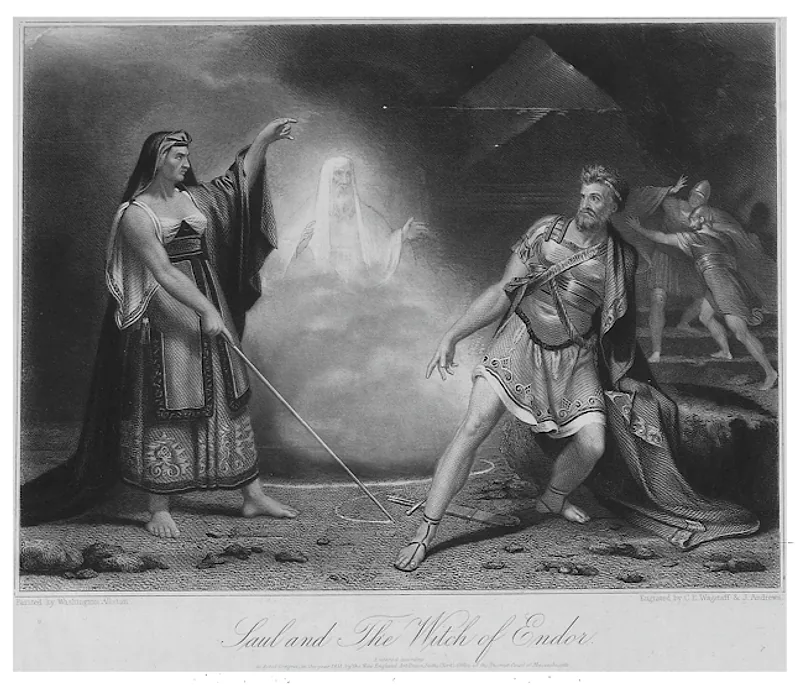
The Hebrew Bible preserves the most influential episode for later Christians. In 1 Samuel 28, King Saul, having banned mediums, seeks out "a woman that hath a familiar spirit at Endor" (KJV) and asks her to bring up the dead prophet Samuel, who foretells Saul's defeat. Patristic writers argued over whether Samuel truly appeared or a demon impersonated him, a debate that shaped medieval assumptions that necromancy really involved demons.
Roman literature dramatised the practice. In the sixth book of Lucan's Pharsalia, the Thessalian witch Erictho reanimates a corpse to prophesy the outcome of the civil war, a scene that became a model of horrific sorcery. The Greek Magical Papyri from Roman Egypt, dating mostly from the second century BCE to the fifth century CE, include rites that use the spirits of the untimely dead as agents, for instance in binding spells, as well as at least one procedure involving a skull. Here the dead serve less as oracles than as intermediaries for the practitioner's purposes.
From Necromantia to Nigromantia§
Isidore of Seville's seventh-century Etymologies still defined necromancers as those whose incantations seem to raise the dead to answer questions, and like Augustine he attributed such appearances to demons. Over the following centuries the Latin spelling nigromantia became common, as though the word came from niger, "black," and the meaning shifted. By the twelfth and thirteenth centuries "nigromancy" meant the learned conjuration of spirits, and the dead had largely disappeared from it. The broader history of this "black art" is told in our article on the history of black magic.
Several streams fed the new practice. Latin translations of Arabic works on astral and image magic, above all the Picatrix (Ghāyat al-ḥakīm), translated into Castilian under Alfonso X of Castile in 1256 and then into Latin, introduced techniques for drawing down the powers of planets and their spirits. Christian exorcism provided a ready-made vocabulary of adjurations by divine names. Solomonic legend supplied a figure who had famously commanded demons by God's authority, a tradition later developed in grimoires such as the Key of Solomon. Popular legend located schools of necromancy in Toledo and attached reputations for the art to learned men such as Michael Scot and, unfairly, Pope Sylvester II.
The Clerical Underworld of Medieval Necromancers§
The phrase "clerical underworld" comes from Richard Kieckhefer's Magic in the Middle Ages (1989). He argued that the necromancer was typically a cleric of some kind: a priest, monk, friar, university student or man in minor orders. Such men knew Latin, owned or copied books, and were familiar with liturgy, including the rite of exorcism, in which demons are commanded in God's name to depart. The necromancer's ritual inverted this procedure, commanding demons to appear and obey.
The stories bear this out. The Cistercian Caesarius of Heisterbach, writing in the 1220s, included anecdotes of clerics who practised necromancy. Trial records from the fourteenth and fifteenth centuries frequently involve chaplains, physicians and university men. A notable English case is that of Roger Bolingbroke, an Oxford cleric and astrologer executed in 1441 for treasonable magic linked to Eleanor Cobham, Duchess of Gloucester. Frank Klaassen and Sophie Page have shown that monastic and university libraries, such as that of St Augustine's Abbey in Canterbury, could hold ritual magic texts alongside works of theology and natural philosophy.
The Munich Handbook (Clm 849)§
The best-studied surviving necromancer's manual is a fifteenth-century Latin manuscript in the Bavarian State Library, Munich, catalogued as Clm 849. Richard Kieckhefer edited and analysed it in Forbidden Rites: A Necromancer's Manual of the Fifteenth Century (1997). The book appears to be the working collection of a cleric, probably in the German lands, and it consists of "experiments" (experimenta), the term the necromancers themselves used.

Kieckhefer grouped the experiments into three broad types. Illusionist experiments promised to produce apparitions, such as a banquet, a castle or a horse to carry the operator. Psychological experiments aimed to influence other people's minds, to win love or favour or to provoke hatred. Divinatory experiments sought hidden knowledge, often by scrying with a mirror, a fingernail or a polished surface, frequently with a young boy acting as the medium. The rites are saturated with liturgical language, including prayers, psalm-like formulas, names of God and invocations of saints, alongside the names of demons, circles, sacrifices and written seals.
For historians, the Munich Handbook is valuable because it shows how a practitioner combined material from different sources, how thoroughly necromancy borrowed from ecclesiastical ritual, and how its goals mirrored the anxieties and desires of its milieu. It does not represent a unified doctrine but a working miscellany.
The Sworn Book of Honorius and Angelic Magic§
The Liber iuratus Honorii, or Sworn Book of Honorius, is a ritual text attributed to Honorius, son of Euclid, of Thebes, who is said to have compiled it at a council of magicians threatened with persecution. It is usually dated to the thirteenth or early fourteenth century; the oldest surviving manuscript, in the British Library's Sloane collection, dates from the fourteenth century, and a trial record of 1347 provides one of the earliest secure references. Gösta Hedegård published a critical edition in 2002.
The book's central aim is spiritual rather than coercive: a long sequence of prayers, purifications and fasting intended to bring the practitioner to a vision of God, alongside operations involving angels, planetary spirits and demons. Robert Mathiesen has highlighted this pursuit of the beatific vision. In this respect it stands close to the Ars Notoria, the Solomonic art of obtaining knowledge through prayers and figures. Such texts show that medieval practitioners did not always see themselves as diabolists; many understood their work as devout, a self-image theologians firmly rejected.
Condemnations of Necromancy: 1277 to 1398§
Church authorities responded in increasingly systematic terms. On 7 March 1277 Étienne Tempier, Bishop of Paris, condemned 219 philosophical and theological propositions. His preface also condemned books, rolls or quires of necromancy, experiments of sorcery, invocations of demons and conjurations endangering souls.
Pope John XXII, deeply concerned about magical plots against him, consulted theologians in 1320 on whether invoking demons constituted heresy. His bull Super illius specula, usually dated to around 1326, declared that those who made pacts with demons, made images to bind them, or sought their help were to be excommunicated. The Catalan inquisitor Nicholas Eymerich's Directorium inquisitorum (1376) argued that invocation involving worship or reverence toward demons was heretical and so fell under inquisitorial jurisdiction.
The culmination came on 19 September 1398, when the theology faculty of the University of Paris, led by its chancellor Jean Gerson, issued a determination condemning twenty-eight articles. These rejected the claims that magic using holy words and prayers was licit, that demons could be compelled by God's names without a pact, and that good ends justified invoking spirits. Jean-Patrice Boudet and Michael Bailey have shown how such texts drew learned magic into the emerging category of diabolical witchcraft that fuelled the later European witch trials.
Renaissance Continuities§
Necromancy did not vanish with the Middle Ages. The texts were recopied, rearranged and printed. The Heptameron, attributed to the physician Peter of Abano, appeared in print in the sixteenth century; the third book of Agrippa's Three Books of Occult Philosophy (1533) addressed ceremonial magic; and the spurious Fourth Book, printed under Agrippa's name in 1559, offered practical conjurations. The Key of Solomon took shape in Renaissance Italy, and the seventeenth-century Lesser Key of Solomon catalogued the seventy-two spirits of the Ars Goetia.
The goldsmith Benvenuto Cellini left a vivid account in his autobiography of a conjuration in the Roman Colosseum in the 1530s, led by a Sicilian priest, showing the clerical model still alive. Frank Klaassen has argued that Renaissance learned magic transformed rather than abandoned its medieval inheritance, as humanists reframed old rites in Neoplatonic and Hermetic terms.
Frequently asked questions§
Did medieval necromancers try to raise the dead?§
Rarely. Although the word originally meant divination through the dead, medieval necromancy was overwhelmingly concerned with summoning demons and spirits. Theologians generally held that any apparent ghost conjured by magic was a demon in disguise.
Who practised necromancy in the Middle Ages?§
Richard Kieckhefer's research suggests most practitioners were clerics or educated men who knew Latin and liturgy, including priests, monks and students. Their training in exorcism provided the formulas they adapted.
What is the Munich Handbook?§
It is a fifteenth-century Latin manuscript in the Bavarian State Library (Clm 849), edited by Richard Kieckhefer in Forbidden Rites. It collects necromantic experiments for illusion, influencing minds and divination.
Why was the 1398 Paris condemnation important?§
The Paris theology faculty, under Jean Gerson, systematically rejected the arguments magicians used to defend their art, especially the claim that holy words could compel demons without a pact. It became an authoritative statement against learned magic.
Sources and further reading§
- Odyssey, Book 11 — Homer
- Pharsalia (Bellum civile), Book 6 — Lucan, first century CE
- Etymologies, Book 8 — Isidore of Seville, seventh century
- Liber iuratus Honorii: A Critical Edition of the Latin Version — ed. Gösta Hedegård, 2002
- Magic in the Middle Ages — Richard Kieckhefer, 1989
- Forbidden Rites: A Necromancer's Manual of the Fifteenth Century — Richard Kieckhefer, 1997
- Conjuring Spirits: Texts and Traditions of Medieval Ritual Magic — ed. Claire Fanger, 1998
- Greek and Roman Necromancy — Daniel Ogden, 2001
- Entre science et nigromance — Jean-Patrice Boudet, 2006
- The Transformations of Magic — Frank Klaassen, 2013
- Magic in the Cloister — Sophie Page, 2013