Liber III · Black & White Magic · Chapter V: Necromancy
The Witch of Endor: Saul, Samuel and Necromancy in the Bible
The Witch of Endor in 1 Samuel 28: Saul's night visit, the raising of Samuel, the Hebrew terms for necromancy and centuries of debate over the apparition.

The "Witch of Endor" is the woman in 1 Samuel 28 whom King Saul consults on the eve of his last battle, asking her to bring up the dead prophet Samuel. The Hebrew text never calls her a witch: it describes her as a woman who has an ʾôb, a means of contacting the dead, and it is the only detailed scene of necromancy in the Hebrew Bible. Whether Samuel truly appeared, or a demon or a trick deceived the king, has been argued by rabbis, Church Fathers, Reformers, witch-hunters, sceptics and Spiritualists for more than two thousand years.
The Story of Saul at En-dor in 1 Samuel 28§
The narrative is set at the end of Saul's reign. The Philistines have mustered at Shunem and Israel is encamped on Mount Gilboa. The writer reminds the reader that Samuel is dead and that Saul himself had driven out of the land "those that had familiar spirits, and the wizards" (28:3, KJV). Frightened by the size of the enemy army, Saul seeks the will of God through the channels the text treats as legitimate, dreams, the priestly lot called Urim, and prophets, but receives no answer.
He then asks his servants to find a woman who possesses an ʾôb, and they name one living at En-dor, a village north of Gilboa. Saul disguises himself and goes to her by night with two companions. The woman protests that the king has cut off such practitioners and suspects a trap; Saul swears by the LORD that she will not be punished and asks her to bring up Samuel. When she sees the figure she cries out, recognising at the same moment that her visitor is Saul. Asked what she sees, she says she sees elohim, "gods" or divine beings, coming up out of the earth, and describes an old man wrapped in a robe. Saul perceives that it is Samuel and bows down.
The dead prophet speaks directly to Saul, complaining at being disturbed. He repeats the judgement already pronounced in the story of the Amalekite war: the kingdom has been taken from Saul and given to David, Israel will be delivered to the Philistines, and "to morrow shalt thou and thy sons be with me." Saul collapses, having eaten nothing all day. The scene ends gently: the woman, whom the narrator never condemns, kills a fatted calf, bakes bread and feeds the king and his servants before they go out into the night. Chapter 31 describes Saul's death on Gilboa, and the Chronicler later gives the consultation as one reason for his fall (1 Chronicles 10:13).
Ob, Yiddeoni and the Hebrew Vocabulary of Necromancy§
The episode is framed by a set of legal prohibitions. Deuteronomy 18 lists, among practices the Israelites must not adopt from the nations, the "consulter with familiar spirits" (shoʾel ʾôb), the "wizard" (yiddeʿōnî) and the "necromancer", literally "one who inquires of the dead". Leviticus 20 prescribes death for a man or woman who has an ʾôb or yiddeʿōnî. Isaiah mocks those who consult "wizards that peep, and that mutter" (Isaiah 8:19), and the books of Kings record that Manasseh dealt with such practitioners while Josiah removed them.
The meaning of ʾôb is disputed. Some scholars have connected it with a Hittite and Mesopotamian word for a ritual pit through which offerings reached underworld powers, so that it would first denote the pit and only later the spirit speaking through it. Others understand it as the ghost of a dead person, and yiddeʿōnî, from the root "to know", as a "knowing one", either a spirit or its consultant. Isaiah's voices that mutter from the ground suggest that the dead were imagined speaking in thin, whispering tones.
The ancient translations shaped later readings. The Greek Septuagint rendered the woman as an engastrimythos, a "speaker from the belly", a term usually translated as ventriloquist, implying that the voice seemed to come from inside the medium. Jerome's Latin Vulgate made her a woman "having a python", borrowing the name of the serpent associated with Apollo's oracle at Delphi; the same Greek term appears for the slave girl with a spirit of divination in Acts 16. The English "witch" comes from the headings and commentary of later Bible translations rather than from the Hebrew itself, which is why critics such as John Webster in 1677 insisted she was "falsely called a Witch".
Necromancy in Ancient Israel and Its Neighbours§
The prohibitions show that consulting the dead was a known practice in Israel and Judah, not an imaginary foreign vice. Mesopotamian texts describe rites for raising a ghost, and Greek literature from the Odyssey onward knew oracles of the dead, a world surveyed by Daniel Ogden. Within Israel, scholars such as Brian B. Schmidt have debated how far necromancy was tied to a wider cult of the ancestors, and whether the biblical writers projected later Deuteronomic concerns back onto earlier periods.
The story of Saul is shaped by this polemic: it shows a rejected king turning to a forbidden channel after the legitimate ones fall silent. Yet the account concedes a great deal. The woman's craft appears to work, at least in the narrative; Samuel speaks, and what he says comes true. Esther J. Hamori and other recent scholars have drawn attention to the medium as one of several women in the Bible who practise recognised arts of knowledge, and to the narrator's sympathetic portrait of her hospitality.
Was It Really Samuel? Jewish and Early Christian Debate§
Rabbinic literature generally accepted that Samuel truly rose. The Mishnah defines the baʿal ʾôb as one who makes the dead speak from his armpit, and later midrash elaborated the scene: one tradition held that the medium sees the dead but does not hear them, while the inquirer hears but does not see, which explained why the woman had to describe the figure to Saul. Another identified the woman with the mother of Saul's general Abner. Such discussions, part of the wider world of Jewish magic and folklore, treated the passage as information about how necromancy worked rather than as illusion.
Among Christians the question became sharper. Justin Martyr in the second century cited the episode as evidence that souls survive death. Origen, in a homily on the chapter, defended the literal reading: Scripture says it was Samuel. Eustathius of Antioch replied that a demon had produced a phantom, since no demon could command a prophet's soul, a view Tertullian had already taken. Augustine wavered, leaving the matter open in one work while elsewhere noting that the book of Ecclesiasticus praises Samuel because "after his death he prophesied". Medieval theologians usually followed Augustine's caution, allowing that God might have permitted the real prophet to appear while insisting that no human art could compel him.
The Witch of Endor in the Early Modern Witchcraft Debate§
During the Reformation the passage acquired new stakes. Protestant theologians, who rejected purgatory, denied that the souls of the dead could return to the living, and therefore read the apparition as a devil in Samuel's shape. The Zurich minister Ludwig Lavater discussed Samuel at length in Of Ghostes and Spirites, arguing that what appears in such cases is a good or evil angel. King James VI, in his Daemonologie of 1597, granted that the woman saw something real but held that it was the devil in Samuel's likeness.
The sceptics read the story differently. Reginald Scot devoted a whole book of The Discoverie of Witchcraft to the "Pythonist of Endor", arguing that she was a cozener who used ventriloquism and confederates to deceive a desperate king, a reading discussed in our article on Reginald Scot. John Webster's Displaying of Supposed Witchcraft developed the same argument with Hebrew philology. Against them, Joseph Glanvill and Henry More, whose Saducismus Triumphatus defended the reality of spirits, treated the episode as scriptural proof that commerce with the invisible world was possible. Because laws against witches rested partly on biblical texts, the reading of 1 Samuel 28 was part of the wider argument behind the European witch trials.
Endor in Art, Spiritualism and Modern Culture§
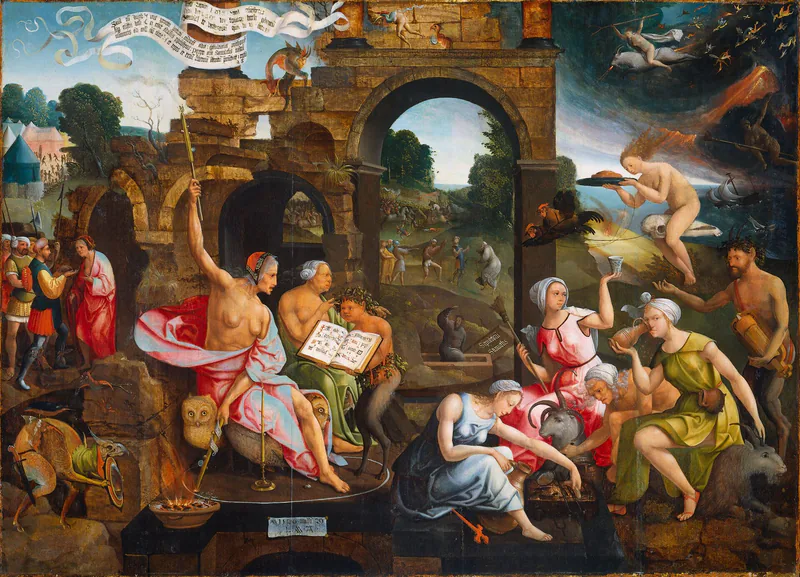
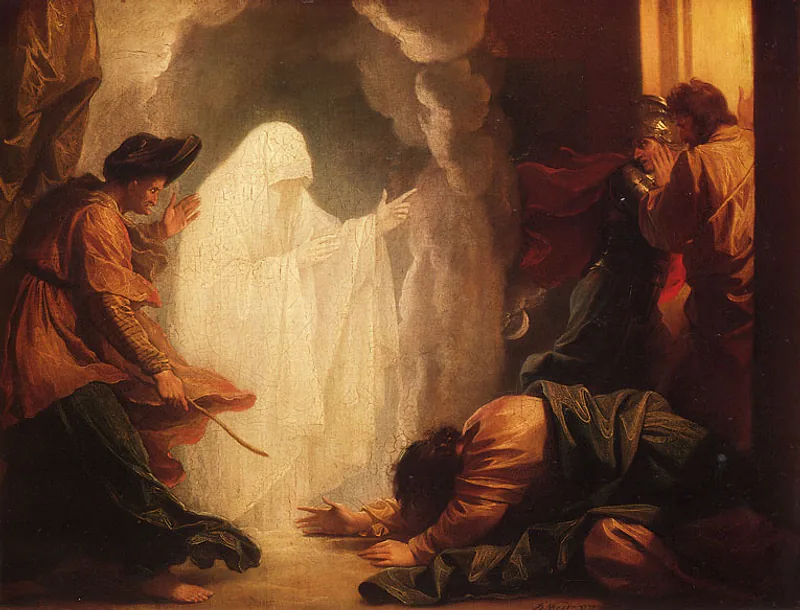
Painters found the scene irresistible. Jacob Cornelisz van Oostsanen's panel of 1526 surrounds the encounter with witches and monsters, Salvator Rosa's canvas of 1668 shows a gaunt Samuel rising amid skeletal attendants, and Benjamin West painted the subject in 1777.
In the nineteenth century the story was claimed by both sides of the debate over Spiritualism. Spiritualists cited it as evidence that the Bible itself recorded successful mediumship; their Christian opponents answered that mediumship was precisely what Deuteronomy forbade. After the First World War, when many bereaved families turned to séances, Rudyard Kipling's poem "En-Dor" (1919) used the old story as a warning. The episode remains the starting point for any history of ghosts and hauntings in the Jewish and Christian world, and for the learned art described in necromancy in the Middle Ages.
Frequently asked questions§
Does the Bible call her the Witch of Endor?§
No. The Hebrew text describes her as a woman who possesses an ʾôb, usually translated "familiar spirit". The title "Witch of Endor" comes from chapter headings and commentary in later translations and became fixed in English through usage. Several early modern writers objected to the label for that reason.
Did Samuel really appear to Saul?§
The narrative presents the apparition as Samuel, and his prophecy comes true. Interpreters have differed: most rabbis and Origen took it literally, Eustathius, Tertullian and most Protestant Reformers held that a demon impersonated him, and sceptics such as Reginald Scot argued that the woman staged a fraud.
Why did Saul consult a medium if he had banned them?§
The text explains that God no longer answered Saul through dreams, the Urim or prophets. The visit to En-dor dramatises his isolation: having lost every legitimate means of guidance, he turns to the practice he himself had outlawed, and the dead prophet only confirms his doom.
What happened to the woman of Endor?§
The Bible does not say. Later Jewish legend made her the mother of Abner, but there is no historical evidence for this.
Sources and further reading§
- The Holy Bible (King James Version) — Anonymous, 1611
- Israel's Beneficent Dead: Ancestor Cult and Necromancy in Ancient Israelite Religion and Tradition — Brian B. Schmidt, 1994
- Women's Divination in Biblical Literature: Prophecy, Necromancy, and Other Arts of Knowledge — Esther J. Hamori, 2015
- Greek and Roman Necromancy — Daniel Ogden, 2001
- Of Ghostes and Spirites Walking by Nyght — Ludwig Lavater, 1572
- Daemonologie — King James VI and I, 1597
- The Discoverie of Witchcraft — Reginald Scot, 1584