Liber III · Black & White Magic · Chapter VI: Protective Magic
Apotropaic Marks: Daisy Wheels, Hexafoils and Witch Marks
Apotropaic marks or witch marks: the daisy wheels, Marian VV and M symbols and taper burns cut into old houses, churches and caves, and what they meant.

Apotropaic marks, popularly called witch marks, are symbols scratched, cut or burned into the fabric of buildings, mostly between the fifteenth and eighteenth centuries, to keep witches, evil spirits and misfortune away. The commonest are the compass-drawn "daisy wheel" or hexafoil, letters invoking the Virgin Mary such as a double V or a stylised M, and teardrop-shaped scorch marks made with candle flames. They cluster at doorways, windows and fireplaces, the openings through which harm was believed to enter.
What Are Apotropaic Marks?§
The word apotropaic comes from the Greek apotrepein, "to turn away", and describes anything intended to avert evil. In the study of historic buildings it has come to mean a specific class of graffiti: small symbols, usually only a few centimetres across, deliberately added to stone, timber or plaster by people who believed that the building and its occupants needed protection. Architectural historians such as Timothy Easton began recording them systematically in England from the 1980s, and they have since been documented in thousands of buildings across Britain, Ireland, continental Europe and colonial North America.
Apotropaic marks belong to the broader archaeology of house protection, alongside witch bottles, concealed shoes and dried cats hidden in walls and chimneys, all described in the survey of protective magic. What distinguishes the marks is that they were visible, or at least accessible, parts of the structure. Some were cut by builders while a house was being framed; others were added later by occupants, sometimes repeatedly over generations, as fears of witchcraft, plague or fire rose and fell.
The Daisy Wheel and Other Compass-Drawn Marks§
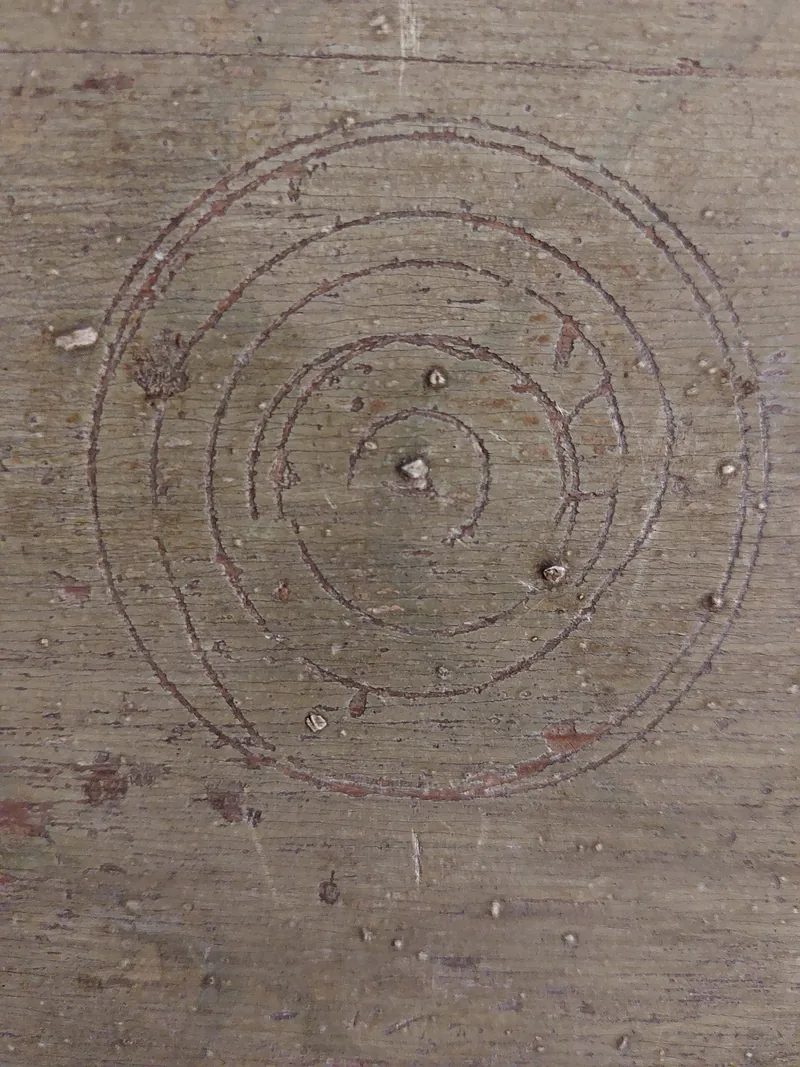
The most widespread mark is the hexafoil, often called a daisy wheel: a circle containing six overlapping petals, produced by keeping a pair of compasses at the same opening and stepping it round the circumference. The pattern is ancient and was not invented for magic. Six-petalled rosettes decorate Roman altars and many first-century Jewish ossuaries from Jerusalem, and the design appears on early medieval metalwork and furniture across Europe. Whether all of these carried a protective meaning is uncertain; in the buildings of late medieval and early modern Britain, however, the hexafoil's placement at entrances and hearths strongly suggests that it was used to guard them.
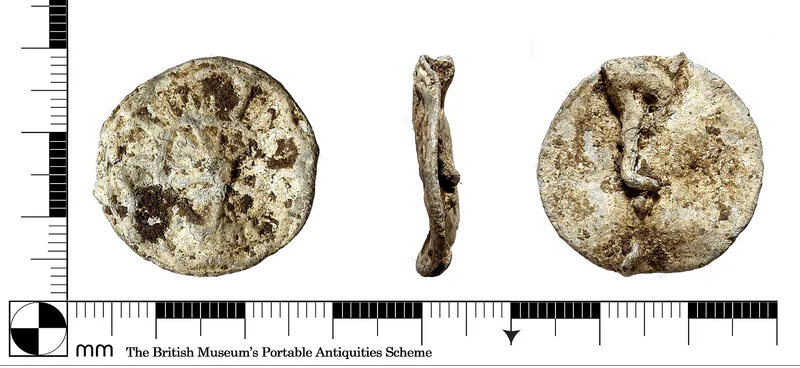
A popular modern explanation holds that the hexafoil works as an "endless line" in which evil spirits become entangled, unable to find a way out. This idea is a reasonable inference from comparable folk beliefs about knots and mazes, but it is not stated in any surviving early modern source and should be treated as a modern interpretation. Related compass-drawn forms include simple concentric circles, overlapping circles forming larger "flowers", and multiple hexafoils interlocking in a lattice. A modern reconstruction of the drawing method is given in the spellbook entry on the daisy wheel.
Marian Marks: VV, M and Sacred Letters§
A second large group consists of letters. The most common is a pair of conjoined Vs, often read as Virgo Virginum, "Virgin of virgins", a title of Mary; when one V is inverted over the other the result can resemble a W or an M. A stand-alone M, sometimes with a crown or cross, is read as Maria, and the ligature AM as Ave Maria. The sacred monogram IHS, for the name of Jesus, also appears, as do simple crosses.
These Marian marks reflect the late medieval devotion to the Virgin as a protector of households and travellers, and they are particularly common in churches and in buildings constructed before the Reformation. Their continued use in Protestant England, where devotion to Mary was officially discouraged, shows how protective habits could outlast the theology that first produced them. Some researchers argue that by the seventeenth century the letters had become conventional protective signs whose original meaning was no longer understood by those who cut them. A comparable development, in which religious formulas became charms in their own right, can be seen in the long history of the evil eye and its amulets.
Taper Burns, Meshes and Other Forms§
Many timber-framed buildings in England bear shallow, teardrop-shaped scorch marks on beams, doors and panelling, especially around fireplaces and stairs. For a long time these were assumed to be accidental burns from candles or rushlights. A study published in 2001 in the journal Vernacular Architecture, which included experiments in reproducing the marks, concluded that many had been made deliberately by holding a taper flame against the wood at an angle for some time. Their purpose remains debated: some historians see them as a protection against fire on the principle that like averts like, others as protection against lightning or witchcraft, and some suggest that they were simply made to test or commemorate a building.
Other recurring forms include grids or "meshes" of crossed lines, sometimes interpreted as nets to trap spirits; pentangles; and ladder-like patterns. Initials, dates and boards for games such as nine men's morris are also found among them, and distinguishing a protective mark from ordinary graffiti can be difficult. Comparable traditions of protective signs exist elsewhere, among them the Icelandic magical staves and the house blessings of Pennsylvania German powwow, though their histories are separate.
Where Marks Were Placed: Thresholds, Hearths and Caves§
The distribution of marks within a building is the strongest evidence for their function. They are concentrated at points of entry and transition: door frames, window mullions, the lintels and bressumers of fireplaces, the openings of chimneys, and the beams above beds. The same logic governed the placement of concealed objects, which were often hidden beside chimneys or under thresholds, and it echoes the much older Mediterranean belief that the boundaries of a house needed guarding.
Some finds have attracted wide attention. At Knole House in Kent, archaeologists in 2014 identified marks, including interlaced Vs and mesh patterns, cut around the fireplace and floor joists of a room apparently prepared for a visit by King James I; the timbers were dated by dendrochronology to about 1605–1606, prompting speculation about anxiety after the Gunpowder Plot. In 2019 cave surveyors at Creswell Crags, on the Derbyshire–Nottinghamshire border, recorded hundreds of marks, including Marian letters and hexafoils, in one of the caves, the largest concentration known in Britain. Medieval churches have yielded many more, recorded by projects such as the Norfolk Medieval Graffiti Survey; some marks on church fonts and porches suggest that protection was sought at the very threshold of sacred space. Historic England has invited members of the public to report examples, and collections such as the Museum of Witchcraft and Magic preserve related material.
How Scholars Interpret Ritual Protection Marks§
Interpreting the marks is difficult because no early modern manual or diary explains them. The people who cut them, often carpenters, masons and householders, left little written record of their beliefs, and the official literature of the period, from sermons to demonologies, was concerned with witches rather than with the small precautions people took against them. Historians therefore rely on context: repeated placement at vulnerable points, association with other protective deposits, and the general picture of early modern folk magic drawn from court records and cunning-folk manuscripts.
Caution is also needed in the opposite direction. Some compass-drawn circles were working lines used by builders to set out joints or arches, and Roman numerals cut by carpenters to match timbers can be mistaken for symbols. Matthew Champion and others have stressed that graffiti in churches includes prayers, memorials, ships, games and idle drawings, and that not every circle is a charm. The scholarly consensus is that a substantial number of marks were indeed protective, made by people who lived in fear of witchcraft as described in the history of maleficium and counter-magic, but that each mark must be assessed on its own evidence. Their study has helped historians recover a layer of everyday belief that written sources largely missed.
Frequently asked questions§
What is a daisy wheel mark?§
A daisy wheel, or hexafoil, is a six-petalled rosette drawn with compasses inside a circle. In historic buildings it is often found near doors, windows and fireplaces and is widely interpreted as a protective symbol. The design itself is much older and appears in Roman and early medieval decoration.
What does VV mean on old buildings?§
Conjoined Vs are usually read as Virgo Virginum, "Virgin of virgins", invoking the protection of the Virgin Mary. Similar Marian marks include a crowned M and the AM ligature for Ave Maria. They are common in churches and in houses built from the fifteenth to the seventeenth century.
Were burn marks on beams made on purpose?§
Many were. Experiments reported in 2001 showed that the teardrop-shaped scorches found on timbers are best explained by a flame held deliberately against the wood. Why they were made is still debated, with protection against fire, lightning and witchcraft all proposed.
When were witch marks made?§
Most surviving examples date from roughly the fifteenth to the eighteenth century, the period of strongest fear of witchcraft in Britain. Some church marks are medieval, and in rural areas the practice continued sporadically into the nineteenth century.
Sources and further reading§
- Magical House Protection: The Archaeology of Counter-Witchcraft — Brian Hoggard, 2019
- The Archaeology of Ritual and Magic — Ralph Merrifield, 1987
- Medieval Graffiti: The Lost Voices of England's Churches — Matthew Champion, 2015
- Physical Evidence for Ritual Acts, Sorcery and Witchcraft in Christian Britain: A Feeling for Magic — Ronald Hutton, 2015
- Religion and the Decline of Magic — Keith Thomas, 1971