The Spellbook · Witchcraft & Wicca
English Witch Bottle for Protecting a Home
How to make an English witch bottle to guard a home, with safe modern ingredients, the history of Bellarmine jugs and what archaeologists have found inside.
- TraditionEnglish cunning-folk and household counter-magic, c. 1600–1900
- ForProtection, Home & hearth
- DifficultySimple
- Time30 minutes, plus time to bury or conceal the bottle
- WhenTraditionally a waning moon; a Saturday is often preferred for works of guarding and closing

The witch bottle is the best-documented piece of household counter-magic in early modern England: a sealed vessel of pins, nails and personal matter hidden under a hearth or threshold to turn away witchcraft. Hundreds have been recovered by archaeologists, most from the seventeenth century, and the practice survived in some districts into the 1900s. The version below keeps the shape of the old working — sharp iron, a sealed vessel, a hidden place near the door or fire — while replacing the bodily ingredients with safe household ones.
How to do it§
- Choose the place first. Traditional bottles were buried beneath the hearthstone, under the threshold, or in a wall or chimney breast: the openings through which harm was thought to enter. In a modern home a flowerbed by the front door, a large planter on the step, or a cupboard close to the main entrance serves the same purpose.
- Prepare the vessel. Wash and dry a small bottle or jar. A brown stoneware bottle echoes the old "Bellarmine" jugs, but any sound glass jar with a lid will do.
- Bend the iron. Take each pin or nail and bend it with pliers. Bent pins were the commonest find in excavated bottles; folk explanation held that bending "killed" the pin for ordinary use and dedicated it to the work. Drop them in one at a time, naming aloud what you wish to keep out — quarrels, ill will, misfortune — rather than any person.
- Add salt and rosemary. Salt was the classic preservative and purifier in English folk practice; rosemary was planted by doors and carried for protection. Add a pinch of each.
- Write a short blessing. On the slip of paper write a line of your own, such as "May nothing that means harm cross this threshold," or a verse you hold sacred, such as Psalm 91, long read in Christian households as a psalm of protection. Fold it towards you and put it in.
- Add the liquid. The historical bottles contained the householder's urine; a safe and long-standing modern substitute is vinegar or red wine, enough to cover the pins.
- Seal it. Close the bottle tightly and seal the join with wax or bind it with red thread wound three times.
- Hide it. Bury it at least a spade's depth by the door, or place it at the back of the chosen cupboard. Say a short closing sentence, for example: "Keep this house and all who live in it."
- Leave it undisturbed. Tradition says the bottle works for as long as it stays whole and hidden. If it is ever broken or dug up, dispose of the contents with ordinary household waste (wrap the sharp metal), wash your hands, and make a new one if you wish.
Origins and history§
Witch bottles belong to a broader English culture of "counter-witchcraft": methods of identifying and defeating a witch believed to be causing illness, failed butter or sick livestock. Cunning-folk — paid local practitioners of healing, finding and protection — frequently recommended them. The physician-astrologer Joseph Blagrave, in his Astrological Practice of Physick (1671), describes stopping a patient's urine in a bottle with nails, pins and needles, and placing it near the fire, so that the witch would suffer until the spell was lifted. Joseph Glanvill's Saducismus Triumphatus (1681), available complete as /read/saducismus-triumphatus-1681, relates a similar case of a bottle being heated on the fire.
The logic was sympathetic: the urine was linked to the bewitched person and through them to the bewitcher, so the pins tormented the witch until the attack ceased. In other words, the historical bottle was not purely defensive. The adaptation above deliberately drops that retaliatory element and keeps only the guarding function.
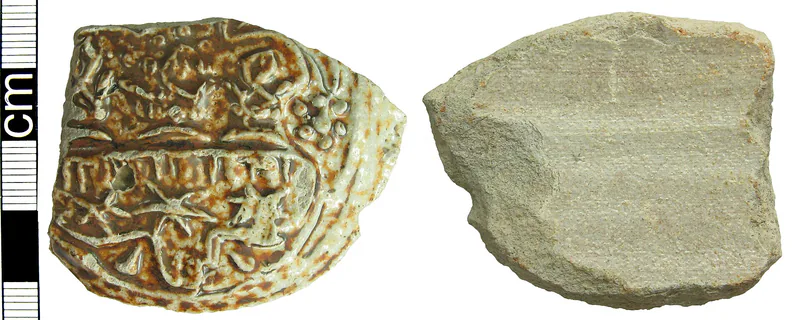
Many early examples are German salt-glazed stoneware jugs made at Frechen near Cologne and imported in large numbers, decorated with a bearded face; collectors call them Bellarmines, after Cardinal Robert Bellarmine, though the link is a later joke rather than a documented intention. From the eighteenth century glass phials and bottles became common. Ralph Merrifield's The Archaeology of Ritual and Magic (1987) first brought the finds together systematically, and Brian Hoggard's survey work has since recorded examples across England and a handful in North America.
The most thoroughly studied example is the Greenwich bottle, found in 2004 and analysed scientifically: it contained bent pins, nails, hair, nail clippings, urine and a small leather heart pierced by a nail. Such finds confirm that the textual recipes reflect real practice. As Owen Davies notes in his work on cunning-folk, the bottles were part of an ordinary, Christian, village worldview rather than a secret cult; see also protective magic and maleficium and protective magic.
Variations§
- Hearth bottles: placed in the chimney or behind the fireplace, where heat was thought to strengthen the working.
- Thread and hair bottles: some later bottles contain coloured threads, which some writers interpret as snares for spirits.
- American bottles: a small number found in Pennsylvania and New England show the custom crossing the Atlantic with settlers.
- Modern witchcraft: contemporary witches often fill bottles with broken glass, herbs and salt as general ward-jars, a practice that owes as much to twentieth-century books as to the archaeological record.
Safety and good sense§
- Bent pins, nails and glass are sharp. Wear gloves, keep them away from children and pets, and bury the bottle where nobody digs without warning.
- Do not use bodily fluids; vinegar or wine keeps the symbolism without the hygiene problem.
- If you light a candle while making the bottle, use a heat-proof holder and never leave it unattended.
- Do not dig into historic floors, walls or listed buildings; old bottles found in place should be reported to a local museum or finds officer, not removed.
- A charm is no substitute for locks, smoke alarms, or for legal or medical help if someone is threatening or harming you.
Sources and further reading§
- Popular Magic: Cunning-Folk in English History — Owen Davies, 2003
- The Archaeology of Ritual and Magic — Ralph Merrifield, 1987
- Magical House Protection: The Archaeology of Counter-Witchcraft — Brian Hoggard, 2019
- Religion and the Decline of Magic — Keith Thomas, 1971
- Saducismus Triumphatus — Joseph Glanvill, 1681