Hekate's Deipnon: The Household Supper at the New Moon
How Hekate's deipnon, the supper left for the goddess at the new moon, was kept in ancient Athens, and a modern household form of cleaning and offering.
- TraditionClassical Athens, 5th–4th century BCE; revived in modern Hellenic polytheism
- ForCleansing, Home & hearth, Protection
- DifficultySimple
- Time1–2 hours (cleaning and offering)
- WhenThe last evening of the lunar month, when the old moon has vanished, the night before the first crescent (noumenia)

The Hekatēs deipnon, "Hekate's supper", was a monthly offering of food set out by Athenian households for the goddess Hekate at the dark of the moon. It marked the end of the lunar month. The house was cleaned and its refuse removed, and a meal was left for the goddess of crossroads and thresholds, who was believed to watch over the boundaries between worlds and to lead the restless dead. Modern Hellenic polytheists have revived it as a monthly rite of household cleansing and protection.
How to do it§
This modern household form follows the ancient pattern of cleaning, offering and leaving, without the animal offerings sometimes mentioned in the sources.
- Find the date. Check a lunar calendar (see /almanac/moon) for the day of the new moon. The deipnon is held on the evening of the last day of the lunar month, before the first crescent appears.
- Clean the house. During the day give the home a thorough clean: sweep, dust, clear out spoiled food and things to be thrown away. In antiquity the remains of household purifications were carried out of the house at this time, so the month ends with a clean threshold.
- Gather the sweepings. Bag up the rubbish and sweepings and take them out of the house before the offering, as a symbolic removal of the month's impurities.
- Prepare the supper. On a small plate set out a simple meal: a piece of bread or a small round cake, an egg, a little cheese, a drizzle of honey. Eggs, cakes and cheese are among the foods mentioned in ancient sources.
- Make the offering. At dusk, take the plate to a place that marks a boundary: ideally a three-way crossroads, otherwise the front step or the edge of your property. Set it down. If you light a small lamp, stay with it. Speak a short address in your own words, for example (an original wording): "Hekate, keeper of the ways and the threshold, receive this supper. Guard this house and those who pass through its door, and let the old month go."
- Walk away. Turn and go back inside without looking back, a custom attested for several Greek rites to the powers of the underworld. The offering is not eaten by the household.
- Begin the new month. The next day, the noumenia, the first of the month, was a day of good omen for the household gods. Many modern practitioners make a fresh offering of incense or a lamp to the household shrine.
- Clear up responsibly. The next morning, remove any uneaten food from public places and dispose of it, or compost it if it was left on your own land.
Origins and history§
Hekate's suppers are mentioned several times in Athenian comedy of the fifth and fourth centuries BCE. In Aristophanes' Wealth (388 BCE), the character Poverty observes that the rich send a meal to Hekate each month while the hungry poor snatch it before it can be set down. That joke shows both how routine the custom was and that the food was left in the open. Other sources mention the shrines of Hekate that stood at crossroads and before house doors (hekataia). They record cakes, eggs and cheese among the offerings, and in some cases dogs, which were sacred to her.
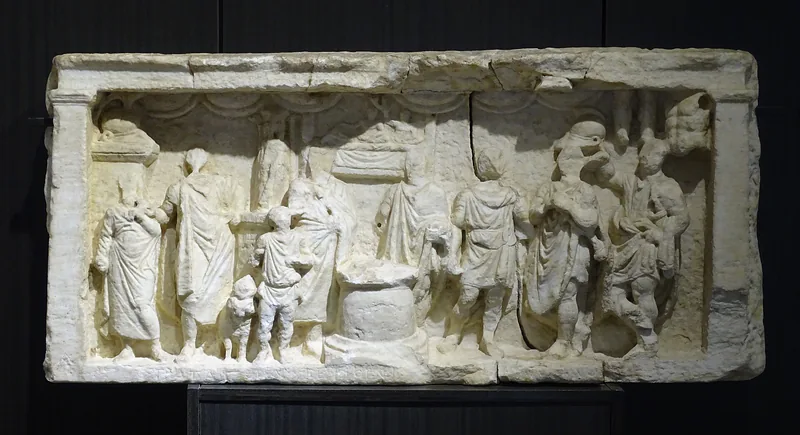
Scholars connect the deipnon with household purification. Robert Parker's study of Greek pollution shows how the refuse of purifications, called katharmata, was disposed of at crossroads, places that belonged to no one and to Hekate. Sarah Iles Johnston has argued that Hekate's role as leader of the restless dead (the aōroi, those who died too soon) explains the timing: at the dark of the moon, when boundaries were thought weakest, the household placated the goddess and the wandering dead in her train so that they would not trouble the home.
Hekate herself had a long and changing history. Hesiod's Theogony praises her as a great giver of blessings. In later antiquity she became a goddess of magic, and in the Chaldean Oracles a cosmic saviour. The deipnon reflects her older, everyday role as a guardian of entrances and crossings.
Variations§
Some modern practitioners hold the deipnon entirely indoors at the household shrine and dispose of the food outside later. Others add a purification with lustral water (khernips) or burn a little incense. Some combine the date with a monthly review of household accounts and affairs.
Safety and good sense§
Do not leave food where it will harm wildlife or pets, or where it breaks local littering rules; clear it the next day. Never leave a lamp or candle burning unattended outdoors or indoors. This is a rite of renewal and respect, not a substitute for repairs, security or professional help.
Sources and further reading§
- Hekate Soteira — Sarah Iles Johnston, 1990
- Restless Dead: Encounters between the Living and the Dead in Ancient Greece — Sarah Iles Johnston, 1999
- Miasma: Pollution and Purification in Early Greek Religion — Robert Parker, 1983
- Greek Religion — Walter Burkert, 1985
- Ancient Greek Religion — Jon D. Mikalson, 2005