The Spellbook · Indigenous & Ancient Religions
The Copal Incense Offering in Aztec and Maya Tradition
The copal incense offering of Aztec and Maya religion as colonial sources and archaeology describe it, why it is shown as history, and how copal is used now.
- TraditionMesoamerica: Aztec (Mexica) and Maya religion, Postclassic period (c. 900–1521) as described in colonial sources; continuing in living Indigenous practice
- ForBlessings, Cleansing
- Presented asHistory only
- WhenIn Aztec temples, at dawn, at intervals through the day and at night, and at the festivals of the 18 'months' of the solar year

Copal, the fragrant white resin of tropical trees, was the incense of ancient Mesoamerica. Aztec priests raised clouds of it before the gods at dawn and through the night. Maya lords burned it in bowls as they awaited the first sunrise of the world in the Popol Vuh. Archaeologists still find lumps of it, sometimes shaped into figures, in the buried offerings of the Templo Mayor in Mexico City. This entry describes the offering as the sources record it, and explains why it is presented as history.
Why this entry is historical§
Aztec copal offerings were part of a temple religion with its own priesthood, calendar and theology, which also included bloodletting and human sacrifice. That religion was suppressed after the Spanish conquest of 1521. Today copal is burned in many living Indigenous ceremonies, for example by Maya daykeepers (ajq'ij) in Guatemala, whose rituals belong to their communities and are learned from initiated elders. For both reasons this library describes the historical offering rather than giving instructions for it.
How it was done§
The Franciscan friar Bernardino de Sahagún, working with Nahua scholars in the mid-sixteenth century, recorded the following practices among others in the Florentine Codex.
- The resin. Copal (Nahuatl copalli) was tapped from trees of the genus Bursera and related species. It was traded and paid in tribute in large quantities as balls, bars and cakes wrapped in maize husks or leaves.
- The censer. Priests used a long-handled ceramic censer, often called a tlemaitl ("fire-hand"), its bowl pierced with openings and its hollow handle sometimes holding rattling pellets. Live coals were placed in the bowl and copal sprinkled on them.
- The offering to the directions. The priest raised the censer towards the four directions in turn, honouring the quarters of the world, and then before the image of the god, before throwing the coals into a brazier.
- The hours. Sahagún reports that temple priests offered incense at fixed times of day and night, and that each household also burned copal before its images and at its hearth, in the morning and evening.
- Festival offerings. At the great feasts of the eighteen twenty-day "months", copal was offered in quantity with flowers, food, rubber and other gifts. Rubber-spattered paper and copal were also burned together.
- Buried offerings. At the Templo Mayor, excavations since 1978 have uncovered offering caches containing copal figurines and lumps among shells, greenstone and other precious materials.
Origins and history§
The use of copal is very old in Mesoamerica. Censers and resin residues appear in Olmec and Classic Maya contexts long before the Aztec empire. Among the Classic Maya, whose inscriptions date from roughly 250 to 900 CE, kings are shown scattering offerings into braziers. The Maya word for incense, pom, survives in modern Maya languages. The K'iche' Maya Popol Vuh, written down in alphabetic script in the 1550s from older traditions, describes the ancestors unwrapping copal they had brought from the east and burning it as the first dawn broke. Smoke was understood as food for the gods and a bridge between earth and sky.
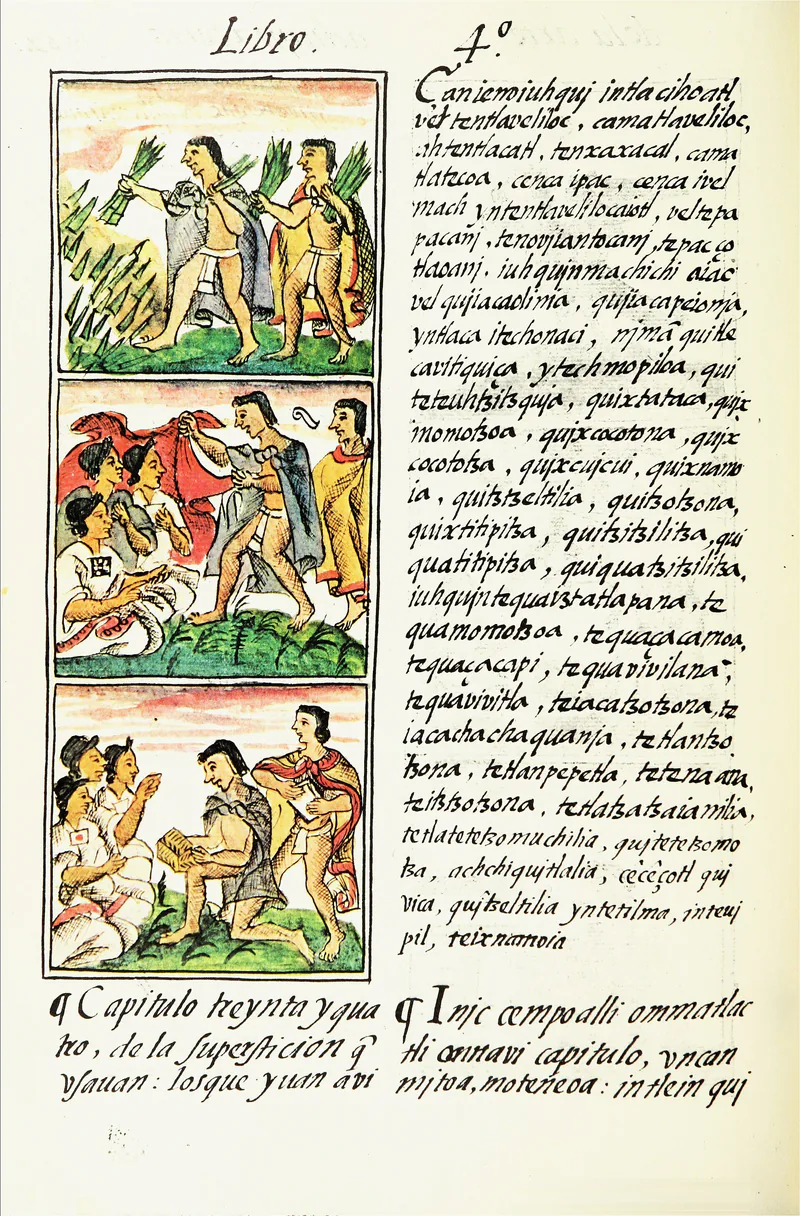
For the Aztecs, offering was a reciprocal duty. The gods had sacrificed themselves to set the sun in motion, and humans returned nourishment to them. Incense, flowers and song were among the gentler offerings in a system that also demanded blood. Miguel León-Portilla's study of Nahua thought emphasises the poetic and philosophical side of this religion, and Mary Miller and Karl Taube's dictionary describes the material culture of offering.
Copal outlived the conquest. Spanish clergy disapproved of its use before Indigenous images, yet it entered Mexican Catholic practice, where it is burned in churches, at shrines and in processions. Barbara Tedlock's study of K'iche' daykeepers in Momostenango shows copal offerings at hilltop altars as part of a calendar and divination system that survives today.
Variations§
In Mexico copal is widely burned on family ofrendas for the Day of the Dead (1–2 November) and in Catholic and folk healing practices, where it is regarded as purifying. This is a public, widespread folk custom. It is distinct from the ceremonies of Indigenous religious specialists, which should be approached only through invitation from the communities themselves.
Safety and good sense§
Copal is resin and burns hot and smoky. Anyone burning it on an ofrenda or elsewhere should use charcoal in a heat-proof censer on a stable surface, never leave it unattended, keep it away from paper decorations and marigolds, and ventilate well. People with asthma should avoid heavy smoke. When buying copal, prefer sustainably tapped resin.
Sources and further reading§
- Florentine Codex: General History of the Things of New Spain — Bernardino de Sahagún, trans. Arthur J. O. Anderson and Charles E. Dibble, 1950–1982
- The Gods and Symbols of Ancient Mexico and the Maya — Mary Miller and Karl Taube, 1993
- Aztec Thought and Culture — Miguel León-Portilla, 1963
- Popol Vuh: The Definitive Edition of the Mayan Book of the Dawn of Life — Dennis Tedlock (trans.), 1985
- Time and the Highland Maya — Barbara Tedlock, 1982
- The Great Temple of Tenochtitlan: Center and Periphery in the Aztec World — Johanna Broda, Davíd Carrasco and Eduardo Matos Moctezuma, 1987