The Spellbook · Indigenous & Ancient Religions
Day of the Dead Ofrenda: Building a Home Altar
How a Day of the Dead ofrenda is built and what each element means: photos, marigolds, water, salt, bread and candles, with the history behind the custom.
- TraditionMexico, colonial period to the present, joining Mesoamerican and Spanish Catholic customs
- ForBlessings, Peace, Home & hearth
- DifficultyModerate
- Time2–3 hours to build; kept from 31 October to 2 November
- WhenBuilt by 31 October; 1 November (Todos Santos) for children who have died, 2 November (All Souls) for adults; taken down on 2 or 3 November

The ofrenda is the home altar built for Día de Muertos, the Mexican days of the dead on 1 and 2 November. Families set out photographs, marigolds, candles, water, bread and the favourite foods of their dead, in the belief or hope that the departed return for a time to visit and enjoy the offering. It is first of all an act of remembrance and love; this page describes a household ofrenda in a way that respects its place as a living family and religious custom.
How to do it§
- Choose whom you remember. An ofrenda is personal: it honours your own relatives and friends who have died. Gather their photographs and think about what they loved — a dish, a song, a drink, a pastime.
- Set the table. Cover a table or a set of shelves with a cloth. Many families make two levels (earth and heaven), three (with the underworld or purgatory), or seven; a single surface is entirely acceptable. Place a cross or a saint's image at the top if your family is Catholic.
- Place the photographs. Arrange the pictures at the top or centre, where they can be seen from the room.
- Set the four elements. A glass of water quenches the thirst of travellers from the other world; salt purifies; candles light the way (often one for each person, or arranged in a cross); papel picado, the cut-paper banners, moves with the air and is often said to stand for wind. Bread and food represent earth.
- Add marigolds. Place vases of cempasúchil and scatter a path of petals from the door or the foot of the altar up to it, so the dead can follow its colour and scent home.
- Add the offerings. Put out pan de muerto, sugar skulls with names written on the foreheads, fruit, the dead person's favourite foods and drinks, and small personal objects. For children, families often add toys and sweets.
- Light and welcome. On the evening of 31 October or 1 November, light the candles and copal (in a heat-proof burner, with ventilation), and say the names of the dead aloud. Many say a rosary or other prayers; others tell stories about the people remembered.
- Share and close. On 2 November, or the day after, the family shares the food — it is commonly said that the dead have taken the essence and the living may now eat. Blow out the candles, give thanks, and take down the altar, keeping the photographs and returning flowers to the earth.
Origins and history§
Día de Muertos joins two calendars. The Catholic Church observes All Saints' Day (1 November) and All Souls' Day (2 November), on which Spanish custom included visiting graves, prayers for the dead and bread offerings. Pre-Hispanic Mesoamerican peoples also honoured the dead in seasonal festivals: the Franciscan friar Bernardino de Sahagún described Aztec feasts for the dead, sometimes called the "little feast" and "great feast of the dead", in his sixteenth-century Florentine Codex. How much of the modern festival continues those Indigenous rites, and how much grew from colonial Catholicism, is debated; anthropologist Stanley Brandes has stressed the Spanish and colonial roots of many elements, while others emphasise Indigenous continuity, especially in rural communities.
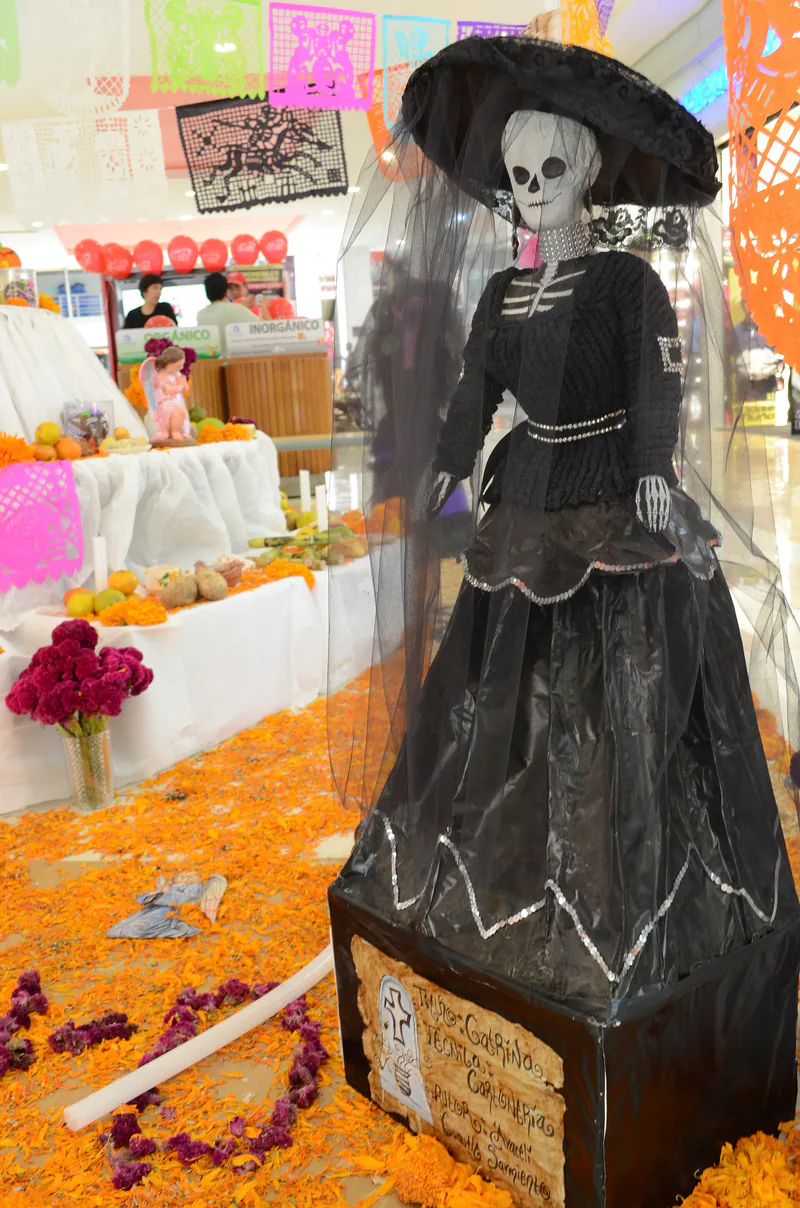
Many of today's most familiar images are recent. Sugar skulls derive from colonial sugar-craft; the elegant skeleton La Catrina comes from the printmaker José Guadalupe Posada (c. 1910) and was named and popularised by Diego Rivera's mural of 1947. In the twentieth century the Mexican state promoted Día de Muertos as a symbol of national identity, and in 2008 UNESCO inscribed "the Indigenous festivity dedicated to the dead" on its list of Intangible Cultural Heritage. Since the 1970s Chicano artists and communities have spread public ofrendas across the United States. See Mesoamerican religion and folk Christianity.
Variations§
In Michoacán, Oaxaca and elsewhere families keep vigil at decorated graves through the night. Some regions add arches of flowers or sugarcane over the altar, or include a mirror, a basin and towel so the visitors may wash. Public and school ofrendas honour notable people or victims of tragedy. Other cultures have their own remembrance customs, such as Chinese Qingming or Catholic All Souls' Masses; visitors to Mexican traditions are welcome to learn and remember their own dead, without wearing sacred or cultural dress as costume.
Safety and good sense§
Candles near paper banners, dried flowers and cloth are a serious fire risk: use stable holders on a non-flammable base, keep them well clear of papel picado, never leave them burning unattended or overnight, and consider battery candles. Burn copal only in a heat-proof dish with ventilation. Keep food and drink away from pets, and do not leave alcohol where children can reach it. Marigold sap can irritate some people's skin. Grief can be heavy at this season; remembrance rituals are no substitute for support from a counsellor or doctor when it is needed.
Sources and further reading§
- Skulls to the Living, Bread to the Dead: The Day of the Dead in Mexico and Beyond — Stanley Brandes, 2006
- Death and the Idea of Mexico — Claudio Lomnitz, 2005
- Day of the Dead in the USA: The Migration and Transformation of a Cultural Phenomenon — Regina M. Marchi, 2009
- Florentine Codex: General History of the Things of New Spain — Bernardino de Sahagún, c. 1577
- The Gods and Symbols of Ancient Mexico and the Maya — Mary Miller and Karl Taube, 1993