The Spellbook · Indigenous & Ancient Religions
Second Merseburg Charm: Bone to Bone, a Healing Blessing
The Second Merseburg Charm, 'bone to bone, blood to blood', as a spoken healing blessing for a sprain, with the tale of Wodan and Balder's foal.

The Second Merseburg Charm is one of only two pre-Christian charms surviving in Old High German. In a few lines it tells how Phol and Wodan rode into the wood, how Balder's foal wrenched its foot, how goddesses sang over it in vain, and how Wodan, "as well he knew how," charmed it whole: bone to bone, blood to blood, limb to limb. Its healing formula, with close relatives across Europe and in ancient India, has been spoken over sprains for over a thousand years. Here it is used as a blessing that accompanies proper first aid.
How to do it§
- Give first aid first. For a sprain or strain, rest the joint, apply a cold pack wrapped in cloth, support it, and raise it. If there is severe pain, deformity, inability to bear weight, numbness, or a wound, seek medical help at once.
- Prepare. Sit with the injured person (or yourself) in a quiet place. Wet your hands with clean water.
- Tell the story. Say in your own words the short tale of the charm: "Phol and Wodan rode to the wood. The foal of Balder wrenched its foot. Sinthgunt and Sunna sang over it; Frija and Volla sang over it; then Wodan sang over it, as well he knew how."
- Speak the formula. Laying your hands gently near (not on) the injury, speak the Old High German words, a short public-domain line: ben zi bena, bluot zi bluoda, lid zi geliden, sose gelimida sin — "bone to bone, blood to blood, limb to limb, as if they were glued." Repeat three times.
- Wrap it. Wind the strip of linen loosely around the support bandage or cold pack (never tightly around the joint), saying the English line once more.
- Close with thanks in your own words, to the gods named in the charm if you are a heathen, to God or the saints if you use the Christian version (see Variations), or simply to those who are caring for the injured person.
- Repeat the blessing each day while the injury heals, alongside whatever treatment it needs.
Origins and history§
The two Merseburg Charms were written, probably in the tenth century, on a blank leaf of a theological manuscript belonging to the cathedral chapter of Merseburg in Saxony. The historian Georg Waitz noticed them in 1841, and Jacob Grimm published them the next year, recognising their importance as rare witnesses to pre-Christian Germanic religion. The First Charm concerns the loosing of fetters by the Idisi, divine women; the Second is the horse-healing charm.
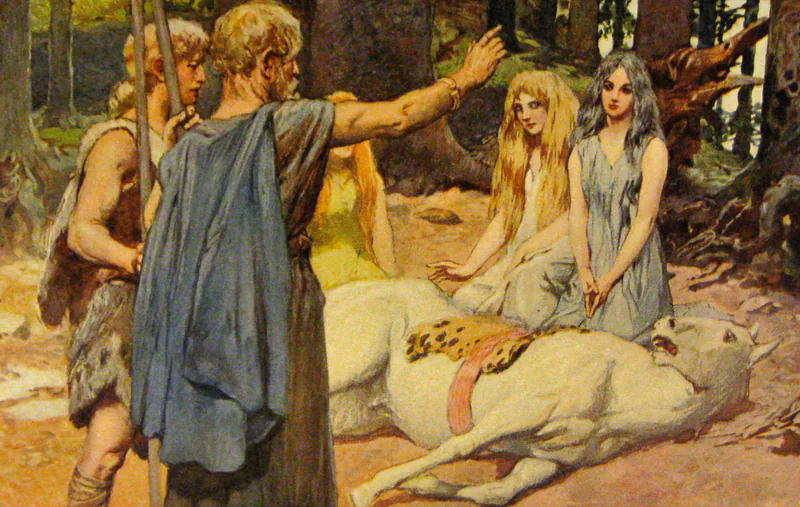
Its names have been much discussed. Wodan is the continental form of Odin; Frija is Frigg; Sunna is the sun personified; Balder appears to be Baldr. Phol is uncertain — perhaps another name for Balder, perhaps a deity otherwise unknown — and Sinthgunt and Volla are also obscure. The charm's structure — a short narrative of a divine precedent (historiola) followed by the healing formula — is shared with a great many European charms.
Comparative philologists have long noted that the formula has close parallels in other Indo-European traditions, most famously a hymn of the Atharvaveda (4.12) that joins marrow to marrow and bone to bone, and in Celtic and Baltic healing charms. Whether these share a common ancient ancestor or arise independently from the same practical image is debated.
The charm also survived by being Christianised. In later Germany, Scandinavia and Britain the same story is told of Christ riding and his foal (or horse) slipping, and the same "bone to bone" words follow. In Shetland and Orkney this version was spoken while a linen "wresting thread," tied with knots, was bound around a sprained limb, a custom recorded into the nineteenth century. See Norse and Germanic religion and folk magic.
Variations§
- Christian form: "Our Lord rode, his foal's foot slid; he lighted down and set it right, bone to bone, sinew to sinew," with the Trinity named at the end.
- The wresting thread: a linen thread with nine knots tied around the sprain as the words are spoken, from Shetland and Scotland; tie it loosely and never on broken skin or over swelling that is increasing.
- Heathen use: modern heathens use the charm in its original form as a prayer to Wodan and Frija.
- For animals: the original is a horse charm; it may be said by owners caring for an animal under a vet's treatment.
Safety and good sense§
- A charm is a blessing and comfort, not treatment. Possible fractures, dislocations, head or neck injuries, and any injury with severe pain or numbness need urgent medical care.
- Never bind anything tightly around an injured limb; swelling can cut off circulation. Cold packs should be wrapped in cloth and used for short periods.
- Treat injured animals with a vet's guidance.
- If you light a candle while saying the blessing, keep it in a safe holder and attended.
Sources and further reading§
- Norse Mythology: A Guide to the Gods, Heroes, Rituals, and Beliefs — John Lindow, 2001
- Magic in the Middle Ages — Richard Kieckhefer, 1989
- Anglo-Saxon Magic — Godfrid Storms, 1948
- How to Kill a Dragon: Aspects of Indo-European Poetics — Calvert Watkins, 1995
- Teutonic Mythology — Jacob Grimm, trans. James Steven Stallybrass, 1882–1888