Limpia con Huevo: The Curanderismo Egg Cleansing
The limpia con huevo of Mexican curanderismo: how the egg is passed over the body with prayer, how the egg in water is read, and the history of the practice.
- TraditionMexican and Mexican American curanderismo, colonial period to the present
- ForCleansing, Healing, Divination
- DifficultyModerate
- Time20–30 minutes
- WhenTraditionally on a Tuesday or Friday; whenever someone feels drained, frightened or 'out of sorts'

The limpia con huevo, or egg cleansing, is one of the best-known practices of curanderismo, the folk healing tradition of Mexico and Mexican American communities. A whole raw egg is passed over the body while prayers are said, in the belief that it absorbs negative energies, envy or the effects of mal de ojo (the evil eye) and susto (fright); the egg is then broken into a glass of water and its appearance read. Traditionally it is performed by a curandera or curandero, or by an experienced family member, on someone who has asked for it.
How to do it§
- Prepare. The person to be cleansed — yourself, or a consenting adult or family member — removes jewellery and stands or sits comfortably, ideally barefoot. Light the white candle before the saint's image. Wash your hands, and the egg if it is not clean.
- Begin with prayer. Hold the egg in your right hand and make the sign of the cross over the person. Pray aloud; the prayers most often used are the Our Father, the Hail Mary and the Apostles' Creed, with requests in one's own words for God, the Virgin and the saints to lift whatever weighs on the person.
- Pass the egg. Without breaking it, move the egg gently over the body, close to the skin or lightly touching it, in small crosses or circles. Begin at the crown of the head, then the forehead, temples and back of the neck, down the arms to the palms, over the chest and stomach, the back, and down the legs to the soles of the feet. Keep praying throughout.
- Use herbs (optional). Some healers then sweep the body from head to foot with a bunch of fresh herbs, or sprinkle it with holy water or a little Florida water.
- Break the egg. Crack the egg into the glass of water and let it settle for a minute. Look at it against the light.
- Read it. Interpretations vary between families and healers. Commonly, a clear yolk and white suggest little was wrong; cloudiness is read as heaviness or tiredness; bubbles as nervous strain; strands rising from the white like needles or "spires" as envy or the evil eye; a spot on the yolk or an "eye" shape as mal de ojo.
- Dispose. Add a pinch of salt to the glass and pour the contents down the toilet and flush, or bury them away from the house. Wash the glass well. Some healers repeat the cleansing on two or three consecutive days.
- Close. Make the sign of the cross over the person, thank God and the saints, and wash your hands. The person may rest and drink water.
Origins and history§
Curanderismo developed in New Spain from the sixteenth century onward. It combines Spanish Catholic devotion and Mediterranean folk medicine — including belief in the evil eye and the humoral theory of hot and cold illnesses — with the herbal knowledge and healing concepts of Indigenous Mesoamerican peoples such as the Nahua, recorded in sources like Bernardino de Sahagún's Florentine Codex (c. 1577). Ritual sweeping of the body with herbs has clear Mesoamerican antecedents; the use of the hen's egg, a bird introduced by the Spanish, is generally thought to come from Iberian and Mediterranean practice, where eggs were used to diagnose and draw out illness.
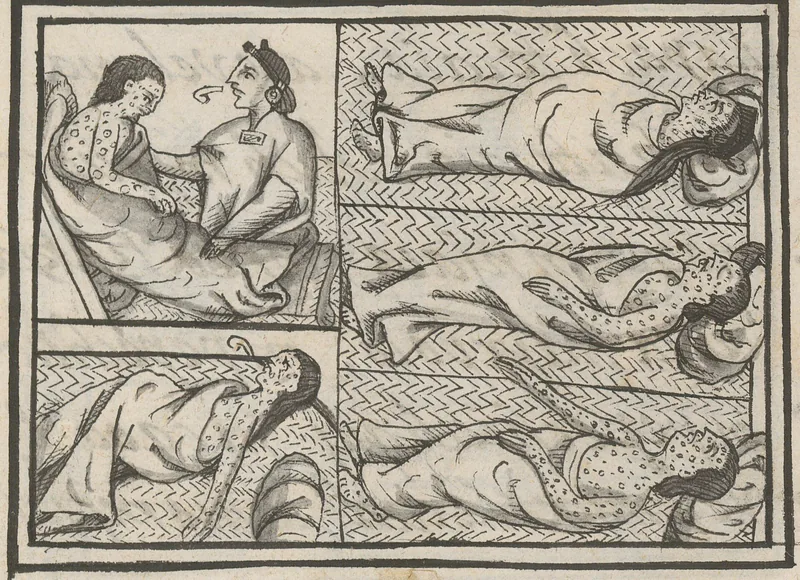
By the twentieth century the egg limpia was common across Mexico and the American Southwest. The anthropologists Robert Trotter and Juan Antonio Chavira, in Curanderismo: Mexican American Folk Healing (1981), describe it as part of the "material" level of the healer's work, alongside spiritual and mental levels. Elena Ávila, a nurse who trained as a curandera, presented the tradition from within in Woman Who Glows in the Dark (1999). Today curanderismo is practised in clinics, homes and community workshops, and is taught in university courses such as those led by Eliseo "Cheo" Torres. See folk Christianity and Mesoamerican religion.
Variations§
In some regions the glass is left overnight under the bed before being read. In Guatemala, Peru and elsewhere in Latin America, similar egg cleansings are performed with local prayers and herbs, and Andean healers have a comparable diagnostic rite with a guinea pig (cuy), which involves the animal's death and is not described here. Some combine the limpia with a Florida water cleansing or a rue sprig.
Safety and good sense§
Raw eggs can carry salmonella: do not break the egg on the skin, wash your hands and all surfaces afterwards, and never eat the egg. If rue is used, wear gloves — its sap can cause blistering burns on skin exposed to sunlight. Keep the candle away from hair, clothing and curtains, and never leave it unattended. In curanderismo itself, healers send serious illness to doctors: a baby or child with fever, diarrhoea, persistent crying or lethargy needs prompt medical care, whatever the egg appears to show. A limpia is a spiritual and cultural practice, not a substitute for medical or psychological treatment.
Sources and further reading§
- Curanderismo: Mexican American Folk Healing — Robert T. Trotter II & Juan Antonio Chavira, 1981
- Woman Who Glows in the Dark: A Curandera Reveals Traditional Aztec Secrets of Physical and Spiritual Health — Elena Ávila, 1999
- Curandero: A Life in Mexican Folk Healing — Eliseo Torres & Timothy L. Sawyer, 2005
- Florentine Codex: General History of the Things of New Spain — Bernardino de Sahagún, c. 1577
- The Evil Eye: A Casebook — Alan Dundes (ed.), 1981