Kamidana Offering and Purification at a Home Shrine
How to set up and honour a kamidana, the Shinto home shrine: placing ofuda, daily offerings of rice, salt and water, the bows and claps, year-end cleaning.
- TraditionJapanese household Shinto; kamidana widespread from the Edo period (1603–1868) to the present
- ForBlessings, Home & hearth, Cleansing
- DifficultySimple
- Time5 minutes daily; 1 hour for the year-end cleaning
- WhenDaily in the morning; fresh branches and sake on the 1st and 15th of each month; a full cleaning in late December before the New Year

A kamidana (神棚, "god-shelf") is a small Shinto shrine on a high shelf in the home. It holds ofuda, paper or wooden talismans that carry the presence of the kami of the great shrine at Ise and of the family's local shrine. A brief morning offering of rice, salt and water, with bows and claps, honours the kami and asks for the protection and harmony of the household. The kamidana is not a magical device but a place of everyday reverence, and its care is itself a form of purification.
How to do it§
Setting up the shelf§
- Choose the place. Put the shelf high, above eye level, in a clean, bright room where the family gathers. It should face south or east if possible. Avoid placing it over a doorway or where people will walk on the floor directly above; if there is an upper storey, many families fix a paper bearing the character for "cloud" (雲) on the ceiling above it.
- Install the ofuda. In a three-door miniature shrine, the Ise talisman (Jingū taima) goes in the centre, the local tutelary shrine's (ujigami) to the right as you face it, and any other shrine's to the left. In a single-door shrine they are stacked with Ise at the front.
- Dress the shelf. Place a sakaki branch in a vase on each side and, if you like, hang a small shimenawa rope with zigzag paper streamers across the front to mark the sacred space.
The daily offering§
- Purify yourself. In the morning, wash your hands and rinse your mouth before approaching.
- Make the offering. Set out fresh rice (washed raw rice or the first cooked rice of the day) in the centre, with salt and water in small dishes to either side. On the 1st and 15th add a little sake and fresh branches.
- Pray. Stand before the shelf and bow twice deeply, clap twice, hold your hands together while you give thanks and ask for the household's safety, then bow once more. Many people also recite the short purification formula harae tamae, kiyome tamae ("purify us, cleanse us"), a traditional phrase used at shrines.
- Take down the offering. Later in the day remove the offerings. Rice and sake are traditionally consumed by the family as osagari, shared blessings. Salt and water may be used in the kitchen or poured away.
The year-end purification§
- Clean the shelf. In late December, after a short bow, take down the ofuda, wipe the shrine and shelf with a clean damp white cloth, and replace worn streamers and the shimenawa.
- Renew the ofuda. Return the old talismans to a shrine during your New Year visit and install new ones (see the entry on omamori and hatsumōde).
Origins and history§
Household altars are old in Japan, but the kamidana as we know it is closely tied to the Ise shrines. From the late medieval period, Ise's oshi, priests who acted as pilgrimage agents, travelled the country distributing paper talismans called taima (or ōnusa) to their client households. During the Edo period (1603–1868) these talismans became common in homes of every class, and the shelf to hold them became a standard feature of the house, often alongside a Buddhist altar (butsudan) for the ancestors.
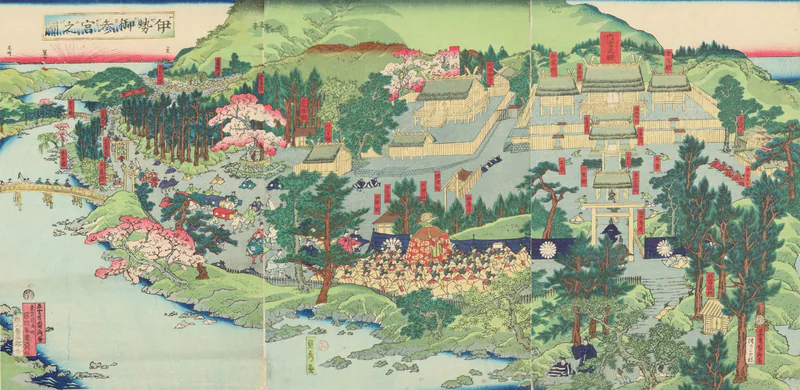
After the Meiji Restoration of 1868 the state reorganised the Ise shrines and promoted the distribution of the Jingū taima to every household as part of State Shinto. Helen Hardacre and other historians have studied how this turned a devotional custom into a civic expectation. After 1945, Shinto was separated from the state and keeping a kamidana became once more a voluntary household choice. The rites themselves draw on the general pattern of shrine worship: purification, offering (shinsen), prayer and the sharing of the offering, which Sokyo Ono describes as the core of Shinto ritual.
Variations§
Businesses, fishing boats, police stations and sumo stables often keep kamidana. Modern flats use compact wall-mounted designs or a single ofuda stand on a high bookshelf. During a period of mourning after a death in the family, the kamidana is traditionally covered with white paper and offerings are suspended, usually for fifty days, because death is regarded as a source of impurity.
Safety and good sense§
If you place candles or small lamps on the kamidana, use electric lights or never leave a flame burning unattended, especially on a high wooden shelf. Fix the shelf securely to the wall. A kamidana expresses gratitude and hope for a household's wellbeing; it is not a substitute for practical help in times of trouble.
Sources and further reading§
- Shinto: The Kami Way — Sokyo Ono, 1962
- A Year in the Life of a Shinto Shrine — John K. Nelson, 1996
- Shinto and the State, 1868–1988 — Helen Hardacre, 1989
- A Social History of the Ise Shrines: Divine Capital — John Breen and Mark Teeuwen, 2017
- Shinto: The Way Home — Thomas P. Kasulis, 2004