Reciting the Gayatri Mantra at Dawn: A Respectful Guide
How the Gayatri mantra of the Rig Veda is recited at dawn: its text and meaning, the custom of receiving it from a teacher, and its place in daily Hindu rite.
- TraditionVedic Hinduism; Rig Veda 3.62.10 (late 2nd millennium BCE), recited in the daily sandhyā rite
- ForWisdom & study, Blessings
- DifficultyModerate
- Time15–30 minutes
- WhenAt sunrise (the morning sandhyā), and if desired at noon and sunset; facing east in the morning and west in the evening

The Gāyatrī mantra, also called the Sāvitrī, is a verse of the Rig Veda addressed to Savitṛ, the divine Sun as the power that rouses all beings. It is widely considered the most sacred mantra of Hinduism. Generations of Hindus have recited it at dawn as a prayer for the illumination of the mind. It is presented here in the believers' own terms, with attention to the traditional rules about who receives it and how.
A note on initiation§
In classical Brahmanical tradition the Gāyatrī is given to a boy by his teacher at the upanayana, the sacred-thread ceremony, and is then recited daily for life. For centuries it was restricted to initiated males of the three upper classes. From the nineteenth century, reformers such as Dayananda Sarasvati's Arya Samaj, and later movements such as the All World Gayatri Pariwar, taught it openly to all, including women. Many Hindus today recite it freely, while others hold that it should be received from a guru. Those who are not Hindu are asked to approach it as a sacred prayer, not as a technique, and to learn from a teacher if they wish to take it up seriously.
How to do it§
Purify. Bathe or at least wash face, hands and feet, and wear clean clothes.
Sit facing the rising sun. Before or at sunrise, sit on a mat facing east. In the evening one faces west.
Sip water (ācamana). Many households begin by sipping a few drops of water from the right palm three times as a purification, while remembering God.
Set the intention. Silently state what you are doing, for example, "I recite the Gāyatrī to honour the divine light and to pray for a clear mind." This is a simple modern wording; the formal saṅkalpa of the sandhyā rite is longer and in Sanskrit.
Recite the mantra. The traditional text, prefixed by Om and the three "great utterances" (vyāhṛti) naming earth, atmosphere and heaven, is:
Om bhūr bhuvaḥ svaḥ / tat savitur vareṇyam / bhargo devasya dhīmahi / dhiyo yo naḥ pracodayāt.
A plain rendering: "We meditate on that excellent radiance of the god Savitṛ; may he stir our thoughts."
Count. Recite slowly and clearly, aloud, softly or mentally, 3, 10, 28 or 108 times, using the fingers or a mala to count. Traditional manuals rate silent recitation highest and audible recitation lowest, but all are valid.
Offer water to the sun (arghya). Standing, take water in cupped hands or a small vessel and pour it in a stream towards the sun while reciting the mantra once more.
Close. Sit for a moment in silence, bow, and if you wish, dedicate the practice to the welfare of all.
Origins and history§
The verse is Rig Veda 3.62.10, in the third "family book" of the collection, attributed to the seer Viśvāmitra. The Rig Veda is usually dated to the later second millennium BCE and was transmitted orally with great precision for many centuries before being written down. The mantra is named after its metre, the gāyatrī of three lines of eight syllables. Its god Savitṛ, the "Impeller", is a solar deity who sets the world in motion each morning and each evening brings it to rest.
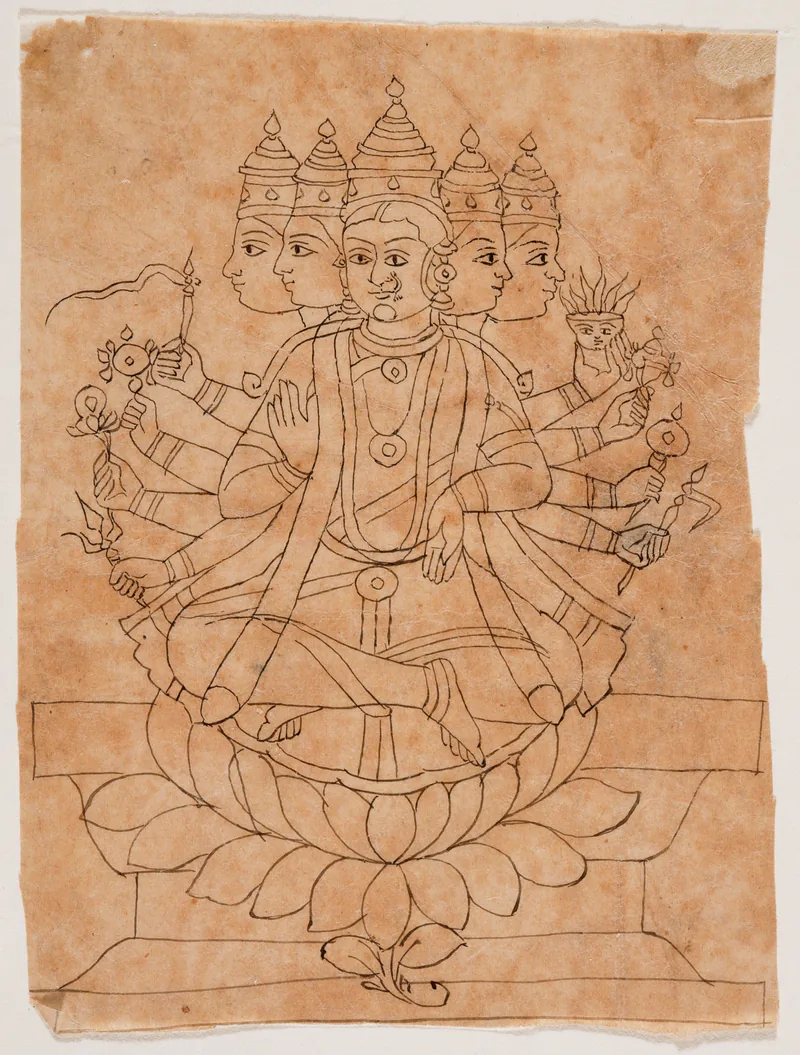
The verse was singled out early. Later Vedic texts and the Upaniṣads praise it, and the Gṛhyasūtras, manuals of domestic ritual from around the middle of the first millennium BCE, make its transmission the core of the upanayana. The law book of Manu treats daily recitation of the Sāvitrī at the junctions of the day as a basic duty. The rite of sandhyāvandana, "worship at the junctions", developed around it, with purifications, breath control and water offerings. Over time the mantra was personified as the goddess Gāyatrī, who is shown with five faces and seated on a lotus.
Scholars such as Gavin Flood note that the modern opening of the mantra to all Hindus is one of the clearest examples of nineteenth- and twentieth-century reform reshaping ancient practice. Translators differ on details of its wording; the translation by Stephanie Jamison and Joel Brereton gives a careful modern reading.
Variations§
Sectarian traditions have composed their own "gāyatrīs" in the same metre for Śiva, Viṣṇu, Gaṇeśa and other deities. In devotional music the mantra is often sung to a melody, a practice traditionalists distinguish from formal Vedic recitation.
Safety and good sense§
Do not stare at the sun, even at sunrise; let the gaze rest low or on the light around it. If you pour water outdoors, take care on slippery ground. Mantra recitation is a religious practice; it can support calm and focus but does not replace education, medical care or professional advice.
Sources and further reading§
- The Rigveda: The Earliest Religious Poetry of India — Stephanie W. Jamison and Joel P. Brereton (trans.), 2014
- The Hymns of the Rigveda — Ralph T. H. Griffith (trans.), 1889
- Hindu Saṃskāras — Raj Bali Pandey, 1949
- History of Dharmaśāstra — P. V. Kane, 1930
- An Introduction to Hinduism — Gavin Flood, 1996