Sri Yantra Meditation: Contemplating the Sacred Diagram
A Sri Yantra meditation: gazing from the outer square to the central bindu, what each layer means in Śrīvidyā, and why full worship needs initiation.
- TraditionŚrīvidyā Śākta Tantra, South Asia, c. 9th–12th century onward; open contemplative use in modern Hinduism
- ForWisdom & study, Peace
- DifficultyModerate
- Time20–30 minutes
- WhenAny time of quiet; Śrīvidyā devotees favour Fridays, the full moon and the nine nights of Navarātri

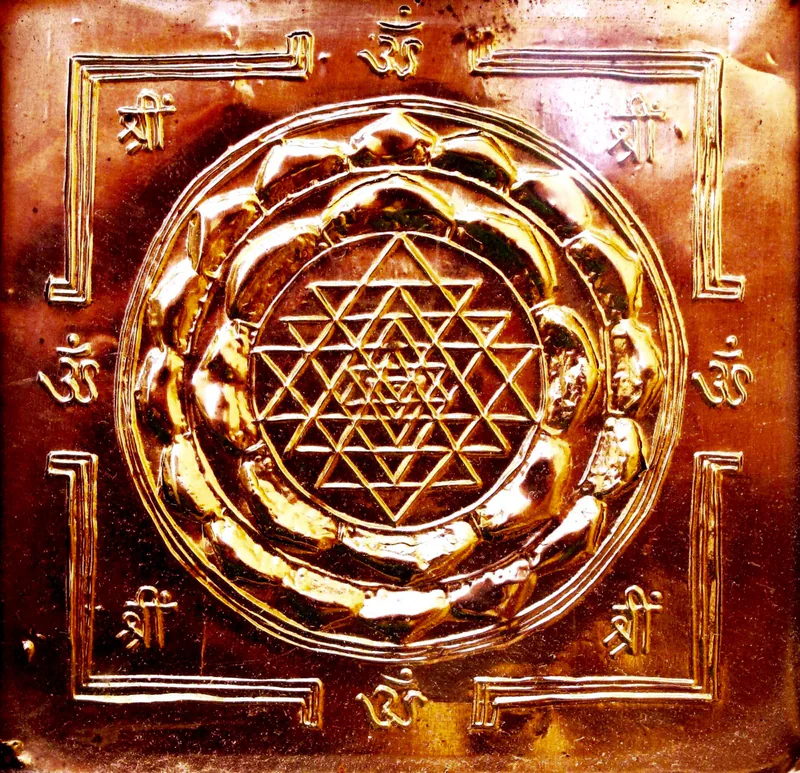
The Śrī Yantra, or Śrī Cakra, is a geometrical diagram of nine interlocking triangles radiating from a central point. In the Śrīvidyā tradition of Hindu Tantra it is the form of the Goddess Lalitā Tripurasundarī and a map of the universe emerging from, and returning to, a single source. Formal Śrī Cakra worship is an initiatory practice. Contemplating the diagram quietly from its outer edge to its centre, however, is a widely shared meditation that requires no initiation, and that open practice is what this entry describes.
How to do it§
Full Śrī Cakra pūjā involves a secret fifteen- or sixteen-syllable mantra and an elaborate liturgy that Śrīvidyā teachers give only after initiation (dīkṣā). Nothing here imitates that. What follows is a contemplative gazing practice, in the spirit of the classical method of moving from the periphery to the centre.
- Set up the yantra. Place a clear image of the Śrī Yantra at eye level, about an arm's length away, in a quiet, clean space. Some people place a flower before it and light a small lamp to one side, out of the line of sight.
- Settle the body and breath. Sit upright. Breathe slowly through the nose for a few minutes until the mind begins to settle.
- Begin at the gates. Let your gaze rest on the outer square with its four T-shaped gates (bhūpura). This is the world of ordinary experience, where the journey inward begins.
- Pass through the circles and lotuses. Move the gaze slowly inward: across the three circles, then the ring of sixteen petals, then the ring of eight. Tradition associates the sixteen petals with the fulfilment of desires and the eight with the movement of the mind and senses. Spend several breaths on each.
- Enter the triangles. Move into the interlocking triangles. Four point upward, associated with Śiva, consciousness; five point downward, associated with Śakti, power. Their meeting forms forty-three small triangles in concentric rings. Let the eye travel inward ring by ring, without trying to count or analyse.
- Rest on the bindu. Finally let the gaze settle on the central point (bindu). In Śrīvidyā this is the Goddess herself, the undivided source from which the whole diagram unfolds. Rest here with soft attention for several minutes.
- Close the eyes. Close your eyes and hold the after-image or the sense of the centre for a while.
- Return. Open your eyes, let your gaze move outward again to the square, and bow. If you wish, offer thanks to the Goddess in your own words.
Origins and history§
Yantras, geometrical diagrams used as supports for worship and meditation, are found throughout Hindu, Buddhist and Jain Tantra. The Śrī Yantra is the best known. It belongs to Śrīvidyā, a Śākta tantric tradition centred on the Goddess Lalitā Tripurasundarī, "the most beautiful in the three worlds". Its early textual basis lies in works such as the Vāmakeśvarīmata (also known as the Nityāṣoḍaśikārṇava), generally dated between the ninth and eleventh centuries. Kashmiri commentators gave it a philosophical framework. The Saundaryalaharī, a hymn traditionally attributed to Śaṅkara but probably later, describes the Goddess and her cakra in poetic detail.
The tradition took deep root in South India, where the Śrī Cakra is worshipped in monasteries associated with Śaṅkara's lineage at Śṛṅgeri and Kāñcīpuram and in temples such as that of Kāmākṣī. The eighteenth-century scholar Bhāskararāya wrote influential commentaries on its worship. Douglas Brooks's study The Auspicious Wisdom describes the nine enclosures (āvaraṇa) of the diagram. Each has its own attendant goddesses, and the worshipper passes through them as through the courts of a palace towards the throne at the centre. Movement from the outside inward is understood as the path of reabsorption into unity; movement from the centre outward, as creation.
In the twentieth century the Śrī Yantra became widely known in the West as an emblem of "sacred geometry", sometimes cut off from its devotional setting. Scholars such as Madhu Khanna and André Padoux have stressed that, for the tradition, it is not an abstract figure but a living form of the Goddess.
Variations§
Śrī Yantras are drawn flat (bhū-prastāra) or built up as three-dimensional pyramids (meru). Many households keep a small engraved copper Śrī Yantra on the shrine and worship it with flowers and kumkum without the secret liturgy. Other yantras exist for Gaṇeśa, Durgā, Kālī and the planets.
Safety and good sense§
Gazing practices can cause eye strain; blink naturally and stop if your eyes water or ache. People with a history of psychosis, dissociation or severe anxiety should approach intensive meditation cautiously and with guidance. If you light a lamp, keep it on a stable, heat-proof surface and never unattended. Meditation can support wellbeing but does not replace medical or psychological care.
Sources and further reading§
- The Auspicious Wisdom: The Texts and Traditions of Śrīvidyā Śākta Tantrism in South India — Douglas Renfrew Brooks, 1992
- Yantra: The Tantric Symbol of Cosmic Unity — Madhu Khanna, 1979
- Tantric Visions of the Divine Feminine: The Ten Mahāvidyās — David Kinsley, 1997
- The Hindu Tantric World: An Overview — André Padoux, 2017
- Myths and Symbols in Indian Art and Civilization — Heinrich Zimmer, 1946