The Heptameron's Conjurations: A Historical Account
A historical account of the Heptameron attributed to Peter of Abano: its magic circle, angels of the seven days, spirits of the air and later influence.
- TraditionHeptameron seu Elementa magica, attributed to Peter of Abano; printed mid-16th century; English translation by Robert Turner, 1655
- ForWisdom & study
- Presented asHistory only
- WhenThe Heptameron organised its operations by the day of the week, the planetary hour and the season

The Heptameron, or Magical Elements, falsely attributed to the medieval physician Peter of Abano, is a compact handbook of ritual magic organised around the seven days of the week. It explained how to draw a magic circle bearing the names of the angels of the hour, day and season, how to consecrate the operator's tools and garments, and how to call the spirits of the air ruling each day. Because its purpose is the conjuration of spirits, the Spellbook presents it only as history, describing what the text contains without giving a usable rite.
How it was done§
The Heptameron began with the circle. The magician was to draw three concentric circles, the outermost nine feet across, a hand's breadth apart. Into these bands went, according to the moment of the work, the name of the planetary hour, the name of its angel, the seal of the angel of the day, the names of that day's angels and their ministers, the name of the current season and its angels, and the names of the earth, sun and moon in that season. Outside the circle, at the four quarters, pentagrams were drawn, and inside, divine names and crosses.
Next came preparations familiar from other grimoires: the blessing of the circle, the exorcism and blessing of fire with perfumes, a priestly linen garment, a pentacle on parchment bearing the names of God, and a series of prayers to be said while vesting and entering the circle. The operator was to be in a state of ritual purity, having fasted, confessed and prayed.
The heart of the work was a long conjuration addressed to the spirits of the air, invoking the names of God and the angels of the day, followed by a "visions and apparitions" section listing the forms in which spirits might appear, and a dismissal. The second part of the book gave, for each day of the week, its angel (Michael for Sunday, Gabriel for Monday, Samael for Tuesday, Raphael for Wednesday, Sachiel for Thursday, Anael for Friday and Cassiel for Saturday), the angel's seal, the heaven it was said to inhabit, the king of the spirits of the air for that day (for example Varcan for Sunday and Maymon for Saturday), the wind from which they came, and a conjuration particular to the day. Each day's spirits were credited with characteristic powers, from bringing gold and favour to causing sickness or discord.
Origins and history§
Peter of Abano (c. 1257–c. 1316), a physician and philosopher of Padua, was famous in later legend as a magician, partly because of his astrological writings and his trouble with the Inquisition. No medieval manuscript of the Heptameron is known under his name, and historians regard the attribution as spurious; the text probably dates from the fifteenth or early sixteenth century and draws on older Latin ritual magic of the kind found in the Solomonic books and in medieval necromancers' manuals.
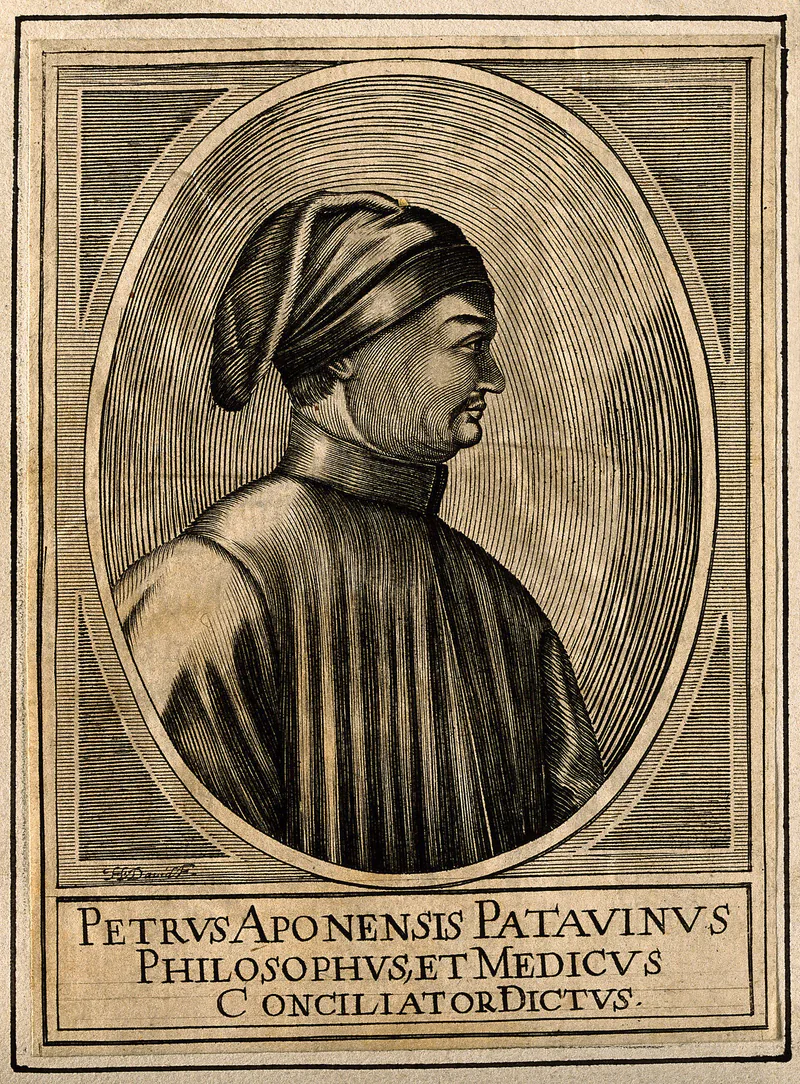
It was first printed in the mid-sixteenth century, and was later bound with collected editions of Agrippa's works together with the spurious Fourth Book of Occult Philosophy, which gave it wide circulation. Johann Weyer, Agrippa's pupil, already dismissed such texts as forgeries in the 1560s. Robert Turner's English translation was published in London in 1655 and is available here as the complete Heptameron; the work is also described under Heptameron of pseudo-Peter of Abano.
The Heptameron had a long influence. Its tables of the angels of the days and their seals were copied into countless later grimoires and into the "Faustian" literature of Germany. Reginald Scot's critique of magic and the later editions of his Discoverie of Witchcraft reproduced related material, and the Golden Dawn and modern ceremonial magicians drew on its planetary angel lists. Historians including Richard Kieckhefer and Owen Davies treat it as a characteristic example of learned "clerical" magic, which mixed liturgical prayer with the command of spirits.
Why this is presented as history§
The Heptameron exists to summon and command spirits, and the Spellbook does not provide instructions for that. Its lists of the angels of the days and hours, however, remain part of the general lore of planetary timing, which readers can explore through the planetary hours almanac.
Safety and good sense§
Grimoires are historical documents; reading them is a way to understand the religious imagination of early modern Europe. Anyone troubled by frightening experiences, sensed presences or voices should talk to a doctor or mental-health professional. Esoteric study is no substitute for medical, legal or financial help.
Sources and further reading§
- The Fourth Book of Occult Philosophy — Henry Cornelius Agrippa (attributed), 1978
- Grimoires: A History of Magic Books — Owen Davies, 2009
- Forbidden Rites: A Necromancer's Manual of the Fifteenth Century — Richard Kieckhefer, 1997
- Magic in the Middle Ages — Richard Kieckhefer, 1989
- Conjuring Spirits: Texts and Traditions of Medieval Ritual Magic — Claire Fanger, 1998
- Ritual Magic — E. M. Butler, 1949