The Spellbook · Witchcraft & Wicca
Casting and Closing a Circle in Wiccan Practice
How Wiccans cast and close a ritual circle: consecrating salt and water, calling the quarters, the cakes and wine, and the history of the rite since Gardner.
- TraditionModern Wicca, England, 1940s–1950s, drawing on Renaissance ceremonial magic
- ForProtection, Blessings
- DifficultyModerate
- Time20–30 minutes (plus the working held inside it)
- WhenAny time a rite is held: at the full moon (esbat), at the eight sabbats, or whenever sacred space is needed

Casting a circle is the opening act of almost every Wiccan rite: the practitioner marks out a round of consecrated space, purifies it with the elements, greets the four quarters and, at the end, releases it again. The circle is understood both as a boundary that keeps out distraction and unwanted influence and as a vessel that holds the energy raised within it, a space "between the worlds". The form described here follows the broad outline that runs through Gardnerian and Alexandrian Wicca and the many solitary versions published since the 1970s.
How to do it§
- Prepare the space. Clean the room or clear the ground, and mark the four directions with candles or small stones. Set an altar in the centre or at the north, with the water, salt, incense, cup and cake. Traditional covens favour a circle nine feet across; a solitary circle need only be large enough to move in comfortably.
- Settle yourself. Wash your hands, stand quietly for a few minutes and breathe slowly until your attention is gathered. Light the altar candle.
- Consecrate salt and water. Touch the water with the blade or finger and ask, in your own words, that it be cleansed of all impurity; do the same over the salt, asking that it be blessed. Add three pinches of salt to the water.
- Cast the circle. Starting in the east (some traditions start in the north), walk deosil — sunwise, clockwise in the northern hemisphere — tracing the boundary with the athame, wand or pointed finger, and imagine a line of light following it. A simple original wording: "I cast this circle as a place apart, a boundary of protection and a meeting place of the seen and unseen." Return to the starting point.
- Purify with the elements. Walk the round again sprinkling the salted water, then a third time carrying the incense (air and fire). Some practitioners carry a candle as well.
- Call the quarters. Face east and greet the powers of air; then south (fire), west (water) and north (earth), lighting each quarter candle. Gardnerian ritual speaks of the "Lords of the Watchtowers", a phrase borrowed from Elizabethan Enochian magic by way of the Golden Dawn; many solitaries simply greet the elements.
- Invite the deities, if you work with them. Wiccans commonly honour a Goddess and a God; others leave this step out.
- Hold the working. Inside the circle you may celebrate the moon or a sabbat, meditate, read, or perform a spell. Move sunwise within it, and try not to cross the boundary until it is closed.
- Cakes and wine. Bless the cup and the cake, take some yourself, and set a little aside as an offering to be placed outdoors afterwards.
- Close the circle. Thank the deities and bid farewell to each quarter in reverse order (north, west, south, east), extinguishing the quarter candles. Walk the boundary once more — widdershins in many covens, sunwise in others — imagining the light drawn back into the blade or hand. A common closing formula is the traditional "Merry meet, and merry part, and merry meet again." Put out the altar candle and return the offering to the earth.
Origins and history§
The idea of a protective ring drawn around the operator is far older than Wicca. Late medieval and Renaissance grimoires such as the Key of Solomon and the Heptameron describe circles inscribed with divine names, inside which a magician was safe while working; MacGregor Mathers's English edition of the Key of Solomon (1889) and the rituals of the Hermetic Order of the Golden Dawn passed these forms to twentieth-century occultists. Gerald Gardner, who made Wicca public in Witchcraft Today (1954), adapted this ceremonial circle for a coven of witches: consecration with salt and water, a ritual blade, the quarters, and a sharing of cakes and wine.
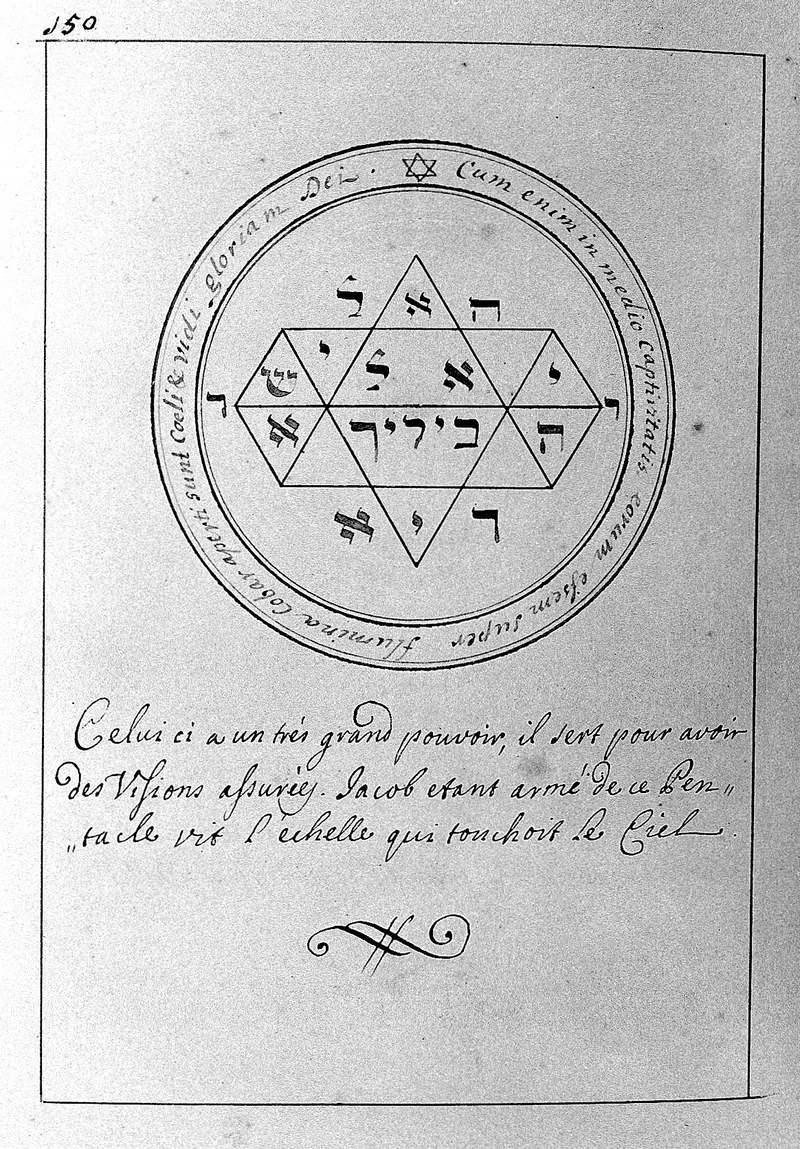
The texts of Gardner's Book of Shadows were revised in the 1950s with Doreen Valiente, who rewrote much of the ritual language. Historians, notably Ronald Hutton in The Triumph of the Moon (1999), show that the rite is a modern synthesis of ceremonial magic, Freemasonry, folklore and Romantic paganism, rather than a survival from an ancient witch cult as Gardner claimed. That conclusion does not lessen its importance: the circle became the shared grammar of Wicca and of much contemporary Paganism, and it was popularised for solitary practitioners by writers such as Scott Cunningham (Wicca: A Guide for the Solitary Practitioner, 1988) and Starhawk (The Spiral Dance, 1979). See also Wicca and Gerald Gardner and the festivals of the Wheel of the Year.
Variations§
Alexandrian covens follow a similar pattern with more ceremonial colour. Reclaiming witches, following Starhawk, often cast the circle collectively with chant and joined hands. Some practitioners begin in the north, the quarter of earth, rather than the east. In the southern hemisphere many reverse the direction so that "sunwise" follows the sun's apparent path there. Traditional (non-Wiccan) witches may use a "compass" with a stang or staff at its centre instead of a cast circle.
Safety and good sense§
Keep candles in stable holders away from robes, hair and curtains, burn incense in a heat-proof censer with ventilation, and never leave flames unattended. If you use a knife, keep it sheathed when not in hand and do not walk with it pointed outwards in a crowded room. Outdoors, check fire rules and leave no trace. Use juice instead of wine if you or others do not drink. A ritual circle is a religious and contemplative practice; it is no substitute for medical, psychological, legal or financial help.
Sources and further reading§
- Witchcraft Today — Gerald Gardner, 1954
- Witchcraft for Tomorrow — Doreen Valiente, 1978
- A Witches' Bible — Janet Farrar & Stewart Farrar, 1984
- The Spiral Dance — Starhawk, 1979
- Wicca: A Guide for the Solitary Practitioner — Scott Cunningham, 1988
- The Triumph of the Moon: A History of Modern Pagan Witchcraft — Ronald Hutton, 1999