The Rose Cross Ritual of the Golden Dawn
How the Golden Dawn Rose Cross ritual is performed: tracing rose crosses at six points with the name Yeheshuah, the INRI analysis, history and cautions.
- TraditionHermetic Order of the Golden Dawn, Second Order teaching, c. 1890s
- ForProtection, Peace
- DifficultyModerate
- Time15–20 minutes
- WhenAny time; traditionally used before meditation, at times of agitation, or to settle a room for rest

The Rose Cross Ritual is a quiet, enclosing rite from the inner teaching of the Hermetic Order of the Golden Dawn. The practitioner traces a cross within a circle at the corners of the room, above and below, joining them with lines of light and intoning the name Yeheshuah, then closes with a meditation on the letters INRI. Where the pentagram ritual is used to banish, the Rose Cross was taught as a veil of peace: a way to calm the mind, shelter one's own space from intrusion, and prepare for meditation.
How to do it§
The divine name and the INRI formula are traditional Golden Dawn material. Published versions differ slightly in the order of the diagonal passes; the sequence below follows the common form.
- Prepare. Stand in the centre of the room and breathe quietly. Light the stick of incense and check that it burns steadily; hold it so that ash falls away from clothing.
- South-east. Go to the south-east corner. With the incense, trace a large cross, then a circle around its intersection. Point to the centre and vibrate Yeheshuah (the Hebrew letters YHShVH).
- Around the corners. Holding the incense at the height of the centre of the cross, walk to the south-west corner and trace the cross and circle, vibrating the name. Do the same in the north-west and the north-east, then return to the south-east, touching the centre of the first cross to close the ring.
- Above. From the south-east, carry the incense high and walk diagonally towards the north-west. In the middle of the room, trace a cross and circle above your head and vibrate the name; continue to the north-west and touch the centre of the cross there.
- Below. Return diagonally to the south-east holding the incense low. In the middle of the room, trace a cross and circle towards the floor and vibrate the name; continue to the south-east.
- The other diagonal. Walk round to the south-west. Pass diagonally to the north-east holding the incense high, joining the cross above; return low from the north-east to the south-west, joining the cross below.
- Complete the figure. Walk around once more (south-west, north-west, north-east, south-east). At the south-east, trace a final, larger cross and circle and vibrate the name. You now imagine six rose crosses joined by lines of light, enclosing the room like a sphere.
- The analysis of the keyword. Return to the centre, face east and say: "I.N.R.I. Yod Nun Resh Yod. Virgo, Isis, mighty Mother. Scorpio, Apophis, Destroyer. Sol, Osiris, slain and risen. Isis, Apophis, Osiris: IAO." Golden Dawn students accompany this with the four "LVX" postures they learn in that grade; others simply stand with arms crossed on the breast.
- Close. Sit in the stillness for some minutes. Rest the incense in a heat-proof dish and let it burn out under watch, or extinguish it in sand.
Origins and history§
The ritual belongs to the Second or Inner Order of the Golden Dawn, the Rosae Rubeae et Aureae Crucis, whose members (Adepti Minores) were given it together with the symbolism of the rose cross lamen. Like most order papers it is unsigned; the papers were circulated in manuscript from the 1890s and became public when Israel Regardie printed them in The Golden Dawn (1937–40).
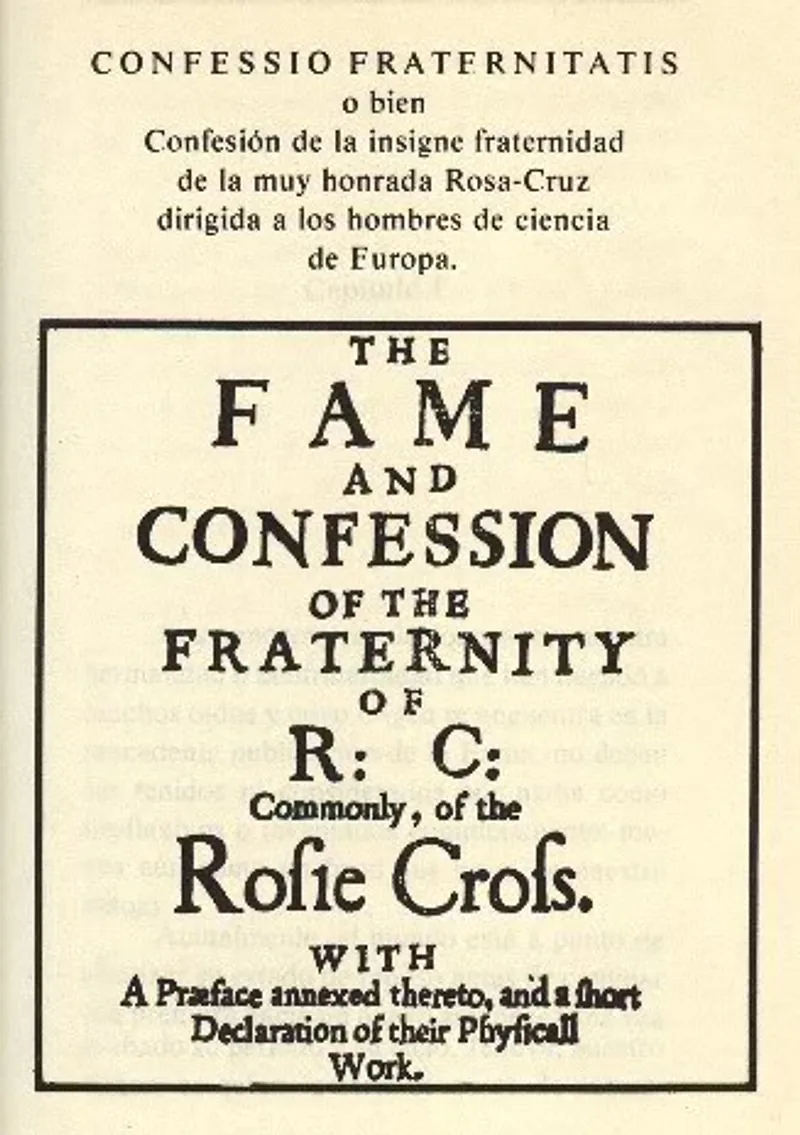
Its components are older. The rose cross itself is the emblem of the Rosicrucian movement launched by the manifestos of 1614–16, which the Golden Dawn claimed as its inner tradition. The name Yeheshuah is the "Pentagrammaton" of Renaissance Christian Kabbalah: by inserting the letter Shin into the four-letter name YHVH, writers following Johannes Reuchlin's De verbo mirifico (1494) produced a Hebrew form of the name Jesus, expressing the idea that the divine name became incarnate. The INRI formula reads the inscription of the cross (John 19:19) as a cycle of birth, destruction and resurrection, combining Hebrew letters, zodiacal signs and Egyptian deities in the syncretic style typical of the order, and deriving the Gnostic name IAO.
The Golden Dawn papers describe the rite as surrounding the practitioner's aura with protection while leaving the mind free for meditation, and as suitable for quietening a disturbed atmosphere. Since Regardie's publication it has been reproduced and adapted widely, notably by the Ciceros in their Golden Dawn handbooks.
Variations§
Some practitioners perform it without incense, tracing with the forefinger. Christian esotericists sometimes say the name of Jesus in English or Latin. The rite is often followed by the Middle Pillar exercise.
Safety and good sense§
Carrying lit incense around a room needs care: keep it away from curtains, hair and loose sleeves, clear the floor before you begin, ventilate the room, and never leave burning incense unattended. If smoke irritates your lungs or you have asthma, trace with the hand instead. The ritual is a devotional and meditative practice and no substitute for medical, psychological, legal or financial help.
Sources and further reading§
- The Golden Dawn — Israel Regardie, 1937
- Self-Initiation into the Golden Dawn Tradition — Chic Cicero & Sandra Tabatha Cicero, 1995
- The Magicians of the Golden Dawn — Ellic Howe, 1972
- The Christian Kabbalah: Jewish Mystical Books and Their Christian Interpreters — Joseph Dan, 1997
- On the Art of the Kabbalah (De Arte Cabalistica) — Johann Reuchlin, 1517
- The Holy Bible (King James Version) — Anonymous, 1611