Nine Herbs Charm: An Anglo-Saxon Herbal Blessing
The Anglo-Saxon Nine Herbs Charm from the Lacnunga, adapted as a herbal blessing sachet with safe herbs, plus the poem's Woden, its plants and its history.
- TraditionAnglo-Saxon England, the Lacnunga manuscript, c. 1000
- ForHealing, Protection, Blessings
- DifficultyModerate
- Time45 minutes
- WhenHerbs were traditionally gathered in summer; the sachet can be made at any time

The Nine Herbs Charm (Nigon Wyrta Galdor) is an Old English poem and remedy in the Lacnunga, a medical miscellany copied around the year 1000. It praises nine plants one by one, tells how Woden struck a serpent with "nine glory-twigs" so that it flew into nine pieces, and ends with a recipe for a salve against poison and infection. The modern working below makes a sachet of nine safe herbs in honour of the poem's catalogue, as a blessing for health and protection; it is not a medicine and nothing is eaten or applied.
How to do it§
- Choose nine herbs. The plants named in the poem are usually identified, not all with certainty, as mugwort, plantain, lamb's cress, "atterlothe" (perhaps betony or a grass), chamomile ("maythe"), nettle, crab-apple, chervil (some editors suggest thyme) and fennel. For a safe sachet use nine common dried herbs, for example:
- plantain leaf, chamomile, fennel seed, chervil, thyme, dried nettle, betony, apple peel or dried crab-apple, and watercress or parsley in place of lamb's cress. Mugwort is often substituted with sage or yarrow, since mugwort can cause allergic reactions and is unsuitable in pregnancy.
- Prepare a space. Lay out the herbs in nine small heaps on a clean cloth, in the order you will name them.
- Name each herb. The poem addresses each plant directly and praises its strength. Take a pinch of each in turn, say its name, and add a sentence of your own: "Chamomile, gentle one, guard against restlessness"; "Fennel, keep away what is foul."
- Grind them together. Put a pinch of each into the mortar and grind lightly while saying, in your own words, what you ask of the sachet: health for the household, strength against sickness, a calm home.
- Write the line. On a small slip of paper write a short line of blessing; you may echo the poem's idea of the "nine against nine" — nine herbs against nine kinds of harm.
- Sew the sachet. Place the herbs and paper in the centre of the cloth, gather the corners and tie or sew it closed with nine turns of thread.
- Place it. Hang it in the kitchen, keep it in a drawer, or place it under a pillow (away from anyone with plant allergies).
- Renew it after a year, scattering the old herbs in a garden or on a compost heap.
Origins and history§
The Lacnunga ("remedies") is the modern name for a collection in London, British Library, Harley MS 585, compiled around the turn of the eleventh century. It mixes Latin and Old English medical recipes with charms, prayers and liturgical fragments, and includes several of the best-known Old English metrical charms, among them "Against a sudden stitch" (Wið færstice) and the Nine Herbs Charm. Godfrid Storms edited the charms in Anglo-Saxon Magic (1948), and Edward Pettit published a full edition and study of the Lacnunga in 2001.
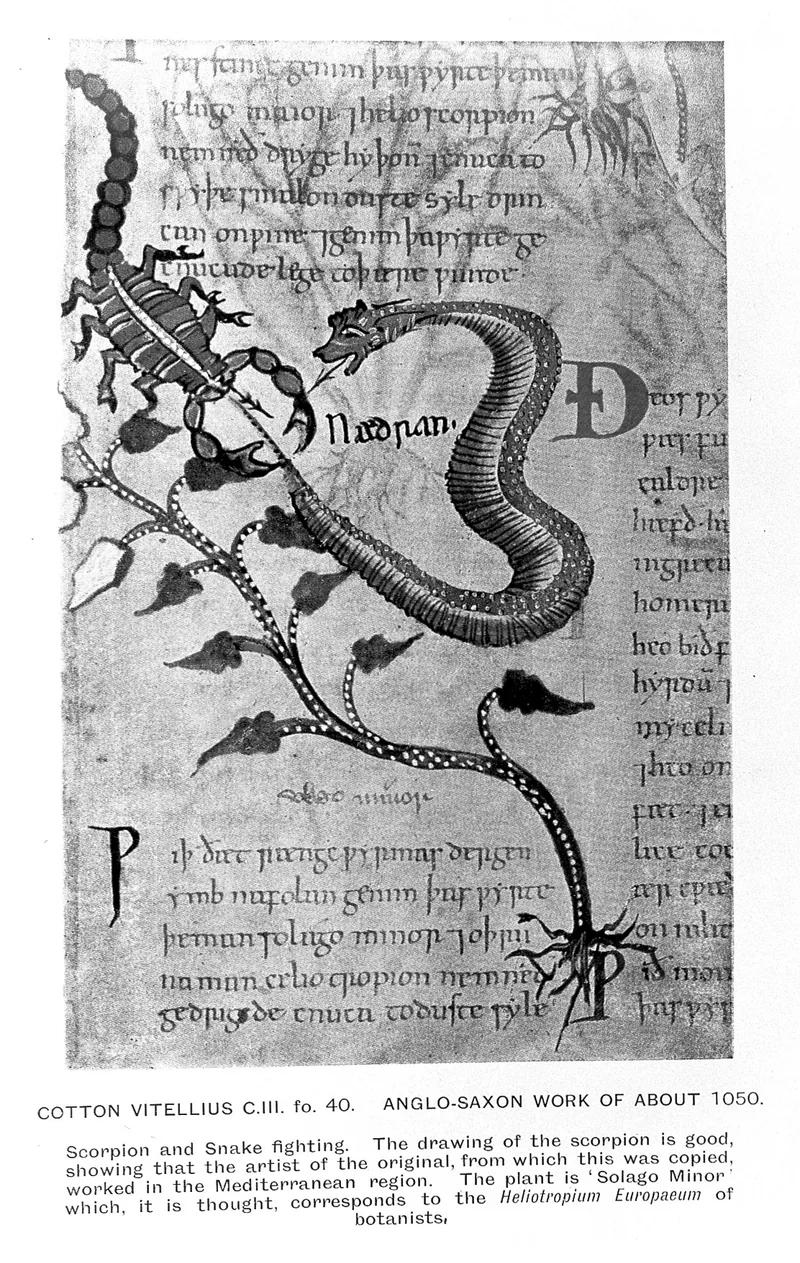
The poem is famous for one of the very few mentions of Woden in Old English poetry: he takes "nine glory-twigs" and strikes the adder so that it flies into nine parts. Scholars have debated whether the twigs were rune-staves, sprigs of the nine herbs, or something else. The poem then turns to Christ, who stood over the venom, and closes with a prose recipe: the herbs are to be pounded to dust and mixed with soap and the juice of apples, and made into a paste with water and ashes, and the charm is to be sung into the mouth, ears and wound of the patient. The original also included an egg; the brief here leaves out all ingestion and application.
The identifications of several plants remain uncertain, and the poem's sequence may be garbled. Most scholars, including Karen Jolly and Edward Pettit, read the text as Christian-era medicine that drew on older poetic and mythological material, rather than as a pagan rite surviving intact. Its blend of Woden, Christ and practical pharmacy is typical of the world of early medieval healing. See herbal magic and the witch's garden.
Variations§
- Nine-herb bundles at midsummer: in later European folk custom, bunches of nine (or seven) herbs were gathered on St John's Eve and hung in the house for protection.
- Kitchen version: nine culinary herbs in a jar on the kitchen windowsill, named one by one.
- Recitation only: some modern heathens and herbalists simply recite the herbs' names as a blessing while tending a garden.
Safety and good sense§
- This sachet is not to be eaten, smoked or applied to skin or wounds. Do not copy the historical salve.
- Some herbs (mugwort, chamomile, yarrow, nettle) can cause allergic reactions; handle with care and keep sachets away from anyone sensitive.
- Do not gather wild plants unless you are certain of their identity; many look-alikes are toxic.
- Herbal blessings are no substitute for medical treatment of infection, poisoning or any illness.
Sources and further reading§
- Anglo-Saxon Magic — Godfrid Storms, 1948
- Anglo-Saxon Remedies, Charms, and Prayers from British Library MS Harley 585: The Lacnunga — Edward Pettit, 2001
- Popular Religion in Late Saxon England: Elf Charms in Context — Karen Louise Jolly, 1996
- The Anglo-Saxon Minor Poems (Anglo-Saxon Poetic Records VI) — Elliott Van Kirk Dobbie, 1942
- Leechdoms, Wortcunning, and Starcraft of Early England — Thomas Oswald Cockayne, 1864