Liber II · Ancient Magic · Chapter IV: Folk Magic
Anglo-Saxon Charms: Leechbooks, Elf-Shot and Healing Magic
Anglo-Saxon charms explained: Bald's Leechbook, the Lacnunga, the Old English metrical charms, elf-shot and the Æcerbot field ritual of early England.

Anglo-Saxon charms are the healing and protective formulas of early medieval England, written in Old English and Latin between roughly the ninth and twelfth centuries, mostly in medical books called leechbooks. They combine herbal remedies, Christian prayers and masses, and older ideas about elves, "flying venoms" and the powers of the earth, and they are the richest surviving record of everyday magic in pre-Conquest England.
The Manuscripts: Bald's Leechbook, Lacnunga and the Herbarium§
Anglo-Saxon medicine is known from a small number of manuscripts. The most important is Bald's Leechbook, now British Library Royal MS 12 D XVII, copied in the mid-tenth century. A Latin colophon says that Bald owned the book and that a scribe named Cild wrote it. It is arranged in two books, one on external and one on internal ailments, and is followed in the same manuscript by a third collection, usually called Leechbook III, which contains more of the remedies against elves and supernatural afflictions.
Much of Bald's Leechbook adapts late antique Latin medical writers such as Marcellus of Bordeaux, Alexander of Tralles and the compilers who drew on Pliny the Elder, showing that Anglo-Saxon physicians were part of a learned Mediterranean tradition. Mixed with this material are remedies that have no known Latin source and that include spoken charms, rituals and references to native beliefs.
The second major collection, in British Library Harley MS 585, was named Lacnunga ("remedies") by its nineteenth-century editor Oswald Cockayne. Written around the year 1000, it is a more miscellaneous compilation and contains several of the most famous verse charms, among them the Nine Herbs Charm. A third important text is the Old English Herbarium, a translation of a late antique Latin herbal attributed to Pseudo-Apuleius, which sometimes prescribes prayers to be said while gathering plants. The wider tradition of plant lore to which these books belong is surveyed in Herbal Magic: A History.
The Old English Metrical Charms§
Twelve charms in Old English verse, scattered across several manuscripts, were gathered in 1942 in the standard edition of Anglo-Saxon poetry and have since been known as the metrical charms. They are short, vivid poems with prose instructions.

The charm Wið færstice, "against a sudden stitch", imagines loud and mighty women riding over a hill and hurling spears; the healer promises to send back a spear against them and lists the possible sources of the pain, whether it be the shot of gods, of elves or of hægtessan, a word that later came to mean "witch". A charm for a swarm of bees addresses the bees as "victory-women" and tells them to settle and not fly to the wood. Others protect against the loss or theft of cattle, often invoking Bethlehem and the cross, against a "dwarf", apparently a fever, and for a safe journey.
These poems are close in spirit to the older Continental charms, such as the Old High German Merseburg charms, which preserve names of Germanic gods; a historical description of one appears in the spellbook entry on the Merseburg healing charm, and the English traveller's charm is described under the Anglo-Saxon journey charm. The Old English charms, however, survive in Christian monastic manuscripts, and nearly all of them invoke Christ, Mary, the saints or the Latin liturgy.
Elves, Flying Venoms and Ideas of Disease§
The charms reveal a theory of illness in which sudden pain, fever and wasting could be caused by invisible agents. Elves (ælfe) are the most prominent. Remedies are prescribed against ælfadl, "elf-disease", against wæterælfadl, "water-elf disease", and against being "elf-ridden", and Wið færstice names elves among those whose shot causes stabbing pain. Alaric Hall's study of the Old English evidence argues that Anglo-Saxon elves were imagined as powerful, human-like beings, closer to the gods than to the tiny fairies of later literature, and that their association with sickness grew over time.
Other agents included "flying venoms" carried on the wind, which the Nine Herbs Charm sets out to defeat, worms thought to cause disease within the body, and night-visiting beings associated with nightmares. Demons and the devil appear alongside these older figures. Remedies against such afflictions frequently combine herbs with holy water, masses sung over the ingredients, and Latin or garbled formulas written on parchment or spoken over the patient.
These beliefs show continuity with the pre-Christian religion of the Germanic peoples described in Norse and Germanic Religion, but scholars caution against reading the charms as a direct window into paganism. By the time they were written down, elves and venoms had been fitted into a Christian cosmos where Christ and the saints were the ultimate healers.
Aecerbot: The Field Remedy§
The longest Anglo-Saxon charm is the Æcerbot, the "field remedy", preserved in British Library Cotton MS Caligula A VII. It was meant to restore fertility to land that had been harmed by sorcery or poisoning, and it takes the form of a full day's ritual. Four sods are cut from the four sides of the field before dawn, sprinkled with a mixture of oil, honey, yeast, milk and parts of every tree and herb, and carried to church, where masses are sung over them before they are returned to the field. Unfamiliar seed is obtained from beggars, the plough is anointed, and a loaf baked with every kind of grain is laid in the first furrow.
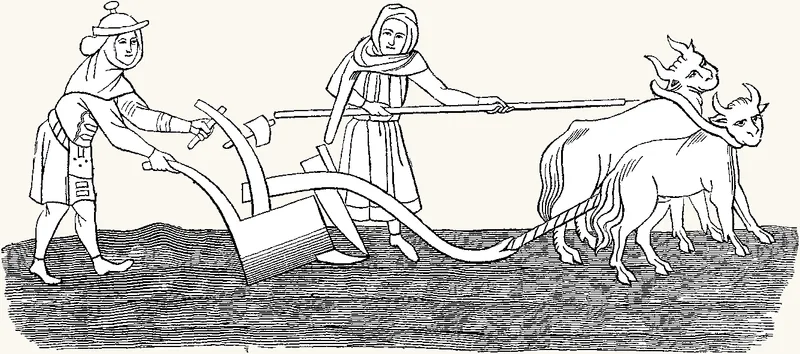
The verses spoken during the ritual include an address to "Erce, Erce, Erce, mother of earth" and a greeting to the earth as "mother of men". Whether Erce was the name of an earth goddess, a corrupted word or a liturgical invention is uncertain, and the charm sets these lines within prayers to the Almighty, Mary and the saints. The Æcerbot is an important example of a Christian agricultural blessing that keeps the form and perhaps some of the language of older rites. A historical note appears in the spellbook entry on the Æcerbot field blessing.
Christian Prayer and Older Belief§
The relationship between charms and the Church was complex. Churchmen such as the homilist Ælfric of Eynsham, writing around the year 1000, condemned the use of incantations, the gathering of herbs with pagan words and the dragging of children through the earth for healing, while approving herbs gathered with prayer. Penitentials prescribed penances for consulting sorcerers and using pagan charms.
Yet the charms themselves were copied by monks and clerics, often in the same manuscripts as liturgical and devotional texts. Karen Louise Jolly has argued that they belong to a "popular religion" in which the boundary between acceptable Christian remedy and forbidden magic was drawn case by case. Charms that invoked Christ, used the Paternoster and the Creed, or required masses and holy water could be accepted as forms of prayer; those that looked to other powers were suspect. The same negotiation runs through later European folk magic and the history of folk Christianity.
Leechcraft as Medicine: Bald's Eyesalve and Modern Tests§
Anglo-Saxon leechbooks were practical medical works, and not every remedy depended on charms. In 2015 a team of microbiologists and medievalists at the University of Nottingham reconstructed a remedy from Bald's Leechbook for a stye, made from an onion or leek, garlic, wine and bovine bile left to stand in a brass vessel, and reported that it killed MRSA bacteria in laboratory tests. The results attracted wide attention. They do not show that early medieval medicine was generally effective, but they suggest that some remedies rested on careful observation and that the leechbooks deserve serious study as medical as well as magical texts.
Modern readers should treat these sources historically. The remedies are not safe guides to treatment, and their ingredients and methods were embedded in a world of belief very different from modern medicine.
Editing and Studying the Charms§
The charms were first made widely available by Oswald Cockayne's three-volume Leechdoms, Wortcunning, and Starcraft of Early England (1864–1866), which printed the texts with translations. Felix Grendon published an influential study of the charms in 1909, and Godfrid Storms's Anglo-Saxon Magic (1948) gathered dozens of charms with commentary, though his search for pagan survivals now seems one-sided. Later scholars, among them Jolly, Hall and Edward Pettit, whose edition of the Lacnunga appeared in 2001, have placed the charms in their manuscript, medical and religious context.
Today the charms are read by historians of medicine and religion, by literary scholars interested in Old English verse, and by modern heathens and folk practitioners who look to them for traces of pre-Christian belief. They remain valuable precisely because they record how ordinary illnesses and misfortunes were understood and treated in early medieval England.
Frequently asked questions§
What is a leechbook?§
A leechbook is an Old English medical book; læce meant "physician". The best known is Bald's Leechbook, a tenth-century collection of remedies that mixes Latin medical learning with herbal recipes, prayers and charms.
What is elf-shot?§
Elf-shot is a term for sudden pain or illness believed to be caused by invisible arrows or spears shot by elves. Old English charms such as Wið færstice list the shot of elves alongside that of gods and hægtessan as possible causes.
Are Anglo-Saxon charms pagan?§
In their surviving form almost all of them are Christian, invoking Christ, the saints and the liturgy, and they were copied by monks. Some contain older imagery, such as elves or the address to the earth in the Æcerbot, but scholars disagree about how much pre-Christian belief they preserve.
Sources and further reading§
- Leechdoms, Wortcunning, and Starcraft of Early England — Oswald Cockayne, 1864
- Anglo-Saxon Magic — Godfrid Storms, 1948
- Popular Religion in Late Saxon England: Elf Charms in Context — Karen Louise Jolly, 1996
- Elves in Anglo-Saxon England: Matters of Belief, Health, Gender and Identity — Alaric Hall, 2007
- Anglo-Saxon Remedies, Charms, and Prayers from British Library MS Harley 585: The Lacnunga — Edward Pettit, 2001
- Leechcraft: Early English Charms, Plantlore, and Healing — Stephen Pollington, 2000