Æcerbot: The Anglo-Saxon Blessing of the Land
The Æcerbot field remedy adapted as a garden or allotment blessing: the four turves, the plough-song to Erce, mother of earth, and the history of the rite.
- TraditionAnglo-Saxon England, field remedy recorded c. 1000
- ForBlessings, Prosperity
- DifficultyAdvanced
- TimeA full day, from before dawn until sunset
- WhenEarly spring before sowing; the rite begins before daybreak and the turves are returned before sunset

Æcerbot, "field remedy" or "land cure", is the longest and most elaborate of the Old English charms. It was meant to restore fertility to land that had failed or been harmed by sorcery, and it weaves together turves cut from the four sides of a field, Latin prayers and masses, a greeting to "Erce, mother of earth", and a loaf laid in the first furrow. Today it is used, in adapted form, as a spring blessing for gardens, allotments and smallholdings.
How to do it§
The steps follow the order of the Old English text, simplified for a garden. Where the original required a priest's masses, a household prayer is suggested instead.
- Before dawn, cut four turves. Take a small clod of earth from each of the four sides (east, south, west, north) of your plot, noting where each came from.
- Anoint them. Mix a spoonful of oil, honey, a pinch of yeast and a little milk. Add a few fallen twigs from trees on the land and a pinch of herbs from the garden (the manuscript asks for "every herb" except one). Drip the mixture three times onto the underside of each turf, with a little water, saying the Latin of Genesis 1:28, Crescite et multiplicamini et replete terram — "Be fruitful, multiply and fill the earth" — and then the Lord's Prayer.
- Take them indoors and bless them. In the original the turves were carried to church, green side towards the altar, while four masses were sung. At home, set them on a clean cloth with the green side facing an icon, cross or window, and spend time in prayer, or read Psalm 65, the harvest psalm.
- Return them before sunset. Make four small wooden crosses and write the names of the four evangelists — Matthew, Mark, Luke, John — on them. Lay a cross in each hole and replace each turf on top of it.
- Turn to the east. Bow nine times towards the rising sun and pray for the land; the manuscript gives a long prayer to the Lord of heaven and earth, and modern users often say the Benedicite or a prayer in their own words.
- Sow, singing to the earth. As you sow or dig the first row, say the famous lines Erce, Erce, Erce, eorþan modor — "Erce, Erce, Erce, mother of earth" — followed by your own request that the Almighty grant the land green growth and a good crop.
- Lay the loaf. Bake or buy a small loaf (the text has it kneaded with milk and holy water) and lay it in the first furrow or row, saying Hal wes þu, folde, fira modor — "Hail to you, earth, mother of mortals" — and asking that the land be filled with food. Cover it with soil. It will feed birds and soil life.
- Close with thanks and the Lord's Prayer, or a simple word of gratitude.
Origins and history§
Æcerbot is preserved in London, British Library, Cotton MS Caligula A VII, a manuscript better known for its copy of the Old Saxon Heliand; the charm was added around the year 1000 and is printed in the standard collections of Old English metrical charms. It is a prose rubric with embedded verse, prescribing what to do if land will not grow well or has been harmed "through sorcery or witchcraft."
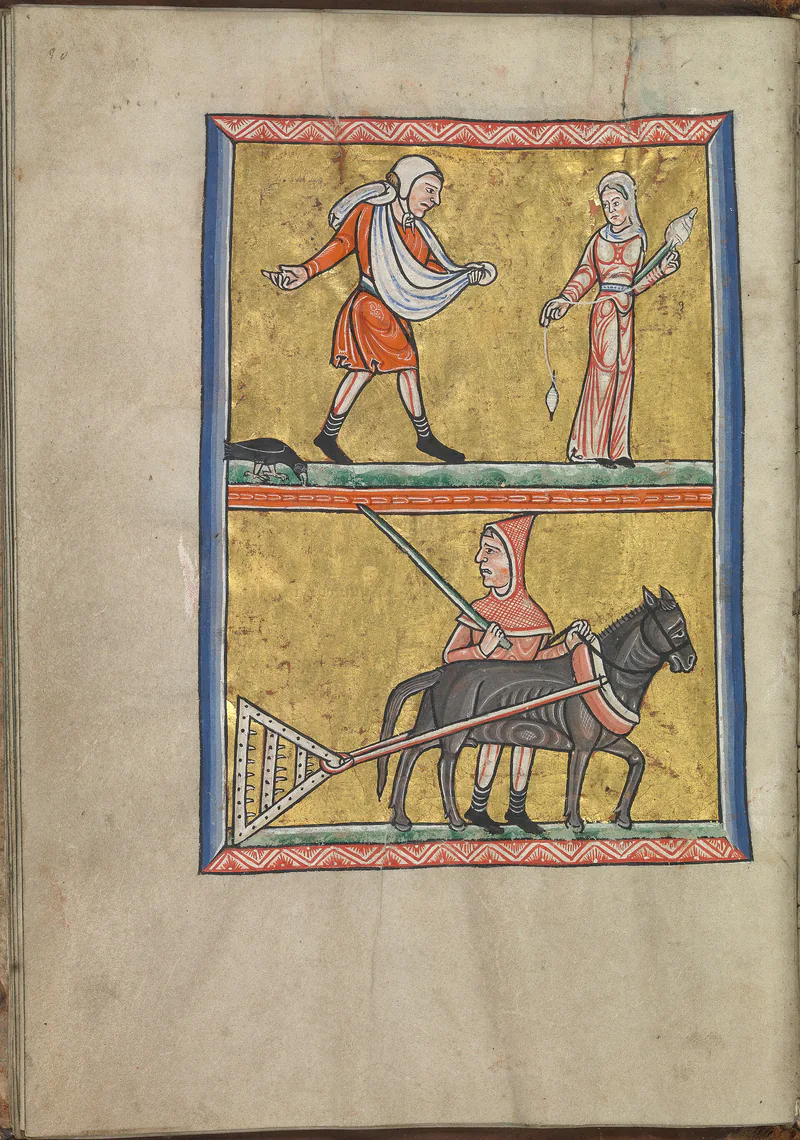
The ingredients and actions are agricultural and symbolic. The turves stand for the whole field; oil, honey, yeast and milk are the produce the land should yield; the original asked for "part of every tree" and "every named herb except buckbean." The plough was censed and anointed with fennel, "hallowed soap" and salt, and seed was to be bought from a beggar at double its value.
The verse invocation to "Erce, mother of earth" has been debated since the nineteenth century. Some writers, from the nineteenth century onward, saw in Erce the name of a pre-Christian earth goddess; others think the word is otherwise unknown and may be a corrupt or nonce formula. The surrounding text is unmistakably Christian — masses, the Trinity, the evangelists, the Sanctus and the Lord's Prayer — and most recent scholars, including Karen Jolly, read the rite as an example of how early medieval Christianity absorbed and redirected older agricultural custom rather than as surviving paganism. Ronald Hutton urges similar caution about reading pagan religion directly from such texts.
The rite is related to later English customs such as Plough Monday and the blessing of seed in parish churches, and to Rogationtide processions round the parish bounds. See folk Christianity and the wheel of the year.
Variations§
- A single bed or pot: a balcony gardener can take one pinch of soil from each corner of a planter and follow the same sequence.
- Rogation-style procession: walking the bounds of a garden with prayers, as English parishes did in the days before Ascension.
- Modern pagan use: some contemporary heathens and witches use the Erce verses alone as an earth blessing, setting the Christian elements aside.
Safety and good sense§
- Only cut turves from land you own or have permission to dig; do not take soil from public parks, nature reserves or protected sites.
- Use fallen twigs; do not strip living trees.
- If you burn incense or a candle, use a heat-proof holder and keep it attended.
- Honey and yeast attract insects; use small amounts.
- Poor growth usually has practical causes — soil, drainage, pests, light — that a soil test or an experienced grower can diagnose.
Sources and further reading§
- The Anglo-Saxon Minor Poems (Anglo-Saxon Poetic Records VI) — Elliott Van Kirk Dobbie, 1942
- Anglo-Saxon Magic — Godfrid Storms, 1948
- Popular Religion in Late Saxon England: Elf Charms in Context — Karen Louise Jolly, 1996
- The Pagan Religions of the Ancient British Isles: Their Nature and Legacy — Ronald Hutton, 1991
- The Stations of the Sun: A History of the Ritual Year in Britain — Ronald Hutton, 1996