The Spellbook · Black & White Magic
Brazilian New Year Simpatias: White Clothes and Seven Waves
Brazilian New Year simpatias for luck: dressing in white, jumping seven waves for Iemanjá, lentils and pomegranate seeds, with their history and meaning.
- TraditionBrazil, 20th century to the present, drawing on Umbanda, Catholic and immigrant customs
- ForLuck, Prosperity, Blessings
- DifficultySimple
- TimeThe evening of 31 December, with each simpatia taking a few minutes
- WhenNew Year's Eve (Réveillon), especially at and just after midnight

On New Year's Eve, millions of Brazilians dress in white, head for the beach and, at midnight, jump seven waves, making a wish with each one. These and other small rites for the turning year are called simpatias — popular charms, often learned from family, friends and magazines, for luck, money and love. They blend Afro-Brazilian devotion to the sea goddess Iemanjá with Catholic, Portuguese and Italian immigrant customs, and are shared by Brazilians of every religion or none.
How to do it§
- Dress in white. Wear white for peace and a clean start. Many add a touch of colour for a particular wish — yellow for money, red or pink for love, green for health and hope, blue for calm. Some choose new clothes, including new underwear, in the colour of their wish.
- Keep pomegranate seeds. Before midnight, eat three pomegranate seeds, making a wish with each, and wrap three (or seven) more seeds in a scrap of paper to keep in your wallet all year for prosperity.
- Go to the water. If you are by the sea, walk to the water's edge shortly before midnight. Inland, many simply step outside, face the east, or stand by a doorway.
- Jump seven waves. As the year turns, step into the shallows and jump seven waves, one after another, facing the sea. With each wave make a wish or a thank-you. In the Umbanda tradition from which the custom grew, the waves honour Iemanjá; others treat it simply as a joyful act for luck.
- Offer flowers. Many throw white flowers into the sea, asking Iemanjá's blessing; if the flowers are carried out rather than returned, it is taken as a good sign. Use only real flowers with no wrapping, and leave nothing else behind.
- Eat lentils. At or just after midnight, eat a spoonful of lentils — said to bring money, since they resemble coins. Some keep a few dried lentils in their wallet.
- Begin with the right foot. Step into the new year on the right foot, and greet the first people you meet with good wishes.
- Keep the charm. Keep the pomegranate seeds in your wallet until the next New Year, then replace them.
Origins and history§
Simpatia comes from the same root as "sympathy" and sympathetic magic: the idea that like influences like. Brazilian folklorist Luís da Câmara Cascudo recorded a great many such popular charms in his Dicionário do Folclore Brasileiro (1954), for love, health, luck and protection, much of it drawing on Portuguese Catholic folk practice brought in the colonial period.
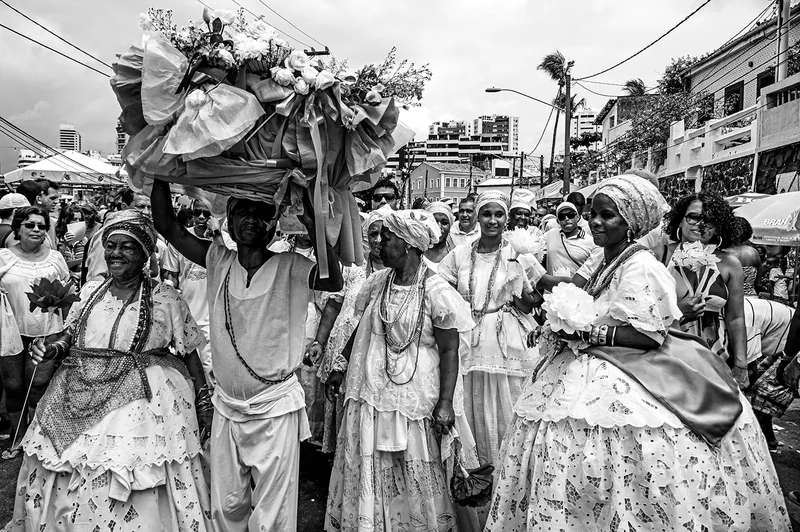
The New Year beach rites have a more specific source. From the mid-twentieth century, followers of Umbanda — an Afro-Brazilian religion that took shape in Rio de Janeiro in the early 1900s, combining African, Catholic, Indigenous and Spiritist elements — gathered on Copacabana and other beaches on 31 December, dressed in white, lighting candles in the sand and sending flowers and small boats out to Iemanjá, the orixá of the sea. In Candomblé and Umbanda white is the colour of Oxalá and of peace. Over the following decades the city's New Year celebrations grew into a mass public event, and white clothes, the seven waves and flowers for Iemanjá became general Brazilian customs, adopted by many with no religious affiliation. Scholars such as Roger Bastide and Diana Brown have studied Umbanda's history; the number seven itself is significant in Umbanda, which organises its spirits in seven "lines".
Other customs arrived with immigrants: lentils at New Year come from Italian tradition (lenticchie), and the pomegranate's many seeds have symbolised abundance across the Mediterranean since antiquity. Eating twelve grapes at midnight, a Spanish custom, is also popular in Brazil. See Candomblé and Umbanda.
Variations§
In Salvador and elsewhere the great festival of Iemanjá is held on 2 February, with offerings carried out to sea by boat. Some Brazilians eat twelve grapes, one for each month, keeping the seeds in their wallet; others keep a bay leaf there instead. Those who honour Iemanjá as members of Umbanda or Candomblé follow the guidance of their own houses, whose rites are learned from initiated elders.
Safety and good sense§
The sea at night is dangerous: stay in the shallows, never go beyond knee depth, never swim after drinking alcohol, and keep children by the hand. Respect lifeguards' flags and local warnings. Do not leave candles, glass, plastic or rubbish on the beach or in the water; flowers should be unwrapped and free of wire. Pomegranate stains clothes. Simpatias are for joy and hope; they are no substitute for financial planning or professional advice.
Sources and further reading§
- The African Religions of Brazil — Roger Bastide, 1960
- Umbanda: Religion and Politics in Urban Brazil — Diana DeG. Brown, 1986
- Dicionário do Folclore Brasileiro — Luís da Câmara Cascudo, 1954
- Carnivals, Rogues, and Heroes: An Interpretation of the Brazilian Dilemma — Roberto DaMatta, 1979
- New Era – New Religions: Religious Transformation in Contemporary Brazil — Andrew Dawson, 2007