Hanging a Hamsa to Protect the Home from the Evil Eye
How a hamsa is hung to protect a Jewish home from the evil eye, with the blessing of Joseph, Talmudic sources, symbolism of the five fingers and history.
- TraditionJewish communities of North Africa and the Middle East; Mediterranean folk custom, medieval to modern
- ForProtection, Home & hearth, Luck
- DifficultySimple
- Time20–30 minutes
- WhenOn moving into a home, after a birth or wedding, or whenever good fortune might attract envy

The hamsa (from the Arabic for "five"; hamesh in Hebrew) is an open right hand, often with an eye in its palm, hung in homes and worn as jewellery across the Middle East and North Africa to turn aside the evil eye. Jewish communities from Morocco to Iraq made it their own, inscribing it with Hebrew blessings, the divine name Shaddai and verses about Joseph, whose descendants the Talmud says the evil eye cannot touch. Hanging one in a new home or above a baby's cradle remains a cherished custom.
How to do it§
- Choose or make the hamsa. Buy one made by a craftsperson, or draw your own on stiff card: an open hand, fingers together, the thumb and little finger often turned outward symmetrically. Blue, the colour long associated with turning the evil eye, is traditional.
- Add a blessing (optional). Jewish hamsas are often inscribed with the word Shaddai ("Almighty"), the priestly blessing (Numbers 6:24–26), or the verse "Joseph is a fruitful bough … by a well" (Genesis 49:22), which the Talmud reads as "above the eye". If you write Hebrew divine names, do so with care; the object will then need to be treated respectfully.
- Choose the place. Hang it facing the entrance inside the main door, in a hall or living room, or above a child's bed. It does not replace the mezuzah, which is a commandment; it is a custom added to it.
- Hang it with a word of blessing. As you fix it in place, a common traditional formula against the evil eye is to recite Genesis 49:22, or to say bli ayin hara, "without the evil eye". You may also read Psalm 121 or Psalm 91 and ask, in your own words, that envy and harm pass by this house and that it be filled with blessing.
- Keep it well. Dust it, and if it breaks, many people say it has "taken" a blow meant for the household; replace it, and bury a broken one bearing Hebrew names.
- Practise its meaning. In Jewish teaching the best protection against the evil eye is a "good eye": generosity and contentment rather than envy. Many families pair the hamsa with giving charity.
Origins and history§
Belief in the evil eye, harm caused by envious or admiring looks, is ancient and widespread around the Mediterranean. The Talmud takes it seriously: in Bava Metzia 107b the sage Rav attributes most deaths to it, and in Berakhot 20a Rabbi Yohanan says the descendants of Joseph are immune, reading Genesis 49:22 ("a fruitful bough by a well", alei ayin) as "a fruitful bough above the eye". Jacob's blessing that Joseph's sons "grow into a multitude" (Genesis 48:16) uses a verb related to fish, and since fish live hidden beneath the water, the same passage says they are untouched by the eye; this is why fish often appear on Jewish hamsas.
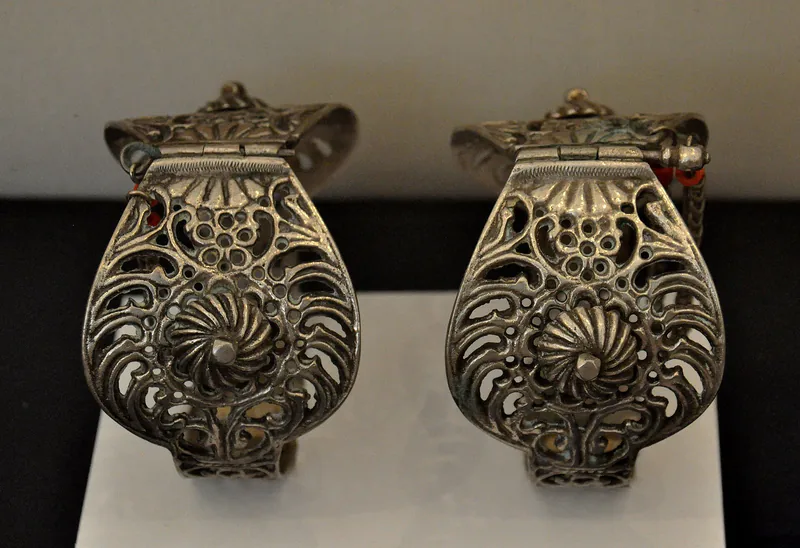
The open-hand amulet itself is harder to trace. Hand motifs appear in ancient Near Eastern and Punic art, but a continuous line to the modern hamsa is not established. Secure evidence becomes plentiful in the medieval and early modern Islamic world: a hand is carved on the outer arch of the Gate of Justice of the Alhambra in Granada (1348). Jewish and Muslim households in North Africa and the Middle East shared the motif, and Jewish silversmiths, who dominated the craft in Morocco and Yemen, produced many surviving examples. Jewish writers linked the five fingers with the five books of the Torah and with the letter he, numerically five, an abbreviation of the divine name.
Since the twentieth century, emigration from North Africa and the Middle East carried the hamsa to Israel, France and the Americas, where it has become a widely recognised emblem of Jewish and Middle Eastern identity as well as a decorative good-luck sign.
Variations§
Some hamsas hang fingers downward as a blessing, others fingers upward as a shield. Many combine the hand with a blue glass eye. Moroccan Jewish women sometimes embroidered hamsas on textiles for brides and newborns. Some rabbinic authorities discourage amulets as superstition, and some families prefer only the mezuzah and prayer.
Safety and good sense§
Fix the hamsa securely, especially above a bed or cot, so that it cannot fall; keep small pendants and chains away from babies and young children. A symbol of protection is no substitute for locks, smoke alarms, or help from doctors, lawyers or the police when needed.
Sources and further reading§
- Jewish Magic and Superstition — Joshua Trachtenberg, 1939
- The Evil Eye: A Casebook — Alan Dundes (ed.), 1981
- Ancient Jewish Magic: A History — Gideon Bohak, 2008
- Jewish Magic before the Rise of Kabbalah — Yuval Harari, 2017
- Binding Words: Textual Amulets in the Middle Ages — Don C. Skemer, 2006
- The Holy Bible (King James Version) — Anonymous, 1611