The Himmelsbrief: Writing a Protective Letter from Heaven
How to write a Himmelsbrief, the German 'letter from heaven' kept in homes and carried by soldiers for protection, and the history of heavenly letters.
- TraditionGerman and Pennsylvania German folk Christianity, printed letters of the 18th–20th centuries
- ForProtection, Blessings
- DifficultyModerate
- Time1 hour or more for a decorated letter
- WhenTraditionally made or bought for a new house, a birth, or a soldier's departure; often renewed at the New Year

A Himmelsbrief ("heaven's letter") is a printed or hand-written sheet that claims, in its traditional form, to have been written by God or delivered by an angel. It urges the reader to keep Sunday holy and live a Christian life, and it promises that the house where it is kept, or the person who carries it, will be protected from fire, flood, lightning and weapons. Such letters were common in German-speaking Europe and among the Pennsylvania Germans, and were carried by soldiers as late as the World Wars. The modern working below writes a personal blessing letter in that form without claiming heavenly authorship.
How to do it§
- Decide its use. A house letter is framed and hung; a travel letter is folded small and carried. Choose the size accordingly.
- Rule the page. Old printed letters had a decorated border, a heading and a block of text, sometimes with a cross or a heart at the top. Pencil a border and a heading line.
- Write a heading. Old letters were often titled "Letter from Heaven" or "House Blessing" (Haussegen). An honest modern heading is "A Blessing for This House" or "A Letter of Protection."
- Write the exhortation. The traditional letters begin by urging the reader to honour God, keep the Sabbath, pray and help the poor. Write two or three sentences of your own intentions: to live kindly, keep a day of rest, and care for others.
- Write the blessing. Then the protection: "May God keep this house and all who live in it from fire and flood, from storm and lightning, from sickness and harm. In the name of the Father, the Son and the Holy Spirit. Amen." Add a verse if you wish; Psalm 91 was a favourite in protective use.
- Decorate it. Add a border of tulips, hearts, stars or birds in the Pennsylvania German Fraktur manner, or keep it plain.
- Bless and place it. Read it aloud once, sign and date it, and hang it near the door, or fold it and carry it in a wallet or bag.
- Renew it when it becomes worn, keeping the old one with family papers or burning it respectfully in a hearth.
Origins and history§
The idea of a letter fallen from heaven is very old. In the late sixth century Bishop Licinianus of Cartagena wrote to condemn a letter said to have descended from heaven onto the altar of St Peter in Rome, demanding stricter observance of Sunday. Versions of this "Sunday letter" circulated throughout the Middle Ages in Latin and many vernaculars, including Old English and Irish, and were repeatedly condemned by church authorities as forgeries, while remaining popular.
From the seventeenth and eighteenth centuries printed German Himmelsbriefe became a staple of chapbook and broadside printing. They typically name a place of discovery and claim to be written in golden letters; they repeat the commandment to keep Sunday, and they promise protection to whoever keeps or carries a copy, and some threaten misfortune to anyone who scorns it or fails to pass it on. Two of the commonest forms are associated with discovery stories set in Holstein and Magdeburg, though wording varies widely between printings.
In Pennsylvania, German printers produced Himmelsbriefe throughout the nineteenth century, and they were kept in family Bibles or framed on walls, sometimes beside the house blessings of Hohman's Long Lost Friend. Soldiers carried them in the American Civil War and German soldiers in the First World War, a practice noted with some alarm by both churches and army chaplains. The folklorist Don Yoder studied the Pennsylvania examples, and Owen Davies places them within the wider history of protective written charms in Grimoires and in his work on popular magic. See folk Christianity and amulets and talismans.
The letters reveal a characteristic blend: their moral message is entirely orthodox — keep the Sabbath, pray, give alms — while the claim of heavenly origin and the promise of invulnerability belong to popular piety rather than to the teaching of any church.
Variations§
- Haussegen: framed house blessings, often in Fraktur, without the claim of heavenly authorship; these are the closest modern equivalent.
- Soldier's letter: folded small, sewn into clothing or carried in a pocket Bible.
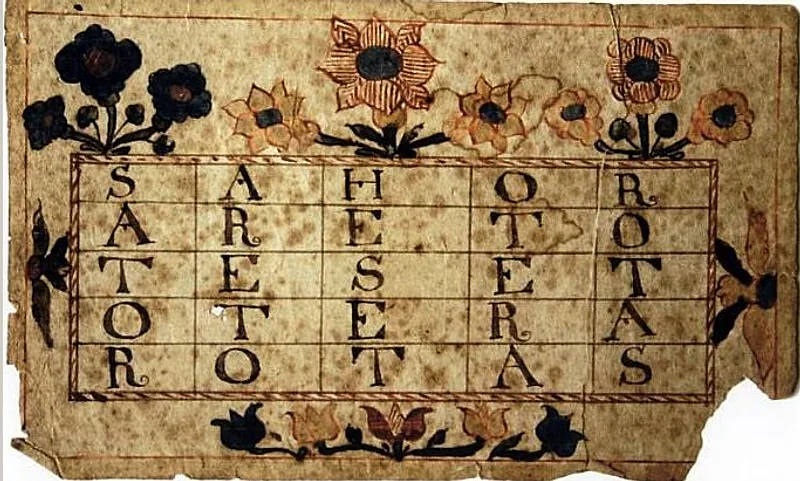
- Sator and Trinity letters: some letters add magic squares, the SATOR formula or strings of crosses; see the SATOR square.
Safety and good sense§
- The old promise of protection against weapons proved tragically false for many soldiers; treat any letter as a prayer, never as armour.
- If you burn an old letter, use a hearth or fire-proof dish, never unattended.
- Present your own letter honestly as your own words; do not circulate it as a message from God or demand that others copy it — a feature of chain letters that churches have always rejected.
- No written blessing replaces insurance, safety equipment or emergency help.
Sources and further reading§
- Grimoires: A History of Magic Books — Owen Davies, 2009
- Popular Magic: Cunning-Folk in English History — Owen Davies, 2003
- Discovering American Folklife: Essays on Folk Cultures and the Pennsylvania Dutch — Don Yoder, 1990
- The Long-Lost Friend: A 19th Century American Grimoire — John George Hohman, ed. Daniel Harms, 2012
- Magic in the Middle Ages — Richard Kieckhefer, 1989