The Spellbook · Black & White Magic
Ægishjálmur: The Helm of Awe as a Protective Stave
The Ægishjálmur or Helm of Awe: how to draw the Icelandic stave and trace it on the brow for courage, with the legend of Fáfnir and its true history.
- TraditionIcelandic galdrastafir, 17th–19th-century manuscripts; name from Old Norse legend
- ForProtection, Courage
- DifficultyModerate
- Time30–45 minutes
- WhenBefore a test of nerve or a difficult meeting; no timing in the sources
Ægishjálmur, the "helm of awe" or "helm of terror," is the name of a magical helmet worn by the dragon Fáfnir in Old Norse legend, and later of a family of Icelandic staves: a central point with eight (or sometimes four) radiating arms ending in forked tines. Icelandic manuscripts describe it being drawn or pressed onto the forehead between the brows to strike fear into enemies and protect the bearer. Today it is used as a symbol of protection and steadiness under pressure. This entry gives a safe way to make and use it, and separates the medieval legend from the later staves.
How to do it§
- Choose a model. Ægishjálmar vary considerably between manuscripts: the number of arms, the shapes of the tines and the crossbars all differ. Choose one historical form and copy it carefully.
- Draw the frame. Mark a centre point and draw a small circle around it. With a ruler, draw eight equally spaced arms outward.
- Add the tines. At the end of each arm draw the trident-like fork; across each arm draw the small crossbars of your model.
- Ink or burn it onto paper or a wooden disc. Some manuscripts specify lead; do not use lead (see Safety).
- Name what you face. Holding the stave, say in your own words what you need courage or protection for: an interview, a hard conversation, a fear to be faced. Keep the request about your own steadiness, not about frightening or controlling anyone.
- Trace it on the brow. Dip a fingertip in a drop of olive oil or clean water and trace a simple form of the stave — a cross of four arms with forks at the ends is enough — on your forehead between the eyebrows, where the manuscripts place it.
- Carry the drawing. Keep the paper or disc in a pocket or bag during the event.
- Afterwards, give thanks in your own words and wash your face. Keep the stave for another time, or burn it in a fire-proof dish.
Origins and history§
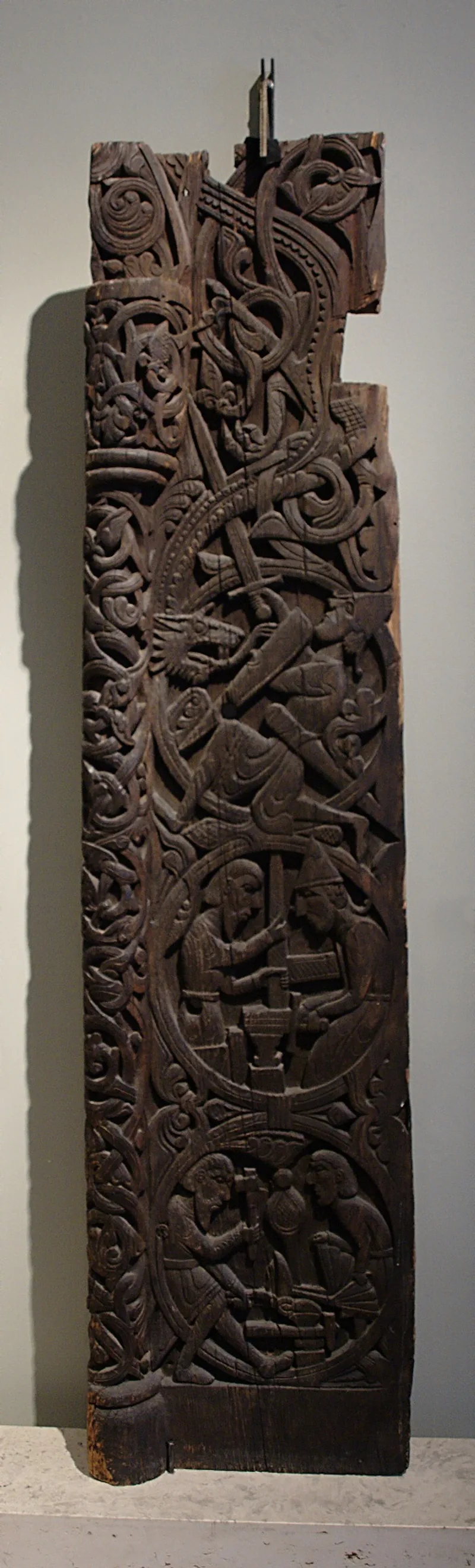
The name comes from legend. In the Eddic poem Fáfnismál and in the thirteenth-century Völsunga saga, the dragon Fáfnir guards a hoard and boasts of wearing the ægishjálmr, the helm of terror, before which all creatures quailed; when Sigurd kills him, he takes it among the treasure. In the older literature it seems to be an object, or perhaps a figure of speech for the dragon's terrifying presence, and no shape is described. See Norse and Germanic religion.
The staves called ægishjálmur belong to the much later world of Icelandic galdrastafir, magical signs recorded in manuscripts mostly of the seventeenth to nineteenth centuries. Several different designs carry the name, in collections such as the Huld manuscript (c. 1860) and in other spell books; the Galdrabók (a sixteenth- to seventeenth-century Icelandic manuscript now in Stockholm) contains related protective and fear-inducing signs. Instructions vary: some say to make the sign in lead and press it between the brows, others to draw it on the forehead with a spoken formula, to be used before meeting enemies or powerful men. The staves draw on runic, Christian and continental grimoire models, and their dating places them in a post-Reformation Christian Iceland, not in the Viking Age.
Like the Vegvísir, the Ægishjálmur has become a popular modern emblem of Norse identity in tattoos, jewellery and heathen religion, where it often stands for protection and the warrior virtues. Some heathen writers interpret its shape as a symbolic projection of power outward from the self. That interpretation is modern but harmonises with the manuscripts' emphasis on courage. Scholars also note the misuse of Norse symbols by extremist groups, which most practitioners reject. See runes and sigils.
Variations§
- Four-armed forms: simpler staves with four tined arms, easy to trace on the brow.
- On a shield or door: modern heathens sometimes paint it on household shields or above doors.
- Combined with runes: Algiz or Tiwaz are sometimes added to the arms; this is a modern practice.
Safety and good sense§
- Lead is toxic. Do not use lead to make or press the sign, and do not handle old lead objects without gloves.
- Do oil-tracing only on unbroken skin; patch-test any oil first, and use plain olive oil rather than essential oils near the eyes.
- If you burn a paper or wooden stave, use a fire-proof dish and keep it attended.
- Anxiety that stops you living normally deserves real support from a doctor or counsellor; a symbol can accompany that, not replace it.
- Use the stave for your own courage, never to intimidate or threaten others.
Sources and further reading§
- The Galdrabók: An Icelandic Grimoire — Stephen E. Flowers, 1989
- Norse Mythology: A Guide to the Gods, Heroes, Rituals, and Beliefs — John Lindow, 2001
- The Saga of the Volsungs — trans. Jesse L. Byock, 1990
- Runes: A Handbook — Michael P. Barnes, 2012
- Grimoires: A History of Magic Books — Owen Davies, 2009