Bes and Taweret: Ancient Egyptian Household Protection
How ancient Egyptians protected home, sleep and childbirth with the gods Bes and Taweret: amulets, ivory wands, painted walls and spells, told as history.
- TraditionAncient Egypt, Middle Kingdom to Roman period (c. 2000 BCE–3rd century CE)
- ForProtection, Home & hearth
- Presented asHistory only
- WhenProtection was renewed at critical times: pregnancy, birth, the first days of an infant's life, and at night

In ancient Egypt the most beloved protectors of the home were not the great state gods but two fierce, homely figures. Bes was a lion-maned dwarf who stuck out his tongue and brandished knives. Taweret was a pregnant hippopotamus goddess with a lion's paws and a crocodile's back. Together they guarded sleepers, mothers in childbirth and newborn children against the snakes, demons and wandering dead that Egyptians feared most at night. Their protection survives in thousands of amulets, carved wands and painted walls, and in spells that are presented here as history.
Why this entry is historical§
Egyptian household protection was performed by trained practitioners, often lector-priests or wise women, who spoke spells identifying themselves with gods and commanding hostile spirits to depart. Some remedies used animal substances. Reconstructing these spells as a working rite would mean taking them out of the religious world that gave them meaning. This entry therefore describes what the sources show. Modern devotees of Egyptian religion (Kemetic practitioners) have their own contemporary forms.
How it was done§
- Amulets on the body. Small amulets of Bes and Taweret, usually in blue-green faience, were worn on cords by women and children, especially during pregnancy and infancy. Taweret is often shown leaning on the sa sign, the hieroglyph for "protection".
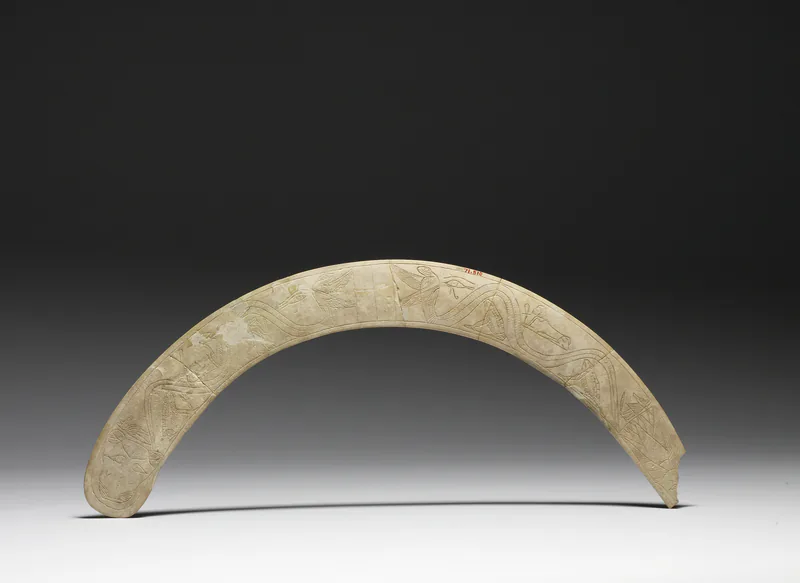
- The magic wand. In the Middle Kingdom (c. 2000–1650 BCE), curved "wands" cut from hippopotamus ivory were incised with processions of protective beings: Taweret, an early form of Bes, lions, griffins, serpents and the sun. Several carry inscriptions promising protection "by day and by night" for a named mother or child. Wear on their tips suggests they were used, perhaps to trace a protective boundary around the bed.
- Protected beds and headrests. Headrests and bed frames were carved with Bes figures so that he would guard the sleeper from bad dreams and from snakes and scorpions.
- Painted walls. At the workmen's village of Deir el-Medina (New Kingdom, c. 1550–1070 BCE), many houses had a raised, enclosed platform in the front room decorated with Bes figures and scenes of women and infants. Its function is debated: it may have been a shrine, a birthing place or a bed, but it was clearly a place of household protection.
- Spoken spells. Papyrus Berlin 3027, the so-called Spells for Mother and Child, collects incantations to drive off a female demon who came in the night to harm infants. The speaker addresses her and orders her out of the house, and amulets were knotted while the words were spoken. Other papyri include spells against snakes, scorpions and nightmares.
- Statues of Horus. In the Late Period (664–332 BCE) and later, small stelae called cippi showed the child Horus standing on crocodiles and holding snakes, with Bes's face above him. Water poured over their spells was believed to absorb their power against bites and stings.
Origins and history§
Bes and Taweret were not single deities so much as types. Egyptologists use "Bes" for a family of related dwarf-lion figures, known under many names, whose images go back to the Old Kingdom and become common from the Middle Kingdom onward. Taweret ("the Great One") belongs with other hippopotamus goddesses such as Ipet and Reret. Hippos were dangerous animals, and their ferocity was turned to protection. As a group these beings were guardians whose frightening looks were turned against threats from outside the house.
Robert Ritner showed that Egyptian magic (heka) was not opposed to religion. It was a power the gods themselves used and gave to humans, and practitioners worked through words, images and ritual action. Geraldine Pinch's work on household magic emphasises how much of it concerned the dangers of childbirth and infancy, in a society where many children died young. The cult of Bes and Taweret spread far beyond Egypt. Bes amulets turn up across the Phoenician and Punic Mediterranean, and Bes remained popular, with an oracle at Abydos, into the Roman period.
Safety and good sense§
Ancient amulets and reproductions are objects of history and devotion; they are not medical protection. Pregnancy, childbirth and infant health need proper medical care. Never use water poured over painted or glazed objects for drinking or treating wounds.
Sources and further reading§
- Magic in Ancient Egypt — Geraldine Pinch, 1994
- The Mechanics of Ancient Egyptian Magical Practice — Robert K. Ritner, 1993
- Amulets of Ancient Egypt — Carol Andrews, 1994
- The Complete Gods and Goddesses of Ancient Egypt — Richard H. Wilkinson, 2003
- Handbook of Egyptian Mythology — Geraldine Pinch, 2002