Lamashtu Amulets: Babylonian Protection for Mother and Child
How Babylonians and Assyrians protected pregnant women and infants from the demoness Lamashtu with plaques, Pazuzu heads and rituals, told as history.
- TraditionAncient Mesopotamia, Old Babylonian period to the 1st millennium BCE (c. 1800–300 BCE)
- ForProtection, Healing
- Presented asHistory only
- WhenPregnancy, childbirth and the weeks after birth; some rites were timed to particular days of the month

Lamaštu was the most feared demon of ancient Mesopotamia. She was the daughter of the sky god Anu, cast down from heaven for her wickedness, and she preyed on pregnant women, mothers in childbirth and newborn infants, causing miscarriage, fever and death. Against her, Babylonian and Assyrian families used carved amulets, protective cords and elaborate rituals that sent her away with gifts. These objects, now in museums across the world, are some of the most striking survivals of ancient magic. They are presented here as history.
Why this entry is historical§
The rites against Lamaštu were performed by professional exorcists. They addressed and commanded a demon, used animal parts in some recipes, and belonged to a medical-religious system that answered real and terrible dangers of childbirth. They are described here as scholars reconstruct them; they are not a practice to repeat.
How it was done§
- The image of the enemy. Lamaštu was depicted with a lion's head, donkey's teeth and ears, a hairy body and a bird's talons. She held snakes in her hands and suckled a dog and a pig at her breasts. Showing her in this form on an amulet was itself protective: the demon was named, pictured and so brought under control.
- Lamaštu plaques. From the Neo-Assyrian period (9th–7th century BCE) come small stone and bronze plaques, pierced for hanging in the house or on the body. A typical plaque shows Lamaštu kneeling on a donkey in a boat on a river, being driven away, with the gifts prepared for her journey around her. The head of the wind demon Pazuzu often peers over the top, or his whole body forms the back of the plaque.
- Pazuzu heads. Small heads of Pazuzu in stone, bronze or faience were worn by pregnant women. Pazuzu was himself a dangerous demon, king of the evil winds, but he was believed to drive Lamaštu back to the underworld. Using one demon against another was a common Mesopotamian strategy.
- Cords and beads. The incantation series prescribes cords of coloured wool knotted with beads of particular stones, worn on the mother's wrists and ankles or around the infant's neck while incantations were recited.
- Gifts and dismissal. The ritual tablets describe making a clay figurine of Lamaštu and furnishing it, like a traveller, with a comb, a spindle, a flask of water, sandals, a brooch and provisions. The figure was set before a dog and a pig or placed on a model boat, then carried out of the house to the steppe or the river after three days of recitations. The demon was courteously but firmly sent on her way.
- Incantations. Spoken formulas named Lamaštu by her seven names, recounted her expulsion from heaven, and adjured her by the great gods to leave the house and never return.
Origins and history§
Incantations against Lamaštu are among the oldest Mesopotamian magical texts. Examples survive from the Old Babylonian period (c. 1900–1600 BCE), and the canonical series of three tablets was standardised in the late second or early first millennium BCE. Walter Farber's 2014 edition gathers all the known manuscripts and related rituals. Frans Wiggermann's profile of the demon shows how Lamaštu differed from most Mesopotamian demons: she acted on her own malice rather than as an agent of divine punishment, which made her especially frightening.
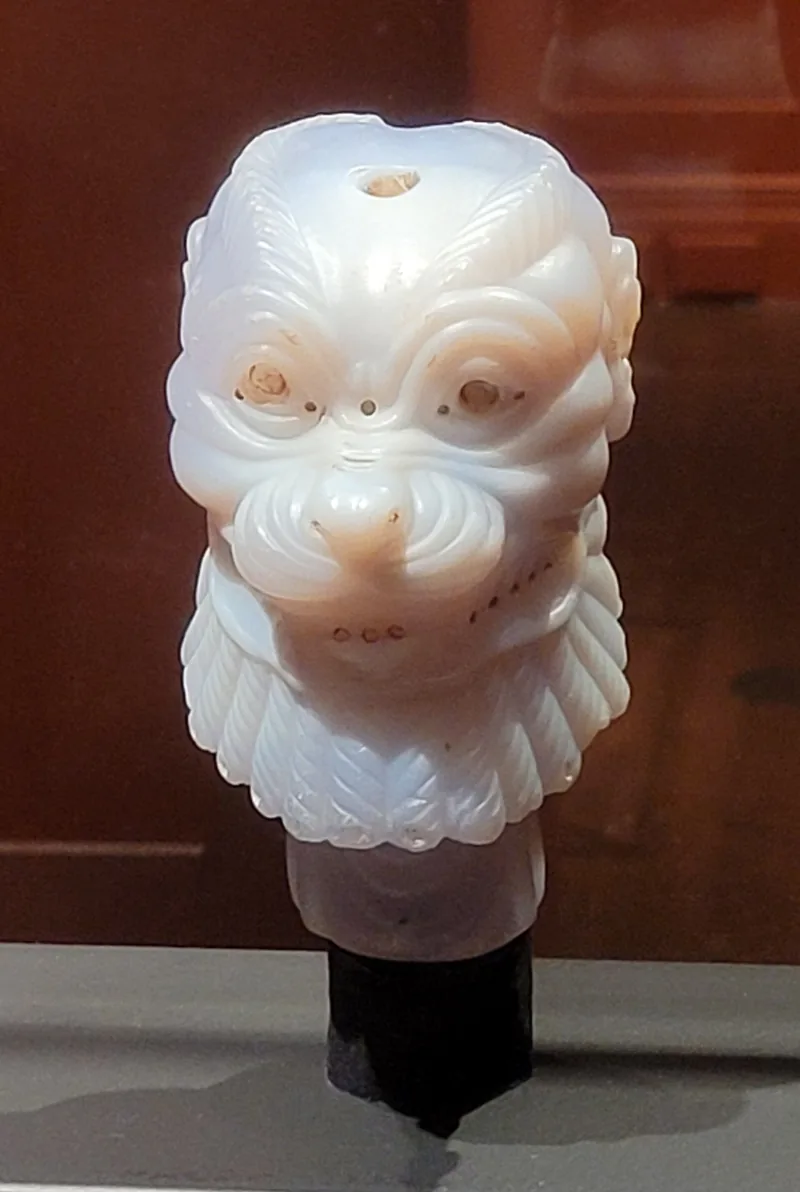
The plaques have been found at Assur, Nineveh, Nimrud, Babylon and as far away as the Levant and Iran, showing that the cult of protection crossed borders. Nils Heeßel's study of Pazuzu traces the rise of that demon as Lamaštu's adversary in the first millennium. The world these objects reflect is one of very high maternal and infant mortality. Mesopotamian healers (asû) and exorcists (āšipu) worked side by side, combining herbal treatment, practical care and ritual.
The figure of a child-killing demoness travelled widely. Scholars have compared Lamaštu with the Greek Lamia and Gello and with Lilith in later Jewish amulet traditions. The comparisons are suggestive, though the lines of influence are debated.
Safety and good sense§
Pregnancy, childbirth and infant fevers need proper medical care; no amulet, ancient or modern, can replace it. Original Mesopotamian amulets are protected antiquities, and buying unprovenanced pieces can fuel looting.
Sources and further reading§
- Lamaštu: An Edition of the Canonical Series of Lamaštu Incantations and Rituals and Related Texts — Walter Farber, 2014
- Birth in Babylonia and the Bible: Its Mediterranean Setting — Marten Stol, 2000
- Gods, Demons and Symbols of Ancient Mesopotamia — Jeremy Black and Anthony Green, 1992
- Pazuzu: Archäologische und philologische Studien zu einem altorientalischen Dämon — Nils P. Heeßel, 2002
- Religion in Ancient Mesopotamia — Jean Bottéro, 2001