Greek Mati: Blue-Eye Protection and the Xematiasma
The Greek mati: how the blue eye bead is used for protection, how the oil-in-water xematiasma checks for the evil eye, and the history from baskania to today.
- TraditionModern Greek folk Orthodoxy, with roots in ancient Greek baskania
- ForProtection, Cleansing
- DifficultySimple
- Time15 minutes
- WhenAt need, and when a new baby, house, car or business is first shown to others

In Greece the evil eye is to mati ("the eye") or matiasma, and the person afflicted is said to be matiasmenos. It is blamed for sudden headaches, yawning and lethargy, a failed cake, or the misfortunes that follow too much praise. Two remedies sit side by side: the blue glass eye, also called a mati, worn or hung to deflect the gaze, and the xematiasma, a quiet rite of oil, water and prayer, usually performed by a grandmother, that lifts it. This entry gives the protective use of the mati and the diagnostic part of the rite.
How to do it§
Wearing and hanging the mati§
- Choose the eye. The classic mati is a disc of dark-blue glass with concentric white, light-blue and black rings. Buy or receive one; many families give them to newborns and newlyweds.
- Bless it if you wish. Hold it, make the sign of the cross, and say a short prayer in your own words: "Lord, keep the one who wears this from envy and harm."
- Hang or wear it. Wear it on a bracelet or necklace, pin it inside a bag, hang it by the front door, in a car, or over a shop counter. Red thread is a common pairing.
- When it cracks. Folk belief holds that a cracked or broken mati has absorbed an eye. Thank it, wrap it in paper and dispose of it, and replace it.
Checking with oil and water§
- Fill a glass with clean water and set it before you.
- Make the sign of the cross over the water three times.
- Drop oil. With a fingertip let three drops of olive oil fall into the water.
- Read them. If the drops float as separate circles, there is no eye. If they spread or sink, the person is said to be matiasmenos.
- Lift it. The traditional words of the xematiasma are secret and are taught in person, in many regions across the sexes — a woman teaching a man, a man a woman. If you have not been taught them, say the Lord's Prayer or a prayer of your own and repeat the oil drops until they hold their shape.
- Finish. Make the cross with the water on the person's forehead, and pour the rest away outside or down the drain.
Origins and history§
The ancient Greeks called the harmful glance baskania, and amulets against it are among the most common finds from the Greek and Roman world. Plutarch's Table Talk includes a discussion of how envy might act through the eyes, and the Athenian "eye-cups" of the sixth century BCE, painted with great staring eyes, are often interpreted as protective, though their purpose is debated. Large "eye" designs and phallic charms were used to turn the gaze aside. See Greek religion.
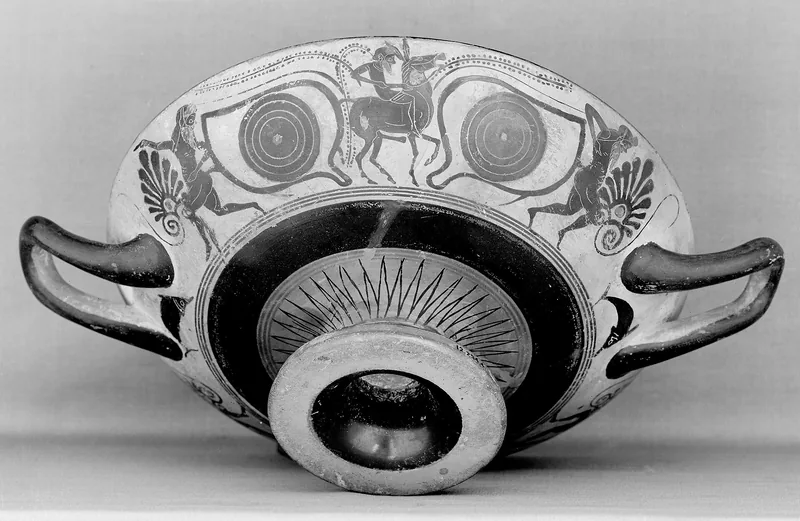
Glass eye beads are an ancient Mediterranean and Near Eastern craft; the modern blue-and-white bead is shared across the eastern Mediterranean, where in Turkey it is called nazar boncuğu. The blue colour is often linked to the belief that blue-eyed people were especially likely to cast the eye, so that "like repels like," though this is folk explanation rather than documented history.
The Orthodox Church has had a complex relationship with these beliefs. It recognises envy as a spiritual danger and includes a prayer against vaskania in its book of blessings (Euchologion), to be read by a priest; it also discourages trust in amulets and secret charms. Anthropologists such as Richard and Eva Blum, whose The Dangerous Hour (1970) studied rural Greek crisis lore, and Charles Stewart, in Demons and the Devil (1991), describe how villagers moved between priestly prayer and the household rite without feeling a contradiction. See Eastern Orthodox Christianity.
The custom of transmission across the sexes, and the belief that the healer will yawn or feel heavy as the eye leaves the patient, are widely reported in Greek ethnography. The rite remains common in Greece and the diaspora today, often half in earnest and half as family custom.
Variations§
- Saying "ftou ftou": a mimed spit, often three times, after a compliment to a child, to avert envy.
- Garlic: a clove carried, or the word skorda ("garlic") said, as a verbal charm.
- Priest's prayer: the formal Orthodox prayer against vaskania, read by a priest.
- Italian malocchio: a near relation; see Malocchio: the oil-and-water rite.
Safety and good sense§
- Never attach beads or amulets to a baby's clothing, dummy, cot or pram: they are a choking and strangulation hazard. Hang them out of reach.
- Lethargy, headaches and a fretful child can have medical causes; see a doctor when symptoms persist.
- Do not mix the folk rite with the Church's own sacraments without the guidance of a priest, if you are Orthodox.
- If a candle or oil lamp is lit before an icon, keep it in a secure holder and never leave it unattended.
Sources and further reading§
- The Evil Eye: A Casebook — Alan Dundes (ed.), 1981
- The Dangerous Hour: The Lore of Crisis and Mystery in Rural Greece — Richard Blum & Eva Blum, 1970
- Demons and the Devil: Moral Imagination in Modern Greek Culture — Charles Stewart, 1991
- The Evil Eye: An Account of This Ancient and Widespread Superstition — Frederick Thomas Elworthy, 1895
- Witchcraft and Magic in Europe: Ancient Greece and Rome — Valerie Flint, Richard Gordon, Georg Luck & Daniel Ogden, 1999