The Abracadabra Triangle Amulet of Serenus Sammonicus
How the Abracadabra triangle amulet is written and worn, from Serenus Sammonicus's Roman medical poem to plague-time London, with its meaning and history.
- TraditionRoman medical verse, Quintus Serenus, Liber medicinalis (c. 3rd century AD); later European folk use
- ForHealing, Protection
- DifficultySimple
- Time15 minutes to make; worn for nine days
- WhenMade when needed; later folk custom preferred a waning moon, so that the illness should wane with the word

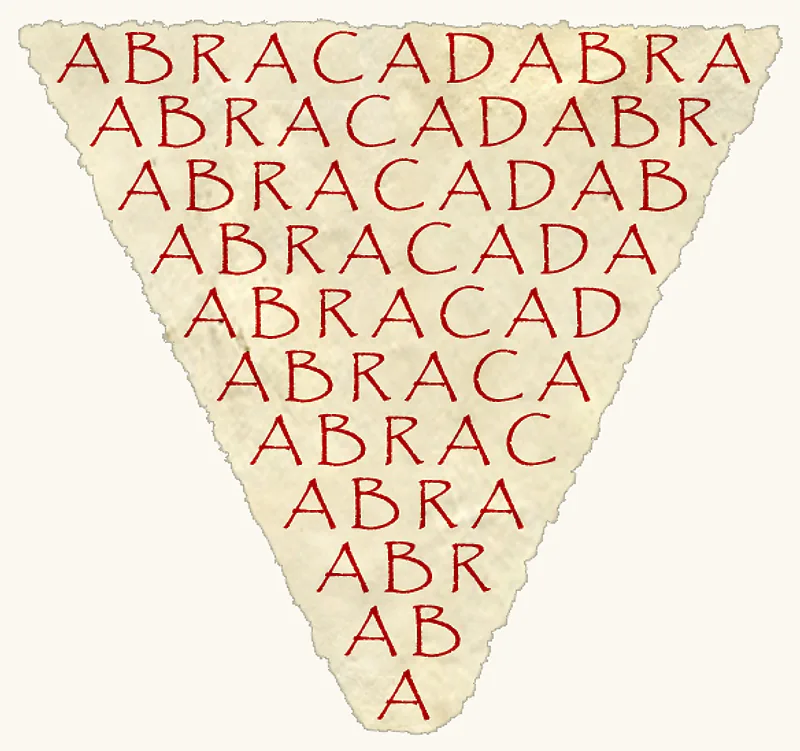
The Abracadabra triangle is a written amulet in which the word ABRACADABRA is set down again and again, one letter shorter each time, until it dwindles to a single A. It first appears in a Latin medical poem of the Roman Empire, the Liber medicinalis attributed to Serenus Sammonicus, as a remedy against a recurring fever, and the idea is that the illness shrinks as the word does. For more than fifteen centuries it was worn round the neck as a healing and protective charm.
How to do it§
Prepare. Cut a strip of paper about the size of a playing card. Sit quietly, wash your hands, and hold in mind the person you wish well (yourself or someone who has asked for the charm), and the trouble you hope will diminish: a lingering illness, a worry, a run of bad luck.
Write the triangle. Write the full word on the top line, then repeat it beneath, dropping the last letter on each line, so that the letters form a downward-pointing triangle:
A B R A C A D A B R A
A B R A C A D A B R
A B R A C A D A B
A B R A C A D A
A B R A C A D
A B R A C A
A B R A C
A B R A
A B R
A B
A
Serenus says only that the word is to be written repeatedly, each time with a letter removed, until it narrows to a cone. Some later writers drop a letter from each end instead.
Speak an intention. As you write each line you may say quietly, in your own words, "As this word grows less, so may the sickness lessen." (This phrasing is modern.)
Bind and wear. Fold the paper, tie it with linen thread as Serenus directs, and hang it round the neck, or keep it in a small pouch close to the body.
Finish. Later custom wore the charm for nine days. Then it was removed without being unfolded. Folk practice told the wearer to throw it backwards over the shoulder into running water before sunrise; a tidier modern equivalent is to burn the paper safely in a heat-proof dish, or bury it in the garden, giving thanks for recovery.
Origins and history§
The Liber medicinalis is a didactic poem of about 1,100 hexameter lines giving remedies for ailments from head to foot. It is traditionally ascribed to Quintus Serenus Sammonicus, a learned man murdered on the orders of the emperor Caracalla in 211 or 212, or to his son of the same name; some scholars date the poem later in the third or even fourth century, so the authorship is uncertain. In the chapter on the hemitritaeus, a semi-tertian fever, the poet prescribes writing the word ABRACADABRA in diminishing lines and hanging it from the neck with linen. The poem was widely copied in monasteries and printed from the fifteenth century, which kept the charm in circulation.
The origin of the word itself is unknown. Suggested derivations from Aramaic ("I create as I speak") or from the Gnostic name Abrasax are popular but unproven. What scholars can say is that diminishing words were an established technique: the Greek Magical Papyri and late antique amulets contain "wing" or "heart" shapes in which names are reduced letter by letter to banish a demon or a disease.
The charm had a long afterlife. It appears in medieval and early modern collections of remedies, and Daniel Defoe's A Journal of the Plague Year (1722), recalling London in 1665, describes people wearing the word written in a triangle as a protection against the plague, which Defoe regarded as superstition. By the nineteenth century "abracadabra" had become a stage magician's catchword, and the amulet a curiosity of museum collections.
Variations§
Some versions write the triangle in an inverted cone bounded by lines, or add a cross beneath. Similar diminishing charms use other names, and Jewish and Christian amulets sometimes reduce a demon's name in the same way so that its power fades.
Safety and good sense§
If you burn the finished amulet, use a heat-proof dish on a stable surface, keep it away from anything flammable, and never leave a flame unattended. Do not tie anything tightly around a child's neck, and never put cords near infants or young children. Fever can be serious: the charm is a token of care, never a substitute for medical diagnosis and treatment.
Sources and further reading§
- The Greek Magical Papyri in Translation — Hans Dieter Betz (ed.), 1986
- Binding Words: Textual Amulets in the Middle Ages — Don C. Skemer, 2006
- Magic in the Middle Ages — Richard Kieckhefer, 1989
- Ancient Christian Magic: Coptic Texts of Ritual Power — Marvin Meyer & Richard Smith, 1994
- Curse Tablets and Binding Spells from the Ancient World — John G. Gager, 1992
- The Archaeology of Ritual and Magic — Ralph Merrifield, 1987