Roman Lararium Offering to the Household Lares
How Romans honoured the Lares at the household lararium with incense, wine, garlands and cakes on the Kalends, Nones and Ides, and a modern form of the rite.
- TraditionRoman domestic religion, Republic and Empire (c. 3rd century BCE–4th century CE); revived in modern Roman polytheism
- ForHome & hearth, Blessings, Protection
- DifficultySimple
- Time15 minutes
- WhenThe Kalends (1st), Nones (5th or 7th) and Ides (13th or 15th) of each month, and on family occasions; a brief daily greeting is also traditional

Every Roman household had its own gods. The Lares watched over the house, its land and its people; the Penates guarded the storeroom; Vesta lived in the hearth; and the Genius was the life-spirit of the head of the family. They were honoured at the lararium, a niche or small shrine in the house, with simple offerings of incense, wine, garlands and food. The rite was short and regular. It sought the protection and prosperity of the household, and it is easy to adapt today.
How to do it§
- Set up the lararium. Choose a shelf or niche in a central place, near the kitchen or the entrance as in many Pompeian houses. Place images of the Lares there; the classic type shows two young men in short tunics, dancing, each holding a drinking horn and a bowl. A printed image or simple figure is fine. Many modern practitioners add a figure or symbol for the Genius and for Vesta.
- Choose the day. Make the full offering on the Kalends, Nones and Ides of the month, and on birthdays, after a journey or at other family events. A brief greeting of the Lares each morning is also traditional.
- Wash and cover the head. Wash your hands. Roman custom was to pray with the head covered (capite velato), drawing a fold of the toga or a cloth over the back of the head.
- Garland the shrine. Hang a garland or set fresh flowers before the Lares.
- Offer incense. Light a little frankincense in a heat-proof burner and say a few words of greeting.
- Pray. Roman prayers were direct and precise. Address the gods by name and state what you ask and what you give. An original sample: "Lares of this house, I give you this incense and this wine, as is right. Be favourable to this house and to all who live in it; keep it safe and let it prosper."
- Pour the libation and offer the food. Pour a little wine or grape juice into the bowl and set out a small cake, a piece of bread or a pinch of salted grain. Romans also gave the Lares any food that fell from the table during a meal.
- Close. Stand a moment in silence, then turn to your right, as Romans did after prayer. Remove the food later in the day; it may be placed in the garden or burned in a safe outdoor fire, and the wine poured on the earth.
Origins and history§
The Lares are among the oldest Roman gods. They were honoured at crossroads (Lares compitales), on farms and in houses, and their origins are debated: some scholars see them as spirits of place, others as deified ancestors. By the late Republic the Lar familiaris was firmly the guardian of the household as a unit, including its slaves.
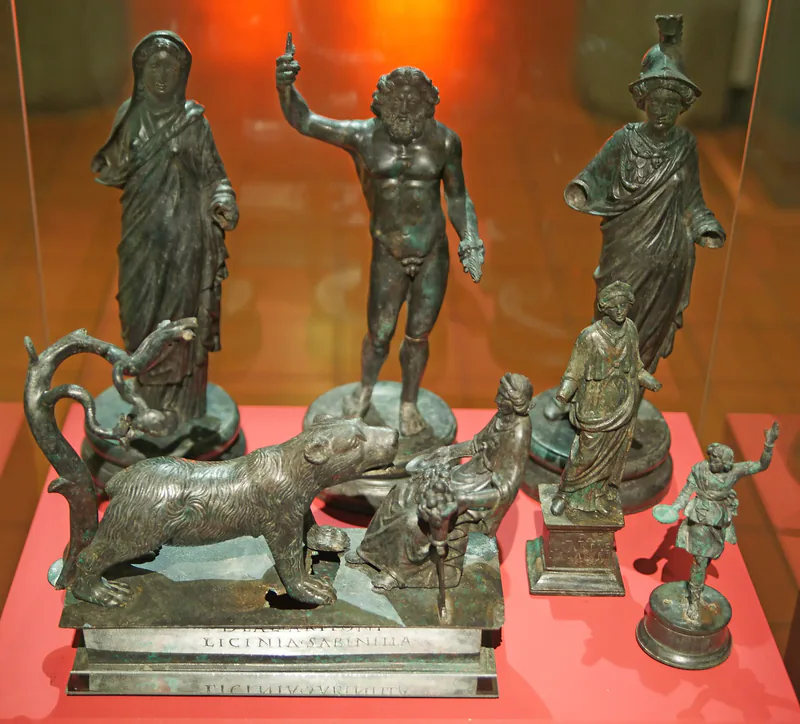
Two early literary witnesses show the domestic cult at work. In his farming manual On Agriculture (c. 160 BCE), Cato the Elder instructs the farm housekeeper to hang a garland over the hearth on the Kalends, Ides and Nones and on holidays, and to pray to the household Lar as her means allow. In the prologue to Plautus's comedy Aulularia (c. 190 BCE), the Lar himself speaks. He explains that he has protected the family for generations and favours the daughter of the house, because she honours him every day with incense, wine or garlands.
Archaeology adds a vivid picture. Pompeii and Herculaneum, buried in 79 CE, preserve dozens of painted lararia: the dancing Lares flanking a togate Genius who pours a libation, with serpents below. Harriet Flower's study of these paintings and of the street-corner cult shows that the Lares were a religion of ordinary people, slaves and freedmen as well as citizens. Augustus reorganised the neighbourhood cult and joined his own Genius to it. The household cult was finally forbidden, along with other pagan worship, by the emperor Theodosius I in 392 CE.
Variations§
The winter festival of the Compitalia honoured the Lares of the crossroads, and households hung woollen figures on their doors. On a boy's coming of age he dedicated his childhood amulet (bulla) to the Lares. Modern practitioners of Religio Romana keep lararia in flats with tea-light lamps and printed images, following the same calendar.
Safety and good sense§
Burn incense on a heat-proof base, away from flowers, curtains and shelves above, and never leave it smouldering unattended; ventilate the room. Use grape juice instead of wine where children take part. A household shrine expresses gratitude and care for a home; it does not replace practical safety or professional help.
Sources and further reading§
- On Agriculture — Cato the Elder, trans. W. D. Hooper and H. B. Ash, 1934
- The Dancing Lares and the Serpent in the Garden: Religion at the Roman Street Corner — Harriet I. Flower, 2017
- An Introduction to Roman Religion — John Scheid, 2003
- Religion of the Romans — Jörg Rüpke, 2007
- Religions of Rome — Mary Beard, John North and Simon Price, 1998