Gaelic House Blessing from the Carmina Gadelica
A Gaelic house blessing in the manner of the Carmina Gadelica: how to bless a home room by room, and the history of Alexander Carmichael's collection.
- TraditionGaelic-speaking Scottish Highlands and Hebrides, collected 1860–1909
- ForBlessings, Home & hearth, Peace
- DifficultySimple
- Time15–20 minutes
- WhenOn moving into a new home, at the New Year, or at Candlemas and other feasts; no lunar rule

The Carmina Gadelica ("Gaelic songs") is Alexander Carmichael's great collection of prayers, blessings, charms and hymns gathered from Gaelic-speaking crofters, fishers and cottars of the Scottish Highlands and Islands in the later nineteenth century. Among them are blessings for the house — for its beams and walls, its hearth and door, and all who sleep under its roof. This working follows that pattern: a walk through the home naming each part and placing it under the protection of the Trinity, Mary, Brigid and Michael.
How to do it§
Carmichael's texts are in his own Gaelic and English versions; the lines below are a simple original wording in their manner, not a quotation.
- Prepare. Tidy and air the house; Gaelic households blessed a home that had been cared for. Fill a bowl with clean water and light a candle in a secure holder in the main room.
- Begin at the door. Stand inside the front door, make the sign of the cross if that is your practice, and say: "God bless this house, from its foundation to its roof, from its door to its hearth."
- Walk sunwise. Move through the rooms in a clockwise direction — deiseil, "sunwise", the auspicious direction in Gaelic custom. In each room touch the wall, sprinkle a few drops of water, and name what the room is for: "Bless the table and the bread upon it," "Bless the bed and the sleep in it," "Bless the hands that work here."
- Name the household. At the hearth or kitchen, name each person and creature who lives there: "God bless the people of this house, and every guest who comes in at its door."
- Call the guardians. Gaelic blessings place the household under the care of the Three — Father, Son and Spirit — and often of Mary, Brigid, Michael and Columba. Say: "The Three be over this house; Mary and Brigid be about it; Michael keep its door."
- Close at the threshold. Return to the door and say a closing line such as "Peace on this house tonight and every night," then put the candle out.
- Dispose of the water by pouring it on the doorstep or garden, a common way of returning blessed water to the ground.
Origins and history§
Alexander Carmichael (1832–1912) was an exciseman whose work took him across the Hebrides and western Highlands. From the 1860s he wrote down prayers, songs, lore and charms from hundreds of people, often elderly, in Uist, Barra, Skye and elsewhere. The first two volumes of Carmina Gadelica appeared in 1900 in a lavish edition with Gaelic and English on facing pages; later volumes, edited from his papers by James Carmichael Watson and Angus Matheson, followed between 1940 and 1971.
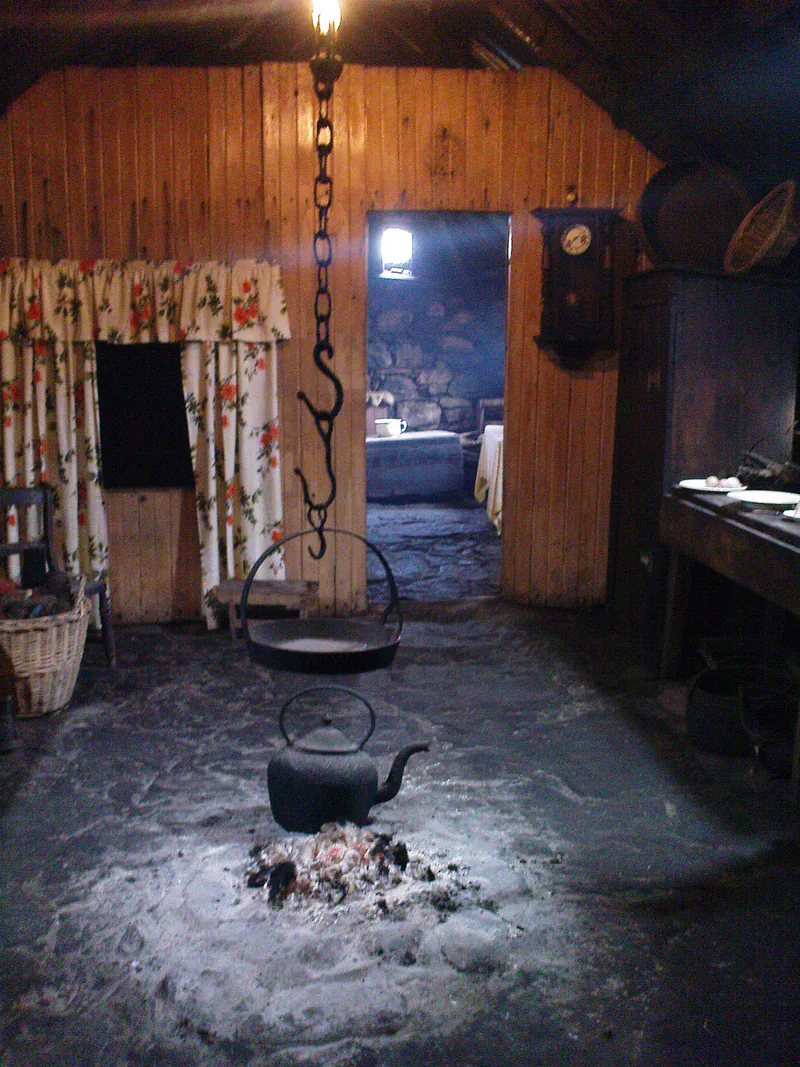
The house blessings sit among prayers for every part of the day and year: kindling the fire, smooring it at night, milking, herding, weaving, going on a journey, and lying down to sleep. Their vocabulary is Catholic and Presbyterian Gaelic piety, with the Trinity, Mary, Christ, Brigid and Michael appearing constantly, and with a strong sense of the sacred in ordinary work.
The collection has also been the subject of scholarly debate. From the 1970s Hamish Robertson and John Lorne Campbell showed that Carmichael smoothed, combined and sometimes embellished his material, and that his English renderings are literary rather than literal. Most scholars now treat the Carmina as a genuine record of a living tradition filtered through one Victorian editor's taste. Its modern popularity owes much to the "Celtic Christianity" movement of the late twentieth century, which some historians, notably Donald Meek, have criticised for romanticising it. See Celtic religion and folk Christianity.
Variations§
- New Year blessing: on Hogmanay, households in parts of the Highlands sprinkled water and smoked the house with burning juniper; a candle and water can stand in for the smoke.
- The blessing of a new house was sometimes said by a visiting priest, minister or respected elder rather than the household itself.
- Short daily form: a single line said at the door each night is closer to the everyday use of these prayers than a long rite.
Safety and good sense§
- Never carry an open flame through the house; leave the candle in one place and keep it attended.
- If you burn herbs or incense in place of the old juniper smoke, ventilate the room and keep it away from anyone with asthma.
- Water on wooden floors and electrical sockets is a hazard; a few drops on the fingertips is enough.
- A blessing does not replace repairs, safety checks, or help with problems in a household's relationships.
Sources and further reading§
- Carmina Gadelica: Hymns and Incantations — Alexander Carmichael, 1900
- The Celtic Vision: Selections from the Carmina Gadelica — Esther de Waal, 1988
- The Quest for Celtic Christianity — Donald E. Meek, 2000
- The Stations of the Sun: A History of the Ritual Year in Britain — Ronald Hutton, 1996
- Pagan Britain — Ronald Hutton, 2013