Picatrix Astral Image: Making a Talisman of Venus
How to make an astral image talisman in the manner of the Picatrix: electing Venus's hour, engraving the planet's image, safe materials and the history.
- TraditionArabic astral magic of al-Andalus, 11th century; Latin Picatrix (1256) and Marsilio Ficino (1489)
- ForLuck, Peace, Success
- DifficultyAdvanced
- Time1–2 hours, at an elected hour
- WhenAn hour of Venus on a Friday, with the Moon waxing and Venus strong (ideally in Taurus, Libra or Pisces and free of Mars and Saturn)

The Picatrix, the Latin name of the Arabic Ghāyat al-Ḥakīm ("The Goal of the Sage"), is the great handbook of medieval astral magic. Its central technique is the talisman, which it defines as a spirit in a body: an image engraved or cast in a suitable material at a carefully chosen astrological moment, so that the power of a planet or star is drawn into it. This working follows that method using an image of Venus, long associated with gladness, friendship and good fortune, and replaces the book's animal-based perfumes with plant resins.
How to do it§
- Elect the moment. Use an ephemeris to find a Friday when the Moon is waxing and Venus is strong: in Taurus, Libra or Pisces if possible, not retrograde, and not closely afflicted by Mars or Saturn. Then use the planetary hours table to pick an hour of Venus, ideally when Venus is rising or high in the sky. The Picatrix treats this election as the most important part of the work.
- Prepare the material. Clean the copper disc, stone or card. Lay out your tools, light a little benzoin, mastic or rose on charcoal, and wash your hands. Settle your purpose in a sentence that concerns your own life, for example "gladness, friendship and good fortune in my undertakings".
- Make the image. At the elected hour, engrave or paint the figure of Venus. Marsilio Ficino, drawing on the image-books behind the Picatrix tradition, reports an image made for happiness and bodily vigour: a young woman holding apples and flowers, clothed in white and yellow. Draw it simply and with care; artistic skill matters less than attention and timing. On the reverse you may add the symbol of Venus (♀).
- Perfume and address. Hold the image in the smoke. The Picatrix gives long prayers addressed to each planet; a monotheist may instead pray to God as the source of the planets' virtues. A short modern form: "Creator of the heavens, who gave Venus her gentleness and beauty, let what is good in her influence rest on this image, for gladness and peace." (This wording is original.)
- Keep it. Place the image in its pouch and carry it, or keep it where you work or rest. Some renew the perfume on Fridays.
- Finish. Let the charcoal burn out under watch. If you later wish to retire the talisman, give thanks; keep a metal or stone image, or burn a card one safely.
Origins and history§
The Ghāyat al-Ḥakīm was composed in Arabic in al-Andalus, probably in the mid-eleventh century. It was long ascribed to the Córdoban astronomer Maslama al-Majrīṭī (d. c. 1007), an attribution modern scholars reject; its true author remains debated. It gathers material from Hermetic, Neoplatonic, Sabian, Indian and Nabataean sources, and is organised in four books on the theory of magic, the heavens, the properties of things and practical operations. Among much else, it lists the images of the planets, the decans and the twenty-eight lunar mansions, and the prayers and offerings once made to the planets.
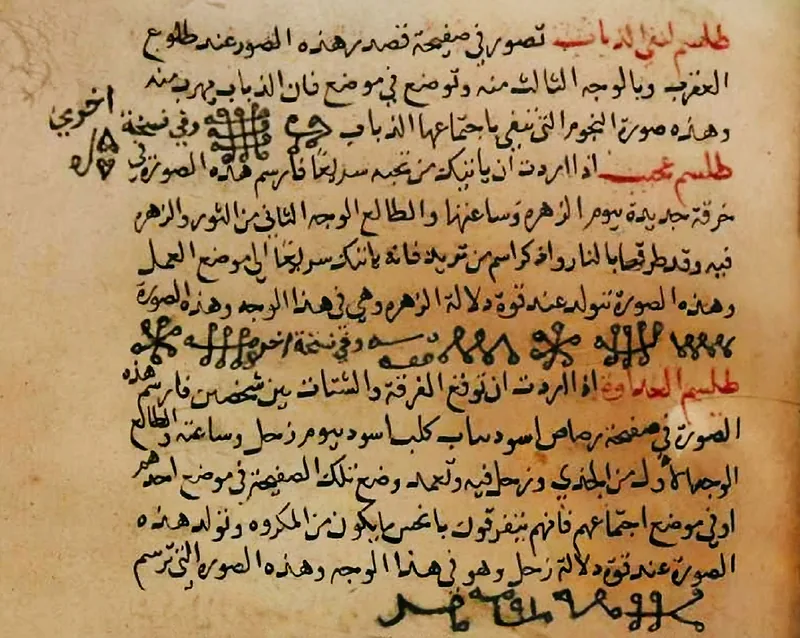
In 1256 the work was translated into Castilian at the court of Alfonso X of Castile, and from that version into Latin as Picatrix. Copies circulated discreetly in the later Middle Ages. Marsilio Ficino's De vita libri tres (1489), especially the third book, De vita coelitus comparanda, reworked its theory of talismans for Renaissance humanists, while hedging carefully against the charge of demonic magic. Ficino mentions the Picatrix by name and describes several planetary images in chapter 18.
Modern study began with Aby Warburg and his circle in the early twentieth century. Hellmut Ritter and Martin Plessner published a German translation of the Arabic in 1962, David Pingree a critical edition of the Latin in 1986, and Dan Attrell and David Porreca an English translation of the Latin in 2019. The Picatrix's original suffumigations and offerings sometimes called for animal parts, blood and toxic or psychoactive substances; none of these is used here.
Variations§
The Picatrix gives images for every planet, so the same method serves for a Jupiter image (for prosperity) or a Sun image (for honour), each at its own day and hour. Some practitioners elect by the lunar mansions instead of the planetary hours. In Islamic talismanic practice, magic squares and Qur'anic letters often replaced figurative images.
Safety and good sense§
Burn resins only on charcoal in a heat-proof censer, on a stable surface, with ventilation, and never leave it unattended. Use only common plant resins and petals; do not experiment with historical recipes. Wear eye protection when engraving metal or stone. A talisman can focus hope, but it is no substitute for medical, legal or financial help.
Sources and further reading§
- Picatrix: A Medieval Treatise on Astral Magic — Dan Attrell & David Porreca (trans.), 2019
- Spiritual and Demonic Magic from Ficino to Campanella — D. P. Walker, 1958
- The Arabic Influences on Early Modern Occult Philosophy — Liana Saif, 2015
- Islamic Occultism in Theory and Practice — Liana Saif, Francesca Leoni, Matthew Melvin-Koushki & Farouk Yahya (eds.), 2021
- Magic and Divination in Early Islam — Emilie Savage-Smith (ed.), 2004
- Magic in the Middle Ages — Richard Kieckhefer, 1989