Sun Talisman for Success with Agrippa's Square of 111
Make a Sun talisman for success and confidence with Agrippa's 6×6 magic square and the seal of Nachiel, at the Sun's day and hour, with history and cautions.

The Sun talisman carries the solar magic square, a grid of thirty-six numbers whose every line adds to 111, together with the seal of the Sun's Intelligence, Nachiel. In Agrippa's Three Books of Occult Philosophy (1533) the table of the Sun, made under a fortunate Sun, renders its bearer renowned, well liked and effective in all his works. It belongs to the family of planetary talismans that Renaissance magicians made to draw a planet's character into daily life: for the Sun, clarity, confidence, recognition and vitality.
How to do it§
Choose the time. Pick a Sunday with a waxing Moon. The first hour after sunrise is always the Sun's; other solar hours are listed in the planetary hours table.
Prepare. Clear the table, wash your hands and, if you like, set frankincense, a pinch of myrrh and a crumbled bay leaf on lit charcoal in a censer. Write your aim in one positive sentence about your own work, such as "That my efforts be seen clearly and bear fruit."
Draw the square. On the face of the disc, rule six by six cells and fill in Agrippa's numbers. Each row, column and diagonal makes 111; the whole makes 666:
 6  32   3  34  35   1
 7  11  27  28   8  30
19  14  16  15  23  24
18  20  22  21  17  13
25  29  10   9  26  12
36   5  33   4   2  31
Draw the seals. On the reverse, copy the seal of the Sun and the seal of Nachiel from Book II, chapter 22 of the 1651 English edition. Agrippa also gives the seal of the solar "spirit" Sorath, whose name sums to 666; like most later makers, leave it off and use the intelligence alone.
Consecrate. Hold the disc in the smoke for a few breaths and then in daylight or before a candle. Speak a short dedication in your own words; a modern example: "As the Sun gives light without loss, may this sign bring warmth, clarity and good success to what I honestly undertake."
Keep it. Wrap it in yellow or gold cloth and carry it to interviews, examinations, performances or the place where you work. Some bring it out into the sunlight on Sundays.
Finish. Let the charcoal burn out under watch. When the purpose is achieved, give thanks; keep the talisman, or burn a paper one safely and scatter the ash in the sun.
Origins and history§
The planetary magic squares reached Latin Europe through translations of Arabic learning, where squares had been studied as mathematical curiosities and used in amulets since roughly the tenth century. A short Latin text on the squares of the seven planets was in circulation by the fifteenth century, and Marsilio Ficino's De vita (1489) had already recommended solar things, gold, saffron, laurel and music, for the health of scholars.
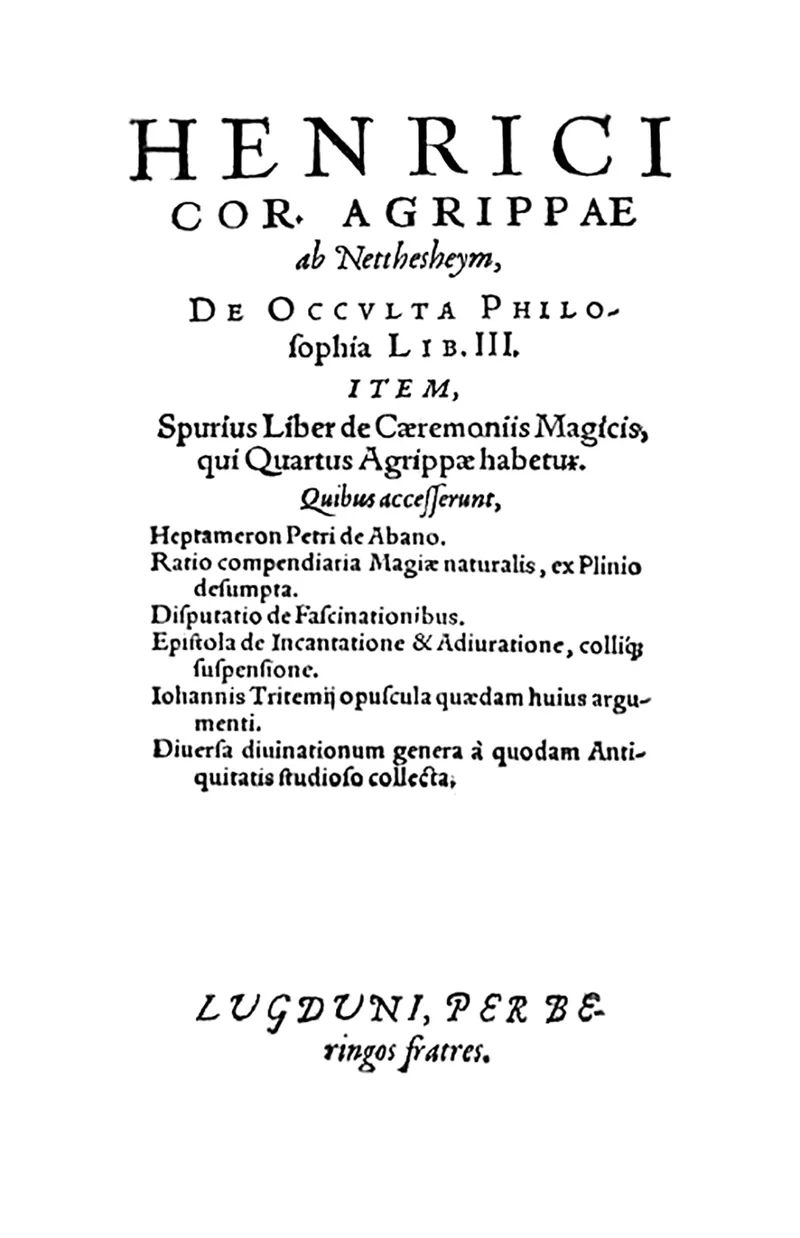
Agrippa systematised the material. His book II, chapter 22 assigns the six-by-six square to the Sun, gives its numbers (6, 36, 111 and 666) and the Hebrew names that equal them, and derives seals by drawing lines through the cells. He prescribes a plate of gold; the planet's metal was gold in every medieval table of correspondences. His solar suffumigation (Book I, chapter 44) combined saffron, ambergris, musk, aloes-wood, balsam, laurel berries, cloves, myrrh and frankincense with animal ingredients; only the common plant resins and bay are kept here. The number 666 attached to the solar square has invited speculation since the sixteenth century, but in Agrippa it is simply the sum of one to thirty-six.
Through Francis Barrett's The Magus (1801), which reprinted much of Agrippa, and the Golden Dawn, which named the squares kameas, the solar talisman entered modern ceremonial practice.
Variations§
Golden Dawn practitioners paint the square in orange or gold on a ground of the complementary colour and may add the hexagram of the Sun. Some write the square on a card kept on the desk instead of carrying it. A Sun talisman may also be made at the solar return (birthday) as a year's token.
Safety and good sense§
Burn resins only in a heat-proof censer on a stable surface, ventilate the room, keep fabric and paper away, and never leave charcoal or candles unattended. Avoid incense if you have asthma or are sensitive to smoke. A talisman can steady confidence, but preparation, advice and effort do the work; it is no substitute for medical, legal or financial help.
Sources and further reading§
- Three Books of Occult Philosophy — Henry Cornelius Agrippa, 1533
- The Language of Demons and Angels: Cornelius Agrippa's Occult Philosophy — Christopher I. Lehrich, 2003
- Spiritual and Demonic Magic from Ficino to Campanella — D. P. Walker, 1958
- The Arabic Influences on Early Modern Occult Philosophy — Liana Saif, 2015
- The Golden Dawn — Israel Regardie, 1937
- The Occult Philosophy in the Elizabethan Age — Frances A. Yates, 1979