The Spellbook · Witchcraft & Wicca
Knot Magic: A Nine-Knot Cord Spell for an Intention
A nine-knot cord spell from modern witchcraft for fixing an intention, with the history of knot magic from Babylon and the Qur'an to Nordic wind-knots.
- TraditionAncient and European knot charms; modern Wiccan cord magic, 20th century
- ForSuccess, Courage
- DifficultySimple
- Time20 minutes, with the cord kept until the goal is reached
- WhenTie during the waxing moon for bringing something in; some untie or release the cord at the full moon or when the aim is achieved

Knot magic works with one of the oldest symbolic gestures in human culture: tying something fast. In this modern witchcraft spell the practitioner ties nine knots in a cord while concentrating on a single aim, "fixing" it in place; the cord is then kept as a charm until the aim is achieved, when it may be untied or ceremonially released. It is used for personal goals such as courage before an interview, steadiness in study, or completing a piece of work — never to tie or restrict another person.
How to do it§
- Choose the cord and the aim. Pick one clear, personal goal and write it in a single sentence. Choose a colour that suits it — green for growth, red for courage, blue for calm, yellow for study, or white for anything.
- Prepare. Sit at a clear table, light the candle if you are using one, and spend a few minutes breathing slowly and reading your sentence until it is firmly in mind.
- Tie the knots in order. A common modern pattern ties the first knot near one end, the second near the other end, the third in the middle, and then fills the spaces between, so that nine knots are spread evenly along the cord: 1 at the left end, 2 at the right end, 3 in the centre, 4 between 1 and 3, 5 between 3 and 2, 6 between 1 and 4, 7 between 3 and 5, 8 between 4 and 3, 9 between 5 and 2.
- Speak with each knot. Pull each knot firm while saying a short phrase. Wiccan books give several traditional-sounding rhymes; you may compose your own, for example: "With knot one, it is begun; with knot two, my aim is true; with knot three, so may it be..." and so on to nine, ending with the aim spoken in full.
- Seal it. Hold the knotted cord in both hands, say your sentence once more, and imagine the intention held tight in each knot.
- Keep it. Put the cord somewhere private — a drawer, an altar, a pocket on the important day. Act steadily towards the goal.
- Release. When the aim is achieved, or the moment has passed, untie the knots one by one with thanks, or bury the natural-fibre cord in the earth. Some practitioners untie one knot each day before the event, "releasing" the energy step by step.
Origins and history§
Knots were used for both helping and harming magic in the ancient world. The Babylonian anti-witchcraft ritual series Maqlû (first millennium BCE) speaks of witches' knots and of untying them to free the victim. The Qur'an's short Sura 113, al-Falaq, asks refuge from "the evil of those who blow on knots", which classical commentators understood as sorcery. Greek and Roman sources, collected by Pliny the Elder, recommend knotted threads for healing and warn of crossed or clasped gestures thought to hinder childbirth; in medieval and early modern Europe the "ligature", a knot tied to cause impotence, was a feared form of harmful magic.
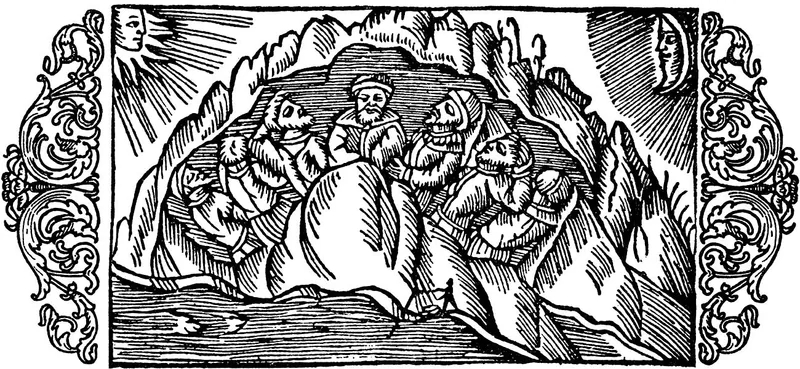
Knots also bound helpful forces. The Swedish cleric Olaus Magnus, in his History of the Northern Peoples (1555), described Finnish and Sámi sorcerers who sold sailors winds tied in three knots of a cord: untying the first released a gentle breeze, the second a strong wind, and the third a storm. Similar stories were told of wise-women in the Isle of Man, the Shetlands and Lapland, and were gathered by James George Frazer in The Golden Bough.
Modern Wicca took up the cord as a ritual tool. Initiates of Gardnerian covens receive a measured cord, and cord magic, in which knots are tied while energy is raised and focused, became a standard working described by Gerald Gardner and later by Doreen Valiente and Janet and Stewart Farrar. The nine-knot pattern and its rhymes are modern; they belong to twentieth-century witchcraft rather than to any documented older source. See what is witchcraft and folk magic.
Variations§
A "witch's ladder" adds a feather, bead or herb at each knot; the name comes from a cord with feathers found in a house in Wellington, Somerset, and described in 1887, whose real purpose is uncertain. Some braid three strands of different colours while chanting. In healing-support work, a cord is sometimes knotted and then untied to symbolise releasing a burden.
Safety and good sense§
Never tie cords around the neck or wrists of children, or leave long cords where small children or pets can become entangled. Keep any candle away from the cord and do not burn synthetic cord, which releases harmful fumes; bury natural fibre instead. A cord charm can be a good aid to focus and confidence, but it is no substitute for preparation, medical care, or professional advice.
Sources and further reading§
- The Golden Bough — James George Frazer, 1890
- Natural Magic — Doreen Valiente, 1975
- A Witches' Bible — Janet Farrar & Stewart Farrar, 1984
- Magic in the Ancient World — Fritz Graf, 1997
- The Witch: A History of Fear, from Ancient Times to the Present — Ronald Hutton, 2017