Jupiter Talisman for Prosperity, after Agrippa
Make a Jupiter talisman for prosperity using Agrippa's 4×4 magic square and the seal of Iophiel, timed to Jupiter's day and hour, with history and cautions.
- TraditionRenaissance astral magic; Heinrich Cornelius Agrippa, De occulta philosophia (1533)
- ForProsperity, Luck, Success
- DifficultyModerate
- Time1 hour, at the hour of Jupiter
- WhenThursday, in a planetary hour of Jupiter, with the Moon waxing and Jupiter well placed

The Jupiter talisman is a small disc bearing the planet's magic square of sixteen numbers, made at a time when Jupiter is strong so that, in the theory of Renaissance astral magic, it gathers the benevolent influence of the "greater fortune". Heinrich Cornelius Agrippa printed the square in his Three Books of Occult Philosophy (1533), saying that, engraved at the right moment, it favours gain and riches, goodwill, peace and concord. It is one of the most frequently made talismans of the Western tradition and needs only a careful hand and a sense of timing.
How to do it§
Choose the time. Find a Thursday when the Moon is waxing, then use the planetary hours table to find an hour of Jupiter (the first hour after sunrise on Thursday is always one). If you follow astrology, avoid a time when Jupiter is retrograde or combust.
Prepare. Wash your hands, tidy the table and, if you wish, light a little benzoin or storax on charcoal in a censer. Sit quietly and fix your intention in a plain sentence, for example: "That my work be fruitful and my household provided for."
Draw the square. On one face of the disc, rule a square of four by four cells and write in the numbers of Jupiter's table as Agrippa gives them. Every row, column and diagonal adds to 34, and the whole to 136:
 4  14  15   1
 9   7   6  12
 5  11  10   8
16   2   3  13
Draw the seals. On the reverse, copy the seal of Jupiter and the seal of its Intelligence, Iophiel, from the plates in the 1651 English edition (Book II, chapter 22). Agrippa also gives a seal for the planet's "spirit", Hismael, which he counts among the evil daemons; most later makers leave it off and use only the intelligence. Around the edge you may write the divine name El Ab ("God the Father"), which Agrippa connects with the number 34.
Consecrate. Pass the disc through the smoke of the resin. Hold it and speak a short prayer in your own words; a simple form is: "Under the God of all good things, may this sign carry the gentle fortune of Jupiter into my labour, to my good and the good of others." (This wording is modern.)
Keep it. Wrap the talisman in blue or purple cloth. Carry it, or keep it with your accounts or at your place of work.
Finish. Let the charcoal burn out in the censer under watch. When the talisman has served its purpose, or after a year, give thanks and either keep it as a memento or burn a paper one safely and scatter the ash in a garden.
Origins and history§
Magic squares are much older than European magic. The three-by-three Luo Shu is attested in China from the early centuries of the common era, and squares of higher orders were studied by Arabic mathematicians from about the tenth century. In the Islamic world they acquired talismanic use, appearing in works on the occult properties of letters and numbers such as those attributed to Ahmad al-Buni (d. 1225). A Latin treatise on the seven planetary squares circulated in late-medieval Europe, and Albrecht Dürer placed a four-by-four square, with the date 1514 in its bottom row, in his engraving Melencolia I, probably as a Jovial remedy against melancholy.
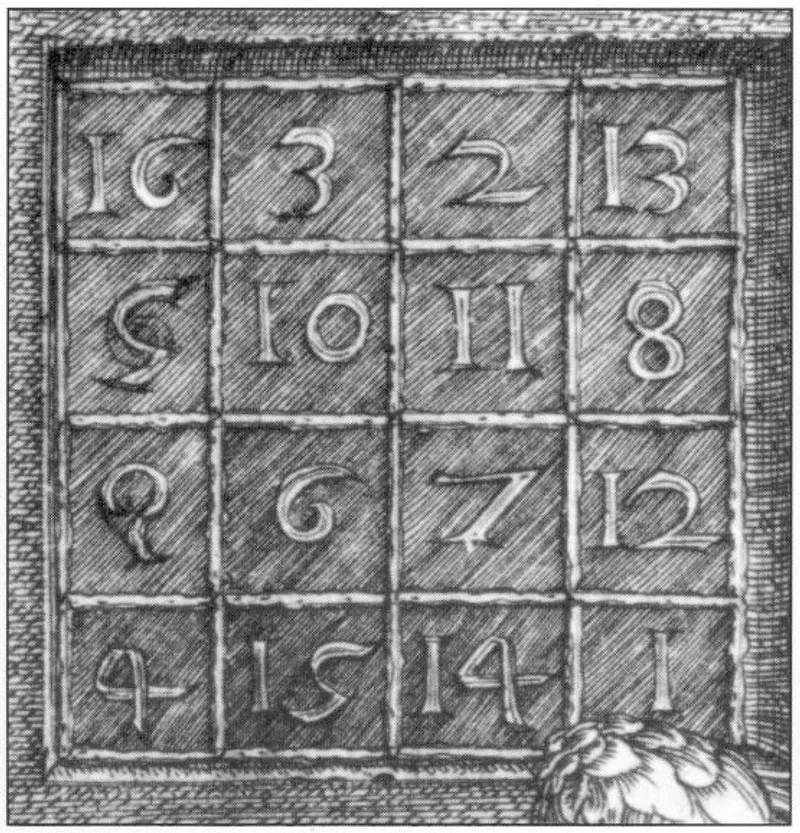
Agrippa's De occulta philosophia, drafted around 1510 and printed in full at Cologne in 1533, gave the seven planetary squares, their sums, the Hebrew names whose numerical values match them, and the seals derived from them (Book II, chapter 22). Jupiter's metal was tin; the English translation of 1651 says the square should be impressed "on a silver plate", with Jupiter "powerful and ruling". For suffumigation, Agrippa's Jupiter recipe (Book I, chapter 44) adds ingredients such as peacock feathers and the blood of a stork or swallow to ash seed, aloes-wood, storax and benzoin; the plant resins alone are used here. The Golden Dawn in the 1890s called these squares kameas, from the Hebrew word for an amulet, and attached modern colour scales to them.
Variations§
Ceremonial magicians may open with the Lesser Banishing Ritual of the Pentagram and an invoking hexagram of Jupiter. Some engrave the square on tin bought as craft sheet; others paint it on paper in blue on a white ground. Islamic and later folk traditions use the four-by-four square on its own as a written amulet for blessing in trade.
Safety and good sense§
Burn charcoal and resin only in a heat-proof censer on a stable surface, with a window open, and never leave it unattended; avoid incense if you have asthma. Use blunt tools carefully if engraving metal. A talisman is a focus for hope and diligence, not a financial plan: debts, investments and money worries call for qualified advice.
Sources and further reading§
- Three Books of Occult Philosophy — Henry Cornelius Agrippa, 1533
- De occulta philosophia libri tres — Heinrich Cornelius Agrippa, 1992
- The Language of Demons and Angels: Cornelius Agrippa's Occult Philosophy — Christopher I. Lehrich, 2003
- Agrippa and the Crisis of Renaissance Thought — Charles G. Nauert, 1965
- Spiritual and Demonic Magic from Ficino to Campanella — D. P. Walker, 1958
- The Occult Philosophy in the Elizabethan Age — Frances A. Yates, 1979