Liber XI · Herbal Magick · Chapter V: Incense & Resins
Myrrh in Religion and Magic: Anointing, Embalming and the Magi
Myrrh in religion and magic: the bitter resin of Egyptian embalming, the holy anointing oil, the myth of Myrrha and Adonis, the Magi's gift and grimoires.

Myrrh is the fragrant, bitter gum resin of Commiphora shrubs from southern Arabia and the Horn of Africa, and one of the most important sacred substances of the ancient world. Egyptians used it in temple incense and embalming, the Hebrew Bible makes it the first ingredient of the holy anointing oil, Greek myth told of a princess transformed into the weeping myrrh tree, and Christians have read the Magi's gift of myrrh as a sign of Christ's death. In magic, from the Greek papyri to Renaissance grimoires, myrrh was burned and written with as a substance of purification, power and binding.
Commiphora Myrrh: Resin of Arabia and the Horn of Africa§
Myrrh is produced by several species of Commiphora, chiefly Commiphora myrrha, small, spiny trees that grow in the dry lands of Yemen, Oman, Somalia and Ethiopia. When the bark is cut, a pale yellow sap seeps out and hardens into reddish-brown "tears." The resin is bitter to the taste and has a warm, earthy, slightly medicinal fragrance when burned. The English word comes through Greek and Latin from a Semitic root, mrr, "bitter," preserved in the Hebrew mor and Arabic murr.
Together with frankincense, myrrh was carried along the caravan routes of South Arabia to Egypt, the Levant and the Mediterranean, and later by sea to Rome and India. The history of that trade, and of incense in general, is told in the guide to incense and resins. Myrrh was costly, and its value made it a fitting offering for gods and kings.
Myrrh in Egyptian Temples and Embalming§
Ancient Egypt imported aromatic resins in great quantities, and myrrh was among the most prized. The Egyptian word antyu, which appears in temple inventories, offering lists and the famous reliefs of Hatshepsut's expedition to Punt, is usually translated "myrrh," though some scholars think it may cover other resins as well. Resins were burned before the gods in the daily temple cult of ancient Egyptian religion, and Plutarch later reported that the Egyptians burned frankincense at dawn, myrrh at midday and the compound incense kyphi, which itself contained myrrh, at evening.

Myrrh also had a place in the treatment of the dead. Writing in the fifth century BCE, Herodotus describes three grades of embalming; in the most expensive, after the removal of the internal organs, the body cavity was filled with pure ground myrrh, cassia and other spices before the body was dried and wrapped. Modern chemical studies of mummies have confirmed the use of plant resins in embalming, though identifying the exact resin is often difficult. For Egyptians, fragrance was a quality of the divine: the gods were sweet-smelling, and to perfume the body of the dead was to help prepare it for divine life.
The Holy Anointing Oil and Myrrh in the Hebrew Bible§
In the Hebrew Bible, myrrh is a sign of holiness and of luxury. In Exodus 30, God commands Moses to make a holy anointing oil of "pure myrrh," sweet cinnamon, sweet calamus and cassia in olive oil, to be used only for anointing the tabernacle, its vessels and the priests, and forbidden for ordinary use on pain of being cut off from the people. The oil marked persons and things as set apart for God, and Jewish and Christian traditions of anointing kings and priests descend from it.
Myrrh is also a perfume of love and royalty. In the Book of Esther, the young women brought before the Persian king were purified for six months "with oil of myrrh" before a further six with sweet odours. The Song of Songs returns to it again and again, from the beloved as "a bundle of myrrh" (Song of Solomon 1) to hands that "dropped with myrrh" (Song of Solomon 5), and Psalm 45, a royal wedding song, describes the king's garments as smelling of myrrh, aloes and cassia. This double character, holy and erotic, sacred and luxurious, shaped later interpretations of the resin.
Myrrha and Adonis: The Greek Myth of the Weeping Tree§
The Greeks called the resin smyrna or myrrha, and they told a myth to explain its tears. In the version best known from Ovid's Metamorphoses (tenth book), Myrrha, daughter of Cinyras, king of Cyprus, fell into a forbidden passion for her own father and deceived him into sleeping with her. When he discovered the truth, she fled, and the gods, answering her prayer to belong neither to the living nor to the dead, transformed her into the myrrh tree. Her tears became the fragrant resin, and from the bark of the tree was born her son Adonis, the beautiful youth loved by Aphrodite.
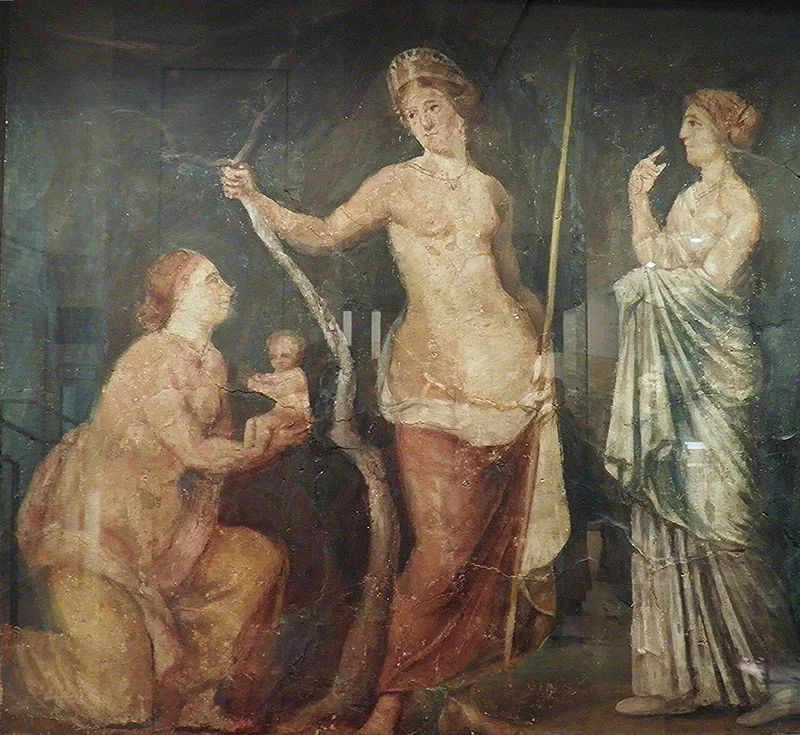
The myth links myrrh with forbidden desire, grief, death and rebirth, and with the cult of Adonis, whose mourning festival, the Adonia, was celebrated by women in Athens and elsewhere. It was a favourite subject of Renaissance and Baroque painters, who showed Adonis being drawn from the split trunk of the tree.
Gold, Frankincense and Myrrh: Christian Symbolism and Holy Myron§
In the Gospel of Matthew, the Magi from the East, discussed in the article on the Magi of ancient Persia, bring the infant Jesus gifts of gold, frankincense and myrrh. Early Christian writers gave each gift a meaning. Origen, in the third century, explained that gold was offered to a king, incense to a god and myrrh to one who would die, and this reading became standard: myrrh, used for embalming, foretold the Passion. The Gospels return to myrrh at the end of Jesus's life: Mark says he was offered wine mingled with myrrh at the crucifixion (Mark 15), and John describes Nicodemus bringing a great weight of myrrh and aloes for his burial (John 19). The women who came to the tomb with spices are honoured in Eastern Orthodox tradition as the Myrrh-bearers.
In the Orthodox churches, the sacred chrism used in the sacrament of chrismation, in consecrating altars and formerly in anointing emperors, is called myron. It is a complex compound of olive oil and many aromatic substances, prepared at intervals with great ceremony and consecrated by the senior hierarchs. The word also gave a name to a category of saints, the myroblytes or "myrrh-gushers," whose relics or tombs were believed to exude a fragrant oil, most famously St Demetrius of Thessaloniki and St Nicholas, whose relics at Bari are said to yield a liquid called "manna."
Myrrh in Magical Papyri, Grimoires and Modern Practice§
In the Greek Magical Papyri of Roman Egypt, myrrh appears constantly. It is burned as an offering to the gods invoked, and many spells call for words or figures to be written in "myrrh ink," a writing medium containing myrrh that was thought to give the text power. One long erotic spell in the great Paris papyrus is addressed to the myrrh itself as it burns, praising it as bitter and powerful and charging it to bind the person desired. Such spells show how a temple substance was turned to private and sometimes coercive ends; like all love magic, they record ancient hopes rather than reliable results.
Renaissance learned magic inherited this role. Agrippa's Three Books of Occult Philosophy includes myrrh among the ingredients of the suffumigation of the Sun, places it in a fume of Saturn and gives it as the fume of the sign Aries (Agrippa, Book I, chapters 43–48). The Book of Abramelin, in the version published by S. L. MacGregor Mathers in 1898, calls for a sacred oil modelled on the biblical anointing oil, with myrrh as a principal ingredient (catalogue entry). Through Mathers and the Golden Dawn, "Abramelin oil" became a fixture of modern ceremonial magic.
Today myrrh remains one of the most widely used resins in church incense, in modern Pagan and ceremonial ritual, where it is often linked with Saturn, the Moon or mourning, and in herbal medicine as a mouthwash and wound remedy. Across all these settings it keeps the associations it had in antiquity: bitterness, preservation, purification, and the boundary between life and death.
Frequently asked questions§
What is myrrh?§
Myrrh is a natural gum resin from small thorny trees of the genus Commiphora, native to southern Arabia and the Horn of Africa. It is harvested by cutting the bark and collecting the resin that hardens on the trunk. It has been used for incense, perfume, medicine and embalming for thousands of years.
Why did the Magi bring myrrh to Jesus?§
Matthew's Gospel does not explain the gifts. Early Christian interpreters such as Origen read gold as a gift for a king, frankincense for a god and myrrh for a mortal who would die, since myrrh was used in burial. This interpretation became traditional in Christian art, hymns and preaching.
What is the difference between myrrh and frankincense?§
Both are resins from trees of the same regions. Frankincense comes from Boswellia and burns with a bright, lemony fragrance; myrrh comes from Commiphora and is darker, bitter and earthier. Frankincense was the main temple incense, while myrrh was especially important in anointing oils, perfumes and embalming.
Was myrrh used in mummification?§
Herodotus says that the most expensive method of embalming in Egypt involved filling the body with pure myrrh, cassia and other spices. Chemical analyses show that resins were widely used in mummification, though the specific resins varied and are not always identifiable.
Sources and further reading§
- The Histories — Herodotus, c. 430 BCE
- Metamorphoses — Ovid, 8
- Contra Celsum — Origen, c. 248
- Three Books of Occult Philosophy — Heinrich Cornelius Agrippa, 1533
- The Book of the Sacred Magic of Abramelin the Mage — S. L. MacGregor Mathers, 1898
- Frankincense and Myrrh: A Study of the Arabian Incense Trade — Nigel Groom, 1981
- The Greek Magical Papyri in Translation — Hans Dieter Betz, 1986
- Scenting Salvation: Ancient Christianity and the Olfactory Imagination — Susan Ashbrook Harvey, 2006