Liber XI · Herbal Magick · Chapter V: Incense & Resins
Kyphi: The Sacred Incense of Ancient Egyptian Temples
Kyphi, the sacred evening incense of ancient Egypt: its Egyptian name, the temple recipes of Edfu and Philae, Plutarch's sixteen ingredients and revivals.

Kyphi was the most celebrated incense of ancient Egypt: a compound perfume of resins, spices, wine, honey and raisins that priests burned in the temples at evening and that Greek writers admired as a fragrance able to calm the mind and bring gentle sleep. Its name renders the Egyptian kapet, "that which is burned," and its recipes survive on the walls of Ptolemaic temples and in the works of Plutarch, Dioscorides and Galen, though the exact ingredients varied and several remain uncertain.
Kapet: Kyphi in Egyptian Temple Ritual§
Incense was central to the daily cult of ancient Egyptian religion. Each morning, priests opened the shrine of the god's statue, purified it, clothed and fed it, and censed it with fragrant smoke; censing also accompanied offerings to the dead in tombs and funerary chapels. Egyptians believed that the gods themselves were fragrant, and texts describe the divine presence as perceived through scent. Incense was called senetjer, "that which makes divine," and the smoke rising toward the sky was understood as a pathway between the human and divine worlds.
Within this world of aromatics, kapet had a special place. The word appears in temple and funerary offering lists, and fumigants for perfuming houses and clothing are among the remedies of the medical Papyrus Ebers (c. 1550 BCE), though whether these were already the kyphi of later sources is uncertain. By the Late and Ptolemaic periods, kyphi was a named, complex preparation of the temple workshops, offered to the gods, especially to the sun god Ra at his setting, and associated with Osiris, Isis and the night. The wider history of frankincense, myrrh and temple incense is told in the guide to incense and resins.
The Recipes of Edfu and Philae§
The great temples built under the Ptolemaic dynasty, between the third and first centuries BCE, include small rooms that Egyptologists call "laboratories," whose walls are inscribed with the recipes for the sacred unguents and incenses made for the cult. The temple of Horus at Edfu and the temple of Isis at Philae both preserve recipes for kyphi.
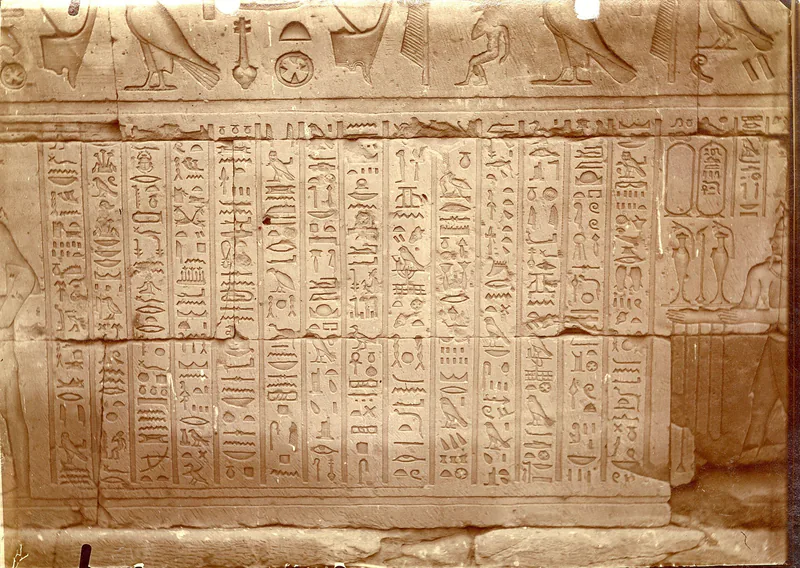
These are not short lists but procedures: aromatic woods, resins and plants were measured, ground, sifted, soaked in wine, mixed with honey and raisins and left over many days, with the temple's own sacred words accompanying the work. The recipes use Egyptian plant names, several of which cannot be securely identified, and give the quantities in Egyptian units whose modern equivalents are debated. They show kyphi as a priestly art, its making itself part of the ritual. Comparable inscriptions record recipes for the sacred oils used to anoint statues.
Plutarch, Dioscorides and the Greek Kyphi§
Greek and Roman writers took a keen interest in kyphi. The most famous account is in Plutarch's essay On Isis and Osiris (written around 100 CE), a philosophical interpretation of the Egyptian myth of Osiris, which also attracted later esoteric readers. Plutarch reports that the Egyptians burned resin (frankincense) at dawn, myrrh at midday and kyphi in the evening, each matched to the state of the air and the body at that hour.
He describes kyphi as a mixture of sixteen ingredients: honey, wine, raisins, cyperus, resin, myrrh, aspalathus, seseli, mastic, bitumen, rush, dock, two kinds of juniper berries, cardamom and calamus. These, he adds, were not combined at random: the sacred writings were read aloud to the perfumers as they worked. Plutarch was not a pharmacist, and his list is best read as a literary witness to a temple product, not a formula.
Dioscorides, the first-century physician whose De materia medica became the foundation of European pharmacy, gives his own recipe and notes that kyphi was used in the service of the gods and also as a medicine. Galen's pharmacological works preserve further versions attributed to earlier physicians. The Greek recipes differ from each other and from the temple inscriptions, so it is better to speak of a family of kyphi preparations than of a single formula.
What Kyphi Was Thought to Do: Sleep, Dreams and the Soul§
Plutarch's description of kyphi's effects is the source of its modern reputation. He says that its aromatic substances relaxed the body, lulled anxieties and brightened the imaging power of dreams, working on the mind like music: smoothing and loosening the cares of the day, much as the lyre was played before sleep. Because its ingredients were things that "delight in the night," it was proper to the evening.

This should not be read as a claim of intoxication; none of Plutarch's ingredients is a powerful drug. Kyphi's effect, for ancient writers, lay in the harmony of fragrances acting on the soul, a theory that matched Greek medical ideas about the influence of air and odours on the body. The association of kyphi with sleep and dreaming gave it a natural place in practices of dream incubation, the seeking of divine messages in sleep, described in the guide to astral projection and dreams.
Kyphi in Magic and Late Antique Medicine§
Kyphi travelled with the cults of Isis and Serapis across the Mediterranean, and it appears in the Greek magical papyri from Roman Egypt, where several rituals list it among the offerings to be burned before a lamp, a divine image or a sun-god invocation. In these texts, compound incenses were not simply pleasant: they attracted, honoured or compelled divine powers, a principle discussed in the guide to Greco-Roman magic. A modern adaptation of one such dream rite is given in the Greek papyri dream request.
Physicians meanwhile prescribed kyphi as an antidote and a remedy for internal complaints, and it entered the later pharmacological tradition through Galen and the Byzantine compilers. As Egyptian temple religion declined in the fourth and fifth centuries, the priestly art of kyphi was lost, and the name survived chiefly in Greek medical texts and in Plutarch.
Modern Reconstructions and Revival§
Since the nineteenth century, Egyptologists, chemists and perfumers have tried to recreate kyphi from the temple inscriptions and the Greek sources. The Danish Egyptologist Lise Manniche, in An Ancient Egyptian Herbal (1989) and Sacred Luxuries (1999), discussed the recipes and the problems of identifying their plants, and museum exhibitions have presented scent reconstructions to the public. Every reconstruction involves choices about uncertain ingredients and quantities, so none can claim to be the original.
Kyphi also became a favourite of modern esoteric and pagan practice. It has been sold by occult suppliers since the twentieth century, and practitioners of Kemetic religion, the modern revival of Egyptian religion, burn versions of it in their household shrines. For many it is a link to the evening rites of temples that once stood beside the Nile, offered, as in antiquity, at the setting of the sun.
Frequently asked questions§
What is kyphi?§
Kyphi is an ancient Egyptian compound incense, made from resins, aromatic plants, wine, honey and raisins, burned in temples at evening. Its name comes from the Egyptian kapet, meaning fumigation or incense.
What were the ingredients of kyphi?§
Plutarch lists sixteen, including honey, wine, raisins, myrrh, resin, mastic, juniper, cardamom, calamus and cyperus. The temple recipes at Edfu and Philae and the Greek physicians give different lists, and some Egyptian ingredients remain unidentified.
When was kyphi burned?§
According to Plutarch, the Egyptians burned frankincense at dawn, myrrh at midday and kyphi in the evening. Kyphi was associated with the setting sun, the night and peaceful sleep.
Does kyphi have psychoactive effects?§
No ancient ingredient list contains a strong drug. Plutarch said that its fragrance relaxed the mind and brightened dreams, which reflects ancient ideas about the power of scent rather than intoxication.
Sources and further reading§
- On Isis and Osiris — Plutarch, c. 100
- De materia medica — Pedanius Dioscorides, c. 70
- Plutarch's De Iside et Osiride — J. Gwyn Griffiths, 1970
- Frankincense and Myrrh: A Study of the Arabian Incense Trade — Nigel Groom, 1981
- The Greek Magical Papyri in Translation — Hans Dieter Betz, 1986
- An Ancient Egyptian Herbal — Lise Manniche, 1989
- Sacred Luxuries: Fragrance, Aromatherapy, and Cosmetics in Ancient Egypt — Lise Manniche, 1999
- Ancient Egyptian Materials and Technology — Paul T. Nicholson & Ian Shaw (eds.), 2000