Liber XXX · Symbols · Chapter II: Number Symbolism
The Number Seven: Its Sacred Meaning in Religion and Myth
Why seven is sacred: the seven planets and the week, Mesopotamian Sebettu, the Sabbath, Revelation's sevens, Islam's seven heavens, and seven in occultism.

Seven is the most widely revered number in the religious traditions of the Near East and Europe, and important in many others. Its prestige rests largely on the sky: ancient observers counted seven moving lights among the fixed stars (the Sun, Moon, Mercury, Venus, Mars, Jupiter and Saturn), and the Moon's phases change roughly every seven days. From Mesopotamian demons and Hebrew Sabbath law to the seven heavens of Islam, the seven sacraments of Catholicism and the planetary magic of the Renaissance, seven came to signify completeness, holiness and the order of time.
Why Seven? The Moon, the Planets and the Seven-Day Week§
Two natural facts lie behind most of seven's significance. First, the Moon passes from new to first quarter, full, last quarter and new again in about 29.5 days, so each phase lasts a little over seven days. Second, the naked eye can see seven celestial bodies that move against the background of fixed stars. Ancient astronomers called them all "planets" (Greek planētai, "wanderers"), and in the standard order by apparent speed they ran: Saturn, Jupiter, Mars, Sun, Venus, Mercury and Moon.
The planetary week combined the two. In the Hellenistic and Roman world each hour of the day was assigned to a planet in that sequence, and each day was named after the planet ruling its first hour; this produces the order Saturn, Sun, Moon, Mars, Mercury, Jupiter, Venus, still visible in Saturday, Sunday and Monday and in the Romance names for the other days (martes, mercredi, giovedì, viernes). The Roman historian Cassius Dio, writing in the early third century, describes the system as Egyptian in origin and already widespread. When the Jewish and Christian seven-day week, counted from Sabbath to Sabbath, met this astrological week, the two merged into the calendar used across most of the world today. Eviatar Zerubavel's study The Seven Day Circle traces this history in detail.
Seven in Mesopotamia and Ancient Greece§
In Mesopotamian religion seven was already charged with power. The Sebettu, "the Seven", were a group of deities, sometimes fierce warriors and sometimes protective demons, associated with the Pleiades; they appear on boundary stones as a cluster of seven dots. Incantations against evil speak of seven demons, seven being the number of a complete and dangerous host. In the Sumerian myth of Inanna's descent to the underworld, the goddess passes through seven gates and is stripped of one of her garments or insignia at each. In the flood story of the Epic of Gilgamesh, the storm rages for six days and seven nights, and on the seventh day the hero Utnapishtim sends out a dove. Seven sages, the apkallu, were believed to have brought civilisation before the flood. These patterns are described in Mesopotamian religion.
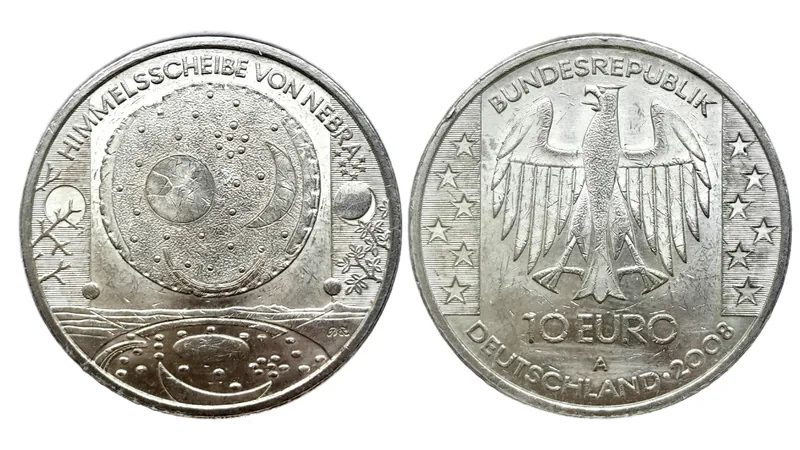
The cluster of the Pleiades, the "Seven Sisters", appears in many cultures; the Bronze Age Nebra sky disc from Germany (c. 1600 BCE) shows a group of seven gold dots usually identified with it. Among the Greeks, seven appears in the Seven against Thebes, the Seven Sages of archaic wisdom, Apollo's birth on the seventh day of the month and the seven-stringed lyre. Philosophers in the Pythagorean tradition called seven the "virgin" number, because within the first ten it is neither produced by multiplying two smaller numbers nor produces another number by multiplication; it was therefore linked with motherless Athena. The Hippocratic treatise On Sevens divided human life and the body into sevens, and the idea of "climacteric" years at multiples of seven, especially 63 (seven times nine), survived into early modern medicine. See Pythagoras and Pythagorean number mysticism.
The Sabbath and Seven in the Hebrew Bible§
In the Hebrew Bible seven is the number of holiness and completion. The first creation account ends with God resting on the seventh day and blessing it (Genesis 2), the foundation of the weekly Sabbath, which became one of the defining practices of Judaism (see Jewish festivals and the Sabbath). The same rhythm extends to years: every seventh year the land lay fallow and debts were released, and after seven times seven years came the Jubilee (Leviticus 25). Passover and the Feast of Tabernacles last seven days, and Pentecost (Shavuot) falls seven weeks after Passover.
Seven also marks ritual action and covenant. Blood is sprinkled seven times, the leper is cleansed with sevenfold rites, the Syrian general Naaman washes seven times in the Jordan, and the priests circle Jericho for seven days, seven times on the seventh, blowing seven trumpets (Joshua 6). The golden lampstand of the Tabernacle, the menorah, has seven lamps. Hebrew links the word for seven, sheva, with the verb "to swear", and Abraham seals an oath at Beersheba, the "well of the seven" or "well of the oath", with seven lambs. Later Jewish tradition counted seven names of God that may not be erased, discussed in the seven names of God.
Seven in Christianity: Seals, Sacraments and Sins§
The New Testament inherited the Hebrew sense of seven. Jesus tells Peter to forgive not seven times but "seventy times seven", seven deacons are chosen in Acts, and above all the Book of Revelation is organised around sevens: letters to seven churches, seven lampstands and stars, seven spirits before the throne, a scroll with seven seals, seven trumpets and seven bowls of wrath (Revelation 1). The Lamb has seven horns and seven eyes, and the dragon seven heads. For the author, seven expressed fullness, whether of divine presence or of judgement.
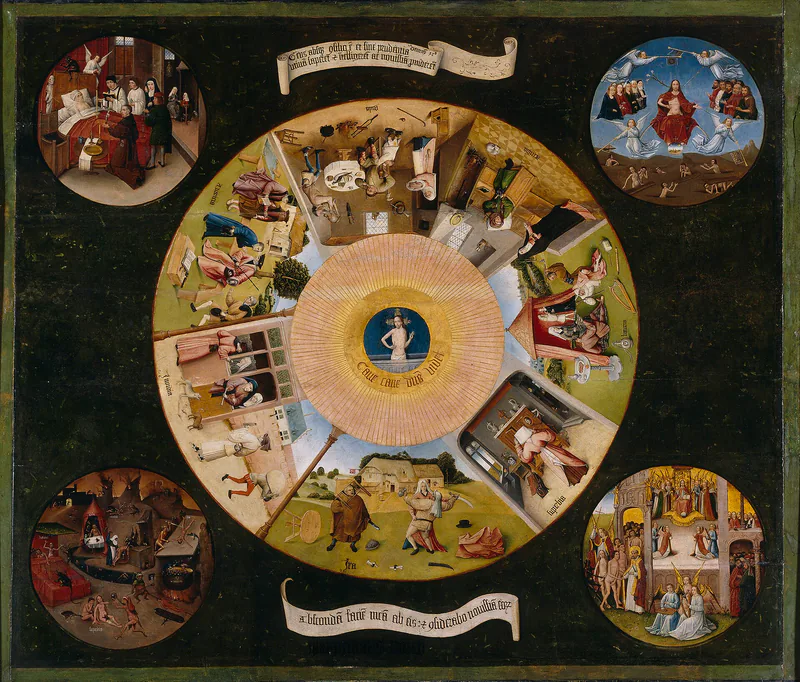
Medieval Christianity built much of its teaching in sevens, often consciously. The seven deadly sins derive from the eight evil thoughts of the fourth-century monk Evagrius Ponticus, reduced to seven by Pope Gregory the Great around 600. The seven sacraments were listed by Peter Lombard in the twelfth century and defined by the Council of Florence (1439) and the Council of Trent. There were seven virtues (three theological and four cardinal), seven corporal works of mercy, seven gifts of the Holy Spirit (from the Greek and Latin text of Isaiah 11), seven sorrows of Mary and the seven last words of Christ. The seven liberal arts, codified by Martianus Capella in the fifth century, organised education. Augustine and other exegetes read seven as the union of three, the number of the soul and the Trinity, with four, the number of the body and the material world. See Biblical numerology.
Seven in Islam, India and East Asia§
The Qur'an speaks repeatedly of seven heavens created in layers (Surat al-Mulk) and of seven earths, and the opening chapter, al-Fatiha, of seven verses, is traditionally identified with the "seven oft-repeated" verses mentioned in Surat al-Hijr. During the pilgrimage, pilgrims walk around the Kaaba seven times and pass seven times between the hills of Safa and Marwa, and at Mina they throw seven pebbles at each pillar. Islamic tradition describes the Prophet's night journey through the seven heavens, meeting a prophet in each. Sufi writers later developed schemes of seven stages of the soul.
In India, the seven sages (saptarishi) are identified with the stars of the Big Dipper, the Vedic world has seven upper realms (lokas), and in a Hindu wedding the couple take seven steps (saptapadi) together around the sacred fire. The modern Western system of seven chakras derives from one tantric model among several; older texts describe different numbers of centres (see the history of the chakras). In Japan, the Seven Lucky Gods (Shichifukujin), assembled from Shinto, Buddhist, Hindu and Taoist figures, became popular from the late medieval period.
The Hebdomad in Philosophy and Western Occultism§
Philo of Alexandria (c. 20 BCE–c. 50 CE) devoted a long passage of On the Creation of the World to the "hebdomad", praising seven as the number of the Sabbath, of the Moon's phases, of the planets, of the stages of human life and of the senses and organs. His blend of Greek number philosophy and Jewish scripture shaped Christian and later esoteric thinking (see Philo of Alexandria).
In Western occultism, seven organised the entire magical cosmos through the planets. Each planet ruled a day, a metal (lead, tin, iron, gold, copper, quicksilver and silver), a colour, plants, stones and an angel. Heinrich Cornelius Agrippa's Three Books of Occult Philosophy (1533) gives a "scale of the number seven" listing these correspondences (read it in the reading room), and the Heptameron attributed to Peter of Abano arranges conjurations by the seven days, discussed in planetary angels, Agrippa and the Heptameron. The seven planetary magic squares or kameas, from Saturn's three-by-three to the Moon's nine-by-nine, are described in magic squares and planetary seals. The Book of Tobit's description of Raphael as one of seven holy angels (Tobit 12) underlies the tradition of seven archangels.
In tarot, the Major Arcana card numbered seven is The Chariot, and modern numerology gives seven a reflective, seeking character (see number 7). Psychologists have also noted a cultural preference for seven: George Miller's famous paper "The Magical Number Seven, Plus or Minus Two" (1956) concerned the limits of short-term memory, and surveys often find seven chosen as a "favourite" or "lucky" number, a modern echo of its ancient prestige. Its partner number in sacred calendars, twelve, is treated separately.
Frequently asked questions§
Why is seven considered a holy number?§
Mainly because of the sky: the seven visible planets and the roughly seven-day phases of the Moon made seven a number of cosmic order. The Hebrew Bible then made it the number of the Sabbath and of completion, a meaning inherited by Christianity and Islam.
What does the number seven mean in the Bible?§
It generally signifies completeness and holiness, beginning with God's rest on the seventh day. It structures the Sabbath, festivals and purifications, and the Book of Revelation uses series of seven seals, trumpets and bowls.
What are the seven planets in ancient astrology?§
The Sun, Moon, Mercury, Venus, Mars, Jupiter and Saturn, the seven bodies visible to the naked eye that move among the fixed stars. They gave their names to the days of the week.
Sources and further reading§
- The Seven Day Circle: The History and Meaning of the Week — Eviatar Zerubavel, 1985
- Medieval Number Symbolism: Its Sources, Meaning, and Influence on Thought and Expression — Vincent Foster Hopper, 1938
- The Mystery of Numbers — Annemarie Schimmel, 1993
- On the Creation of the World (De opificio mundi) — Philo of Alexandria, c. 40
- The Theology of Arithmetic — Iamblichus, 1988
- Gods, Demons and Symbols of Ancient Mesopotamia — Jeremy Black and Anthony Green, 1992
- Three Books of Occult Philosophy — Henry Cornelius Agrippa, 1533