Liber XVII · Islam · Chapter I: The Five Pillars
The Ka'ba in Mecca: History, Black Stone and Sacred Meaning
The Ka'ba in Mecca explained: its structure, the Black Stone and kiswa, pre-Islamic Mecca, Abraham, rebuildings, sieges and its meaning in Sufi thought.

The Ka'ba (al-Kaʿba, "the cube") is the cubical stone building at the centre of the Sacred Mosque in Mecca, which Muslims call the House of God (Bayt Allāh) and towards which they turn in every prayer. Muslims believe it was raised by Abraham and Ishmael as a sanctuary for the worship of the one God; it was a pilgrimage shrine of the Arabs before Islam, was cleared of its idols by the Prophet Muhammad in 630, and has been rebuilt several times since.
The Ka'ba Described: Walls, Kiswa and Black Stone§
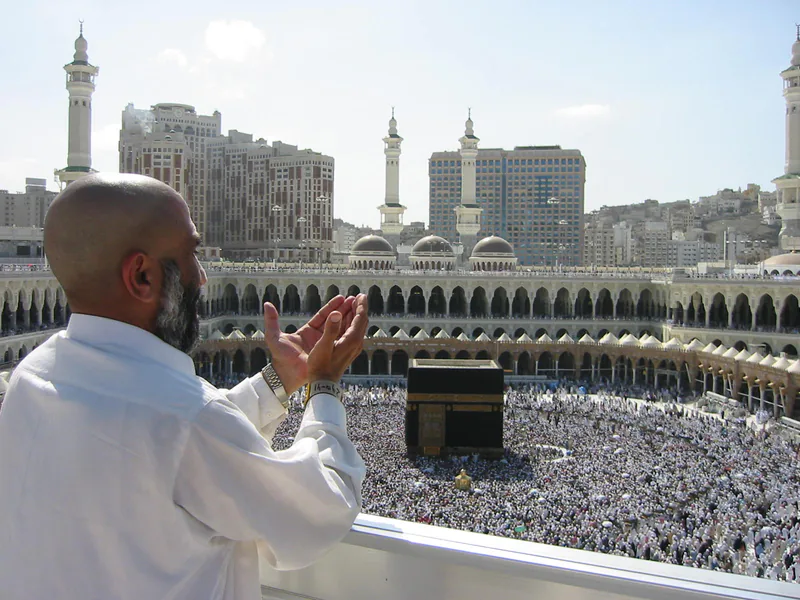
The Ka'ba is a roughly cubical structure of grey stone masonry, a little over thirteen metres high, with sides of unequal length of roughly eleven to thirteen metres. Its four corners carry traditional names: the Black Stone corner to the east, the Iraqi corner to the north, the Syrian corner to the west and the Yemeni corner to the south. A single door, raised about two metres above the pavement on the north-eastern face, is opened only on special occasions, such as the ceremonial washing of the interior. The interior holds no images.
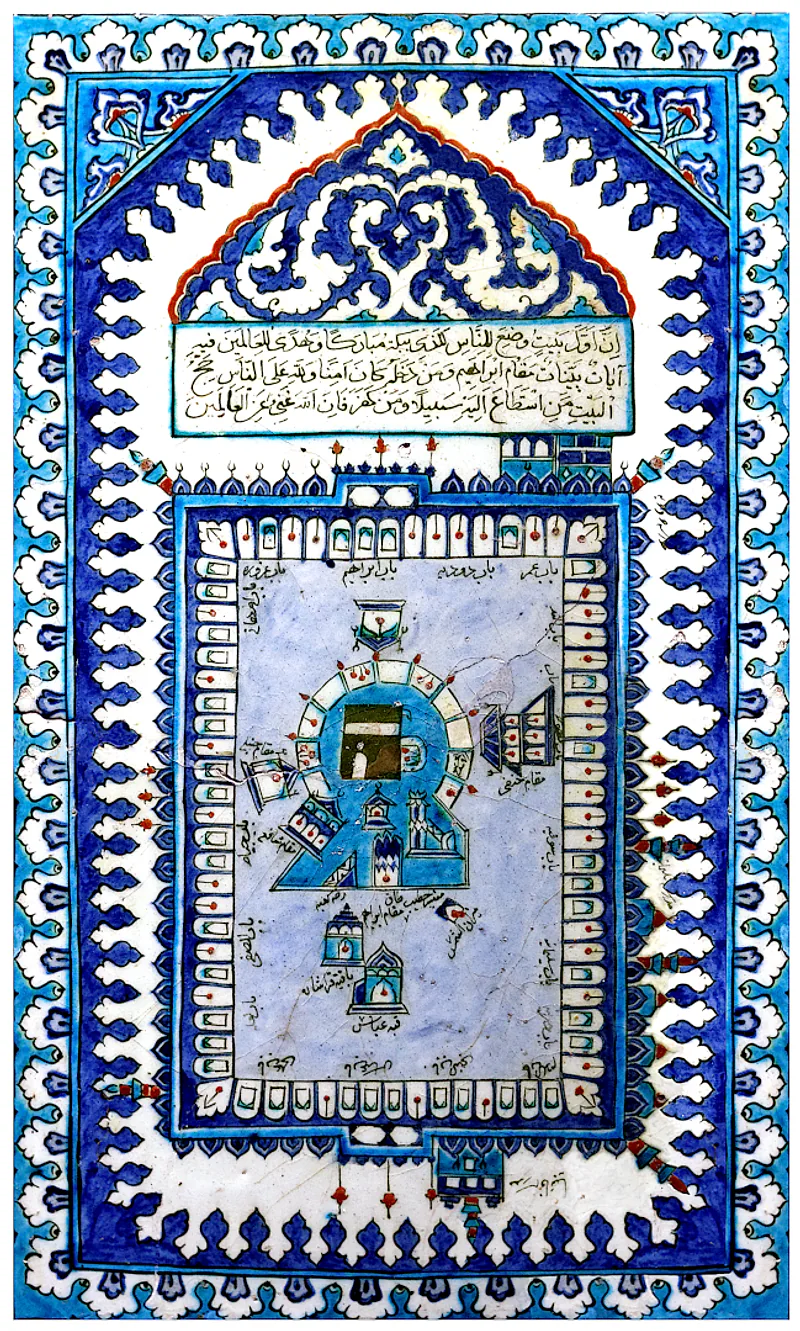
Beside the north-western wall a low semicircular wall encloses the Ḥijr Ismāʿīl, also called the Ḥaṭīm. Tradition holds that this area belonged to the original foundation, so pilgrims circle outside it. Nearby stands the Maqām Ibrāhīm, the "Station of Abraham", a stone kept in a gilded enclosure and believed to bear the imprint of Abraham's feet; the Qur'an mentions it as a place of prayer (al-Baqara 2:125).
The building is covered by the kiswa, a black cloth woven with Qur'anic verses and banded near the top with a belt of gold-embroidered calligraphy. A new kiswa is made each year. For centuries it was produced in Egypt and carried to Mecca with the ceremonial litter called the maḥmal; since the twentieth century it has been made in Mecca itself.
The al-ḥajar al-aswad, the Black Stone, is set into the eastern corner about one and a half metres from the ground. It survives as fragments held in a silver frame. Pilgrims try to kiss or touch it at the start of each circuit, or salute it with a raised hand when crowds make that impossible. A hadith preserved in the collection of al-Tirmidhi says it descended from Paradise whiter than milk and was blackened by human sins. Modern writers have speculated that it is a meteorite or a piece of impact glass, but the stone has never been scientifically examined and these suggestions remain conjecture.
Pre-Islamic Mecca and the House of the Idols§
Mecca lies in a barren valley of the Hijaz without agriculture of its own, and its importance before Islam rested on the sanctuary (ḥaram) around the Ka'ba, where fighting was forbidden, and on the trade and pilgrimage fairs connected with it. The Qur'an itself evokes this when it calls on the tribe of Quraysh to worship "the Lord of this House" who fed them and kept them safe (Quraysh 106). Muslim historians credit Qusayy ibn Kilab, an ancestor of the Prophet, with settling the Quraysh in Mecca and organising the offices of the shrine, such as keeping its keys and feeding pilgrims.
Islamic sources describe the Ka'ba of this period as full of idols. Hisham ibn al-Kalbi's Book of Idols, written around 800, names Hubal, a red carnelian figure with a broken hand replaced in gold, as the chief image inside the House, before which divining arrows were cast, while the goddesses al-Lat, al-'Uzza and Manat had their own sanctuaries elsewhere in the region. A well-known report puts the number of idols around the Ka'ba at 360. Historians treat these later accounts with care, since archaeological evidence from pre-Islamic Mecca is almost non-existent, though inscriptions elsewhere confirm that sanctuaries and pilgrimage were widespread in Arabia.
The Qur'anic sura al-Fil recalls the "people of the elephant", whom Muslim tradition identifies with the army of Abraha, the Christian ruler of Yemen, who is said to have marched on Mecca to destroy the Ka'ba and been turned back by divine intervention. Tradition places this in the "Year of the Elephant", the year of the Prophet's birth, usually given as about 570, though historians who compare the South Arabian inscriptions of Abraha tend to place his campaigns somewhat earlier.
Abraham, Ishmael and the Qur'anic Story of the House§
In Islamic belief the Ka'ba did not begin as a pagan shrine but as the first house of worship of the one God. The Qur'an calls it "the first House appointed for mankind", at "Bakka", a place of blessing and guidance (Al 'Imran 3:96–97), and tells how Abraham and Ishmael raised its foundations while praying that God would accept their work and raise a messenger from among their descendants (al-Baqara 2:127–129). Abraham is told to purify the House for those who circle it and pray, and to proclaim the pilgrimage to mankind (al-Hajj 22:26–27). His prayer for the family he settled "in an uncultivated valley near Your sacred House" appears in Ibrahim 14:37.
Some later traditions add that Adam first built a house of worship on the site. The idolatry of pre-Islamic Mecca is therefore understood as a corruption of an originally monotheistic sanctuary, and the Prophet's mission as its restoration. Historians cannot test these accounts, but for Muslims the story gives the Ka'ba its meaning as a link between the religion of Abraham, whom the Qur'an calls a ḥanīf, an upright monotheist, and the final revelation.
The Prophet Muhammad and the Purification of the Ka'ba§
The biographies of the Prophet Muhammad connect him with the House long before his mission. When the Quraysh rebuilt it, around 605, the clans quarrelled over who should have the honour of replacing the Black Stone; they agreed to accept the judgement of the next man to enter the sanctuary, who was Muhammad. He placed the stone on a cloak, had a representative of each clan lift a corner, and set it in place with his own hands, a story told to show his standing as al-Amīn, "the trustworthy".
In the early years of Islam Muslims prayed towards Jerusalem, the setting of the Prophet's Night Journey. Some sixteen or seventeen months after the emigration to Medina, around 624, a revelation turned the qibla to the Sacred Mosque in Mecca (al-Baqara 2:142–150). When the Prophet entered Mecca in 630 he circled the Ka'ba and had the idols in and around it broken; the sources say he recited the verse "Truth has come and falsehood has vanished" (al-Isra 17:81). In 632, on his Farewell Pilgrimage, he performed the rites that became the model for the hajj described in The Five Pillars of Islam.
Rebuildings, Sieges and the Qarmatian Theft of the Black Stone§
The Ka'ba has suffered fire, flood and war. During the civil war that followed the death of the caliph Mu'awiya, 'Abdallah ibn al-Zubayr held Mecca against the Umayyads, and in 683 the House was badly damaged by fire during a siege. Ibn al-Zubayr rebuilt it on what he held to be the Abrahamic plan, enclosing the Hijr and adding a second door. After the Umayyad general al-Hajjaj took the city in 692, the caliph 'Abd al-Malik had those changes undone and the Ka'ba restored to the smaller Qurayshi dimensions, which it keeps today.
The most dramatic episode came in 930, when the Qarmatians, a radical Isma'ili movement based in eastern Arabia, attacked Mecca during the pilgrimage under their leader Abu Tahir al-Jannabi. Chroniclers describe a massacre of pilgrims, the filling of the Zamzam well with bodies and the removal of the Black Stone, which was returned only around 951.
After torrential floods in 1629 brought down part of the walls, the Ottoman sultan Murad IV ordered a complete reconstruction, and the building standing today is essentially that of 1629–1630, with later repairs, including a major restoration in 1996. Around it the Sacred Mosque has been enlarged repeatedly, on an unprecedented scale by the Saudi state since the 1950s.
The Ka'ba in Prayer, Pilgrimage and Mystical Thought§
Every Muslim prayer anywhere on earth is oriented towards the Ka'ba, so that the faithful form concentric circles around it. Medieval astronomers devised tables for finding the qibla from distant cities, learning that overlapped with the sciences described in Islamic Occult Sciences. The dead, too, are buried facing it.
Muslim theologians insist that worship is directed to God alone. A report in al-Bukhari's collection has the caliph 'Umar address the Black Stone, saying he knew it was a stone that could neither harm nor benefit and kissed it only because he had seen the Prophet do so. Tradition also links the House with a heavenly counterpart, the "frequented House" of al-Tur 52:4, circled by angels.
For Sufis the outward House points to an inward one. The heart of the believer, in a widely quoted saying, contains God when heaven and earth cannot, and it is this inner Ka'ba that must be purified of idols. Sufi masters taught that the pilgrim should seek the Lord of the House rather than the House. The theme could be dangerous: one of the accusations brought against Mansur al-Hallaj was that he taught a spiritual pilgrimage that could stand in for the journey to Mecca. Ibn 'Arabi began his Meccan Revelations in Mecca and describes a visionary encounter while circling the Ka'ba, which became for him an image of the heart around which the divine names revolve. On these ideas see Sufism in Islam.
Frequently asked questions§
Do Muslims worship the Ka'ba?§
No. Muslims face the Ka'ba in prayer as a common direction and a sign of unity, but they worship God alone. Islamic teaching explicitly denies any power to the building or the Black Stone themselves.
What is inside the Ka'ba?§
The interior is an empty chamber with a marble floor, three wooden pillars, hanging lamps and plaques commemorating restorations. There are no images or objects of worship, and the interior is opened only on special occasions.
Is the Black Stone a meteorite?§
Some modern writers have suggested so, but the stone has never been scientifically tested. Muslim tradition holds that it came from Paradise, and its geological nature remains unknown.
Sources and further reading§
- The Book of Idols — Hisham ibn al-Kalbi, 1952
- Mecca: A Literary History of the Muslim Holy Land — F. E. Peters, 1994
- The Hajj: The Muslim Pilgrimage to Mecca and the Holy Places — F. E. Peters, 1994
- Mecca: The Sacred City — Ziauddin Sardar, 2014
- Hajj: Journey to the Heart of Islam — Venetia Porter (ed.), 2012
- Muhammad at Mecca — W. Montgomery Watt, 1953